
Three Colombian artists, Armando Montoya, a teacher at the Faculty of Arts of the University of Antioquia, Alejandro Castaño, and Sugel Nayibe Pedroza, of the National University of Colombia, were selected, after the submission of plans, to work on a monumental sculpture for International Sculpture Neige et Glace du Carnaval de Quebec, which was held in Canada between January 30 and February 5.
The inhabitants of the tropics feel a special longing for contact with snow, a ludic symbol of recreation, magic, the imagination in flight...which can only be achieved in dreams. Thus, we would like to respond to the convocation by proposing an exploration of softness versus the rigidity of the solid block. We are referring to the pre-Columbian culture of San Agustín, which provides a wide range of formal solutions to the monolithic aspects and proposals of sculpture. This was how these three artists presented their project, several features of which are worth examining.
When art is considered a game, an anthropological need which is impossible for man, as homo ludens, to exist without, we are returning to one of the essential features of art which brings it out from the obscure and vacuous domain to which it has been confined by our institutions and systems. Far from the world of competitions and prizes, theoretical formalizations and castrating criticism, art is above all imagination in flight,# or in other words, dreams. We dream only with reality, but nothing is closer to reality than a dream. Thus, we believe it is very important at the very beginning for ludic and symbolic elements and the event to dominate this project. Since ice sculptures can be kept for only a few days, the ephemeral element helps reinforce the idea of play, an activity which, like art, has no purpose and which recalls the old Gadamerian philosophy that art is, above all, symbol, play, and merriment.
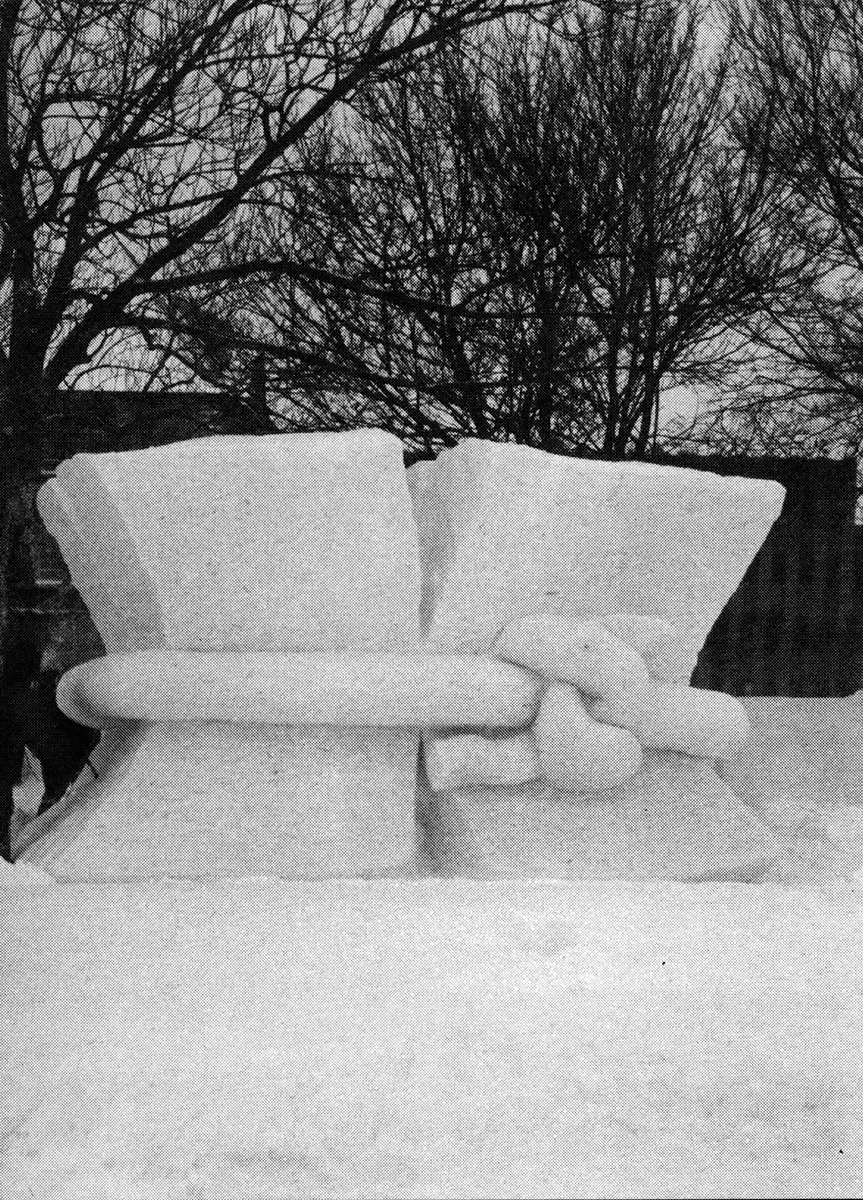
The other concepts governing this sculpture are understood with its description: It consists of four large columns, measuring 1.5 meters by 5.5 meters high, linked together by a rope which, when tightened, makes the columns bend and create the effect of a sheaf. They represent the four cardinal points, linked together by a knot of "encounter," as the title of the work points out.
This in turn sheds light on the second concept underlying the work: softness in contraposition to the idea of the rigidity of the block attempts to create a dynamic of visible opposites; the blocks of compacted snow and their size, visibly closer to the whitest marble of Carrara, are virtually "bent" by the tightening of the cord which is emphasized with a knot.
Finally, the third concept refers to the formal contribution of the sculptural solutions in the pre-Columbian culture of San Agustin. Indeed, in the large monolithic figures of this culture, the cords and knots are not only matters of dress and apparel, but provide solutions to the question of equilibrium. On the one hand, there is the rigidity of the stone material versus the flexible, curved nature of the cords, and on the other, the vertical statues vis-à-vis the horizontal and heavy elements, the sensation of the block versus the lightness of some illusory cord.
All these concepts could, however, be reduced to just one, which is the most important contribution of the pre-Columbian cultures: the use of opposites. We know from studies and research that these cultures were characterized by dualistic thought. Where could life be found without finding death? What would be its meaning? It was a process based on complementary relations, a binary system of opposites: Softness and rigidity, night and day, hatred and love, reality and dream. These ideas were intensified in the Quebec work, because everyone knew that the sculpture would end up by dissolving into water and, like the title of a handsome book, All trace of solidity would vanish into the air.
HUGO HERNÁN CEBALLOS