
Nostalgia is one of the most recurrent sentiments in current Mexican painting, reflecting the notion that things should remain immobile, unchanging. Several factors have motivated this nostalgic version of reality. The first of these was the shock produced among Mexicans by the continuous calamities in the social and economic spheres. This desperate situation, which seems to have no immediate solution, has inspired more prostration than action, with the end of one cycle and the beginning of another inspiring thoughts about where we went wrong, how we could have arrived at such a futureless present when our past has been so glorious. Hence the nostalgic mood.
The work of Arturo Elizondo reflects some of the keys to this magical effect of distance. He describes the transformation brought about by distance in his case as follows: New York is not America; it is the entire world. Here, my identity has not changed, my painting has developed, and my sadness about what is happening in my country has increased. I have not tried to shake off roots, nor do I want to. What has happened is that there is a symbiosis between the two worlds and the two countries between which I divide my time. There are so many good and bad things in both, although of course the perspective from Mexico is always more bitter, I have taken advantage of the practical capacity of the "North Americans to decant, decipher, and decode symbols, experiences, images, objects, and the history of my country... The benefit is in the distance of time and space. From afar, nostalgia and memory engender another kind of approximation to memory, both visual and emotional."1
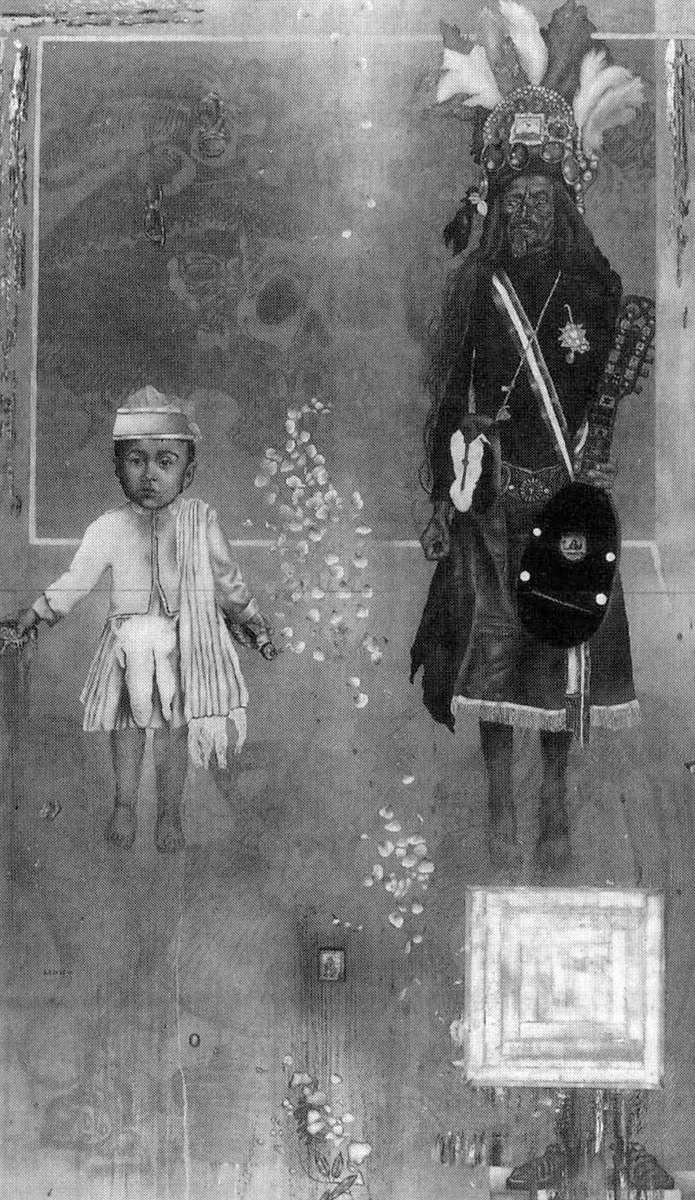
The images reproduced by Elizondo come from various sources: from the work of the popular Mexican painter Hermenegildo Bustos, to whom Elizondo paid tribute in an earlier show, the prints of José Guadalupe Posada, the pre-Hispanic cultures, the landscape school, European mannerism, and vernacular photography. With this complex fusion of different elements, the artist reconstructs his past, like a letter-day Marcel Proust, in search of his identity.
This search puts Elizondo between the devil and the deep blue sea. On the one hand, the reaffirmation of a nostalgic Mexicanness contrasts with his apparent flight to New York, where Latin American art is an easy prey to exoticism. On the other hand, the insertion of his work into the Mexican context does not lead to any definition of identity; on the contrary, it reduces it to the accumulation of the past, as fantastical and illuminated as a hallucinatory trip. The artist is trapped in a paradoxical situation: in the city in which he lives, New York, time is reduced to just one anguish-ridden, fragile minute, which lasts all day, while in Mexico, his work returns to circular time, where the images with which he identifies give the impression of some melancholic immobility.
Despite the paradox, Elizondo is right when he describes the current situation of Mexico. In this sense, it can be said that both the artist and the cultural context that he describes are part of the same orbit, with the one being the reflection of the other. It is in this respect that his work is interesting, not as a proposal but as a reflection, not as an exit but as an enclosure.
This circular time is the time of the eternal return to the establishment of identity and “Mexicanness.” As Roger Batra has pointed out: "One of the modern mechanisms of this endless recycling of the past is to highlight a supposed permanence, a non-evolution (passiveness), and the continuity not only of forms, but of the meanings they involve... Although this is not unique to Mexico, this legitimization process acquires a special feature in this country in that it feels obliged to use, on the one hand, objects (forms) which belong to an archaic culture (and which only remain because they have been rehabilitated as objects of modern or contemporary cultural use, as in the case of “traditional” handicrafts) and, on the other, a complex religious background the functioning of which is very difficult to understand from outside the country, and therefore, appears very violent within the context of Western culture (hence the exoticism which results from a superficial interpretation)."2
From a pragmatic standpoint, Elizondo’s position within an artistic center (which he emphasizes in his text) is understandable in terms of the search for a professional future offering greater opportunities. But from a purely cultural standpoint, the option of distancing himself from his country and seeking reconciliation through nostalgia makes it ambivalent, rather than clarifying any perception of its “roots.” Let us see why.
The North American Anglo-Saxon culture tends to see vernacular spontaneity as a marginal category reflecting culture and identity per se. Kitsch and camp have been taken up at different times as elements of the identity of the average North American white population. But in Mexico, the displacement of what is popular into what is artistic is part of an accumulation or raising of the concept of cultural identity. Carlos Monsivais offers an example of this process when he points out that we have to see photographs of indigenous peoples taken by outstanding artists to understand the value of their culture and not let them die. Any attempt at the re-evaluation of popular elements includes the discovery of their “spiritual” values before admission into the mausoleum of “national values.”
Thus, the incorporation of popular images within modern painting, the purpose of which is to define identity, is a way of reaffirming the non-evolutionary process of identity. What Elizondo misses is the recognition of the present with all its varied contradictions and hybrid assimilations. Even though autobiographical elements may appear, they seem to refer to a time that is much more distant than that of his life. If, as Carlos Fuentes says, "we have the right to imagine the future, today more than ever we have to imagine the past,"3 we can say that the need to break with an archetypal vision of the past is more urgent than ever before.
The description of an outline of personal identity by the painter is very pertinent as a visual version of the clash between local and European culture. The secret of his strategy lies in substituting subjective life with the collective image, an analogous procedure to that intuitively used by the indigenous peoples in dealing with the images imposed by the Conquistadores. This “war of images”, as it is called by Serge Gruzinsky, results in a paradox: there are no winners or losers, no homogenous identity, but the creation of new languages and images through the fusion of the archaic and the modern or, as in Elizondo’s case, the personal and the collective. The baroque nature of the image is, in the final analysis, the result of the crossing of opposites. This is, in the end, the sign of Mexico more than nostalgia, as Fuentes has pointed out: "in Mexico, the baroque goes beyond the sensual or intellectual reason of Europe and becomes a vociferous and vital need and affirmation. A land of sun, a conquered land, a land of hunger and dreams: the baroque of the Americas is the art of deficiencies; it is the imaginary abundance of those who have nothing, it is the fatal jump over the chasm in the hope of landing on two feet on the other side."3
NOTAS
1. Arturo Elizondo, comments by the artist in the exhibition catalogue, OMR Gallery, May 1995.
2. Roger Batra, La Jaula de la Melancolía, Identidad y Metamorfosis del Mexicano, Mexico City, Ed. Grijalbo, 1987.
3. Carlos Fuentes, Nuevo Tiempo Mexicano, Ed. Aguilar, Mexico City, 1994, p.19.
JOSÉ MANUEL SPRINGER