When we look at exhibitions of work by young Colombian artists, the question sometimes arises about what they think about our terrible recent history, and where the terrible images we see every day on television and in the newspapers are going to take us. Precisely one of the differences between Beatriz González and many other artists is that she does not forget these images: neither those of the present, for example, the former mayor of Bogota, Jaime Castro, forgotten by almost everyone, or the death of Luis Carlos Galán, nor those of our history, which she has examined closely. By a process of free association, it is impossible not to recall the crosses, scythes, and battles which have been such constant features in the history of caricature in our country, the print of Urdaneta in the coffin published in the Papel Periódico Ilustrado, nor all the bishops —fallen, sleeping, or dead—in the paintings of Fernando Botero.
But Beatriz González has not forgotten the events of her own life either, and her work also includes photographs from the family album, for example, of Don Valentin González, her grandfather. She tells us: "The photo album of my family has a photograph of my grandfather, Valentin González, on his deathbed. Although my father did not think it strange to include this photograph and even told us how my great-grandparents built a niche over the bed in which their coffins could be placed, my mother thought that such a relationship with death was incomprehensible and in bad taste." Like all these stories which inexplicably stayed in the memory of the artist, they can be moved around and transferred to other contexts, so that the events occur at the same time and her work becomes a kind of double reflection: on what has happened to us, our history, but also on the way in which artists work. For this reason, this recent exhibition had two titles: The Color of Death, which in fact is the reconstruction, through examples chosen by the artist herself, of death, a subject which has always been present in her work as far back as The Sisga Suicides, the series of three paintings from 1965 at the beginning of her career which were based on a newspaper report of the suicide of two lovers who, before throwing themselves into the Sisga lake, had photographs taken of themselves embracing and holding a bunch of flowers in their hands. From that time on, the color of death in her work gradually became the illuminating color, bringing the photograph of that inexplicable absence, the newspaper print, to the living present. The exhibition included examples of her furniture pieces, in this case the beds with The Death of the Just One and The Death of the Sinner (1973), or the Assasinated Woman in Lodging (1985), an example of her flower fabrics, which seem so amusing and agreeable, but which are bedcovers for any place, the final support of lonely men and women in acrylic, the drawing which Beatriz González seems to do more with a scalpel than with a pencil or brush, highlighting the most startling and meaningful aspects, leaving the rest to become anonymous silhouettes.
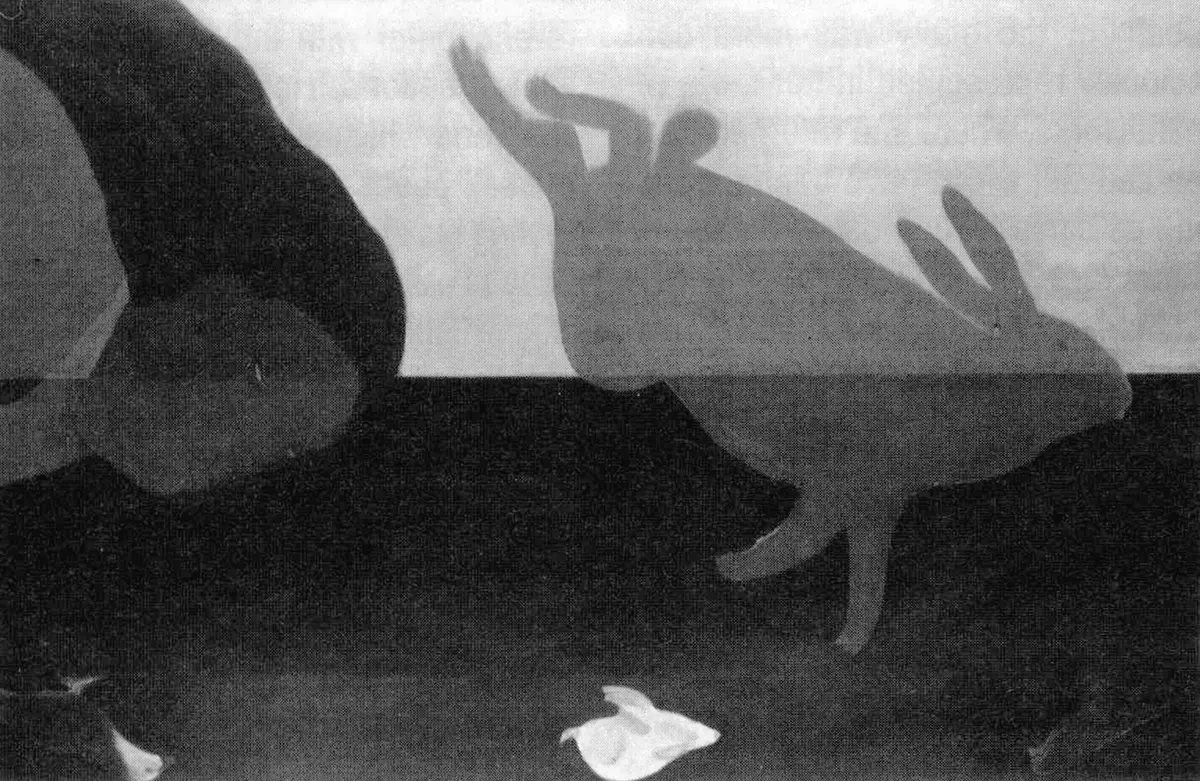
But the reflection on the color of death in the show was more consciously represented in her more recent works, where she returned to oil on canvas, which has been surprising us since 1992. Most of these pictures are divided horizontally, with superimposed visions that summarize what is passing through her mind. Against the Flow, an oilwork which she presented at the National Salon of Artists in 1994, shows the head of a woman apparently dreaming about a dead hare, as if the destiny of the artist was in fact to bury herself in her own thought. In these pictures, the figures accommodate themselves in the format as if they were in a bed, which is also a river, in which they navigate along with their dreams. The portrait of Galan looks into a mirror, like Narcissus, and other well-known or anonymous persons float in a series of parallel histories or events of all kinds because, like the rabbit springing out of a hat, we never know when an idea will occur, and artists must be attentive to such moments. This takes us to the second title of the show, Dreams as Investigations, a homage paid to the rules of hazard to which Beatriz González has completely submitted herself.
The work of Beatriz González is always based on photographs, mostly from newspapers, and in particular those related explicitly to death. Susan Sontag said that every family uses its photographs to construct its own story, as if it were a myth to be commemorated, and to reestablish symbolically the continuity which is always threatened. These faces, chosen from so many, made potent through linework and color, recalling the place which they held, the wounds which they suffered, their importance or banality, all create the presence of a family in the largest sense of the term, and in the end, they are all that remains. An album which, in the final analysis, helps us to consolidate a moral position.
NATALIA GUTIÉRREZ