The recent exhibition by Bruno Zeppilli at the Luis Miró Quesada Garland Salon in Lima was a long-awaited event. Zeppilli is not a prolific artist—he has had two previous one-man shows in Peru and two in the United States—but he is widely recognized in Peru. When an artist reaches the age of 40, he generally diversifies his range of activities. This is not the case with Zeppilli. His painting is a slow process, distant from any current or fashionable trends. It is a work in which meticulous finish characterizes all aspects of that work’s content.
At first sight, to judge from Zeppilli’s imagery, one might think that he is bent on capturing the avatars of passion, the incidences of desire, and the pleasure of pain. However, his painting is so rich in its many references to the history of Western art, in its precise allusions to certain aspects of mass culture, that to review it is to embark on an adventure of real delight, not only because of the refined sense of finish, based on short brush strokes, blurring techniques, and transparencies, but because of its sense of decodification as the spectator (involun tarily?) tries to relate the work with his own memories or imagination.
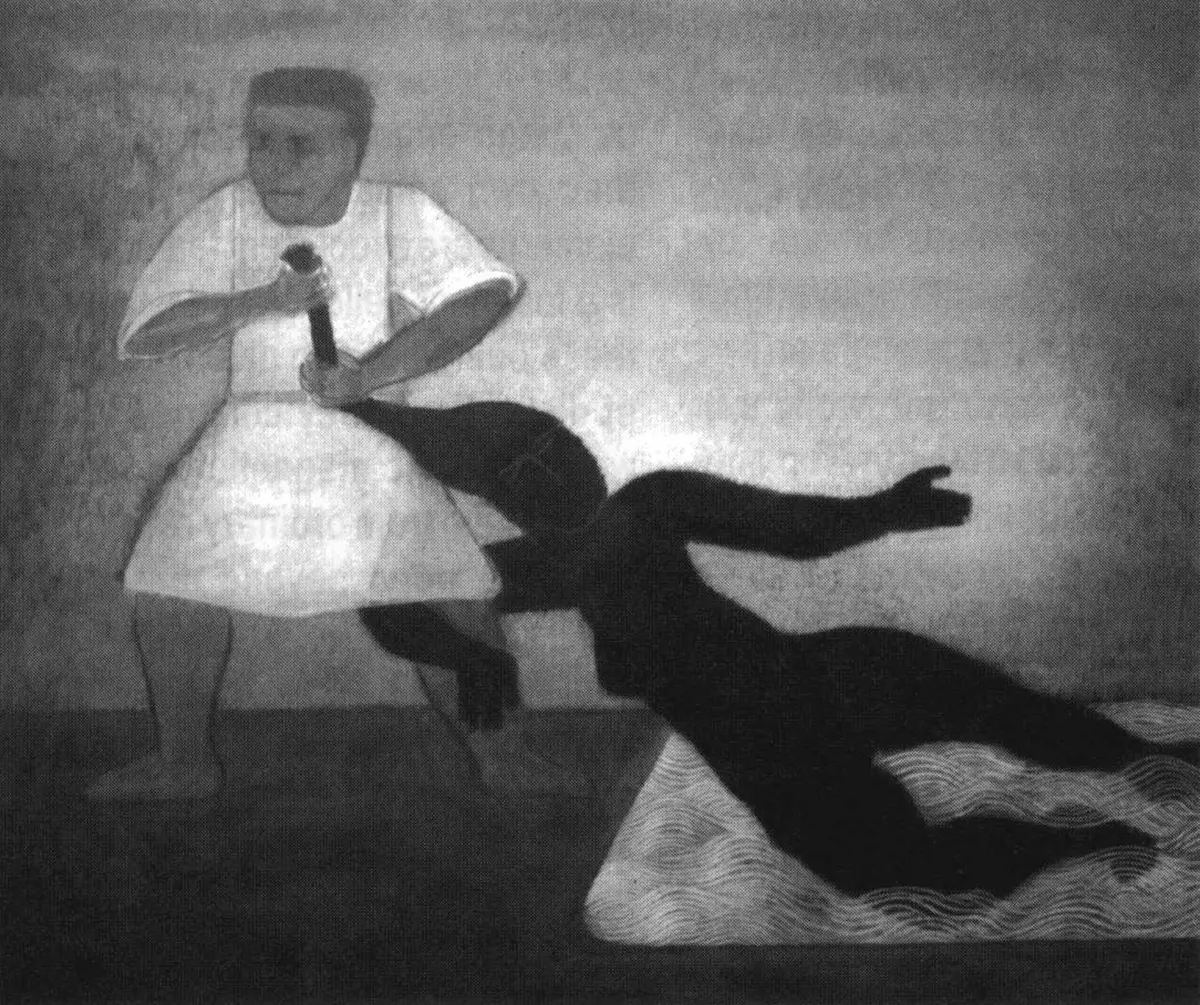
From the above, one might conclude that Bruno Zeppilli is part of that Latin American post-modernist current on the point of extinction. But there is nothing further from the truth. The rigor of his painting is foreign to any kind of impact generated by strident elements. Furthermore, there is a severity in its use of space, resulting from the artist’s capacity to renounce all accessories, to create through color an atmosphere which envelops all the bodies participating in acts full of love and piety, tragedy and religion.
During the 1970s, when the new surrealism reached its peak in Peru, an unforgettable woman, Tilsa Tsuchiya, seduced Peruvians with works that perfectly matched our aspirations in art. Trained in the School of Fine Arts in Lima and in Paris, Tilsa used very brief brush strokes to create biomorphous figures and evoke ancestral myths, capturing in a way which was unlike that of any other artist of the decade our most intimate illusions, the search for a balance which was impossible in our turbulent everyday lives. The sinuous opulence of that work, with its fusion of East and West, and its ambiguous eroticism, became one of the landmarks of Peruvian art in this century. These were precisely the years that Bruno Zeppilli was working with Tilsa, apprehending the mystery which he would subsequently renew in his own work.
For Alfonso Castrillón, one of our most distinguished theorists, Bruno Zeppilli’s work contains allusions to the images of Sassetta (a fifteenth-century Italian painter), North American popular art, black art, Indian miniatures, and the impressive scenes from Jodorowsky’s The Magic Mountain. In addition, there are references to the nudes of Guaman Poma, especially those that are tied, whipped, and full of lacerations. It would be too ingenuous to think that such images are the only citations. Zeppilli’s painting may also evoke the penitential Psalms like a simple text from the Polish cinema, the Dies Irae, Artaud and Genet in a disconcerting conspiracy with the boleros of the Cuban La Lupe or the exciting figure of a Thunderbird from 1959.
All these citations find their place within the space fixed by the stretchers, according to Castrillón. Although such claims might appear to be excessive, when we look at this painting we begin to realize that behind all these carefully wrought images, there is an attempt at assignation and investigation which in its own way goes beyond the act of painting, and becomes a synthesis of experiences which makes the artist a humanist who knows what he wants to paint and who does so in an exceptional manner.
Zeppilli appears as a painter of whispers; his work is almost secretive, and the artist’s silent activity coincides with the enigma of his images. It is a work which suggests multiple readings, since nothing on the surface is what it seems to be at first sight. Thus, for example, under the blurred veils lurks the discovery of ominous and unsayable events, just as the multiple layers of color have covered up countless other possible pictures which have become hidden under the final version. The religious iconography, the love scenes, or the bodies engaged in unknown rituals make us think of Eros and Thanatos, the intimate relationship that subsists between passion and submission.
In the case of Zeppilli, it would be very easy to think of Balthus, because of the sense of light, or Oshima, because of his apologia of excess. But it is more enlightening to plunge into the pictorial space where the artist places his references, which “function” through a process of constant reworking and transformation made possible by the artist’s compositional skills and his desire to discover new meaning.
These pictures have an integrating capacity which makes Zeppilli one of the most brilliant painters in Lima at the end of the twentieth century. The sense of measure and refusal of accessories which characterize his work strengthen his position towards an art, like that of Peru, which often refuses to accept anything ominous or even the existence of such things.
Zeppilli’s new work once again reveals that he is an occult painter, and yet paradoxically one who is not afraid of the immodesty of feelings; an artist who has distanced himself from current trends to explore his own path, in solitude and in the enormous respect which he has so fully deserved.
LUIS LAMA