
I find it increasingly difficult to confuse it with the natural condition of man. To speak of peace as a higher state of something, therefore, becomes a controversial task like creating an institution that has spent 50 years talking about peace. Because, in fact, all the talk is about war and its prevention, it is understood that peace is the absence of conflict. This is a coarse kind of dialectics which leads on to more transcendental questions, which undoubtedly include the true response to cohabitation, the possibility of a peaceful kind of life.
It is a matter of avoiding war, its causes and consequences: hunger, disease, illiteracy, religious, racial or ideological intolerance... in the hope that free choice will take care of the rest. It is this reason that all the talk about peace mainly serves the interests of the power centers, the real Achilles heel of the democratic myth and the equally fetishized concept of equality, as the term acquires an air of propaganda and demagoguery in general.
I should like to discuss these two poles of attraction in the context of this recent exhibition entitled Dialogues of Peace. First, there was the instrumentalization of a commonplace of post-Cold War rhetoric by the curators, which was not only reflected in the melifluous and inoffensive (or sterilized?) nature of the title, but determined the conditions governing the selection of the participants. Second, the tendency and incapacity, in the case of most of those participants, to define peace in terms of absence, because they were reproducing the mental structures characteristic of the West, or because they were afraid to be lyrical, which is what happens to those who succumb to the rhetorical definition of peace noted earlier, or who believe that lyricism is a fruitless exercise.
Let me take two examples. Ousmane Sow, from Senegal, was invited and presented two clay fighters, with powerful muscles and bulging eyes, each concentrated on overcoming his opponent. Ilya Kabakov, although with lamentable technical effects, had another idea: he showed a piece of sky that had fallen to earth. In the first case, there appeared to be an urgent need for pacification, and the fighters could have requested the necessary forms in the building opposite the exhibition. In the second case, peace was seen as a poetics, that is, as an attitude, or with the certainty that it forms part of a whole.
The curators thus moved about doubtfully between various possibilities, making the politically correct decision to invite representatives from a wide geographical spectrum, which could include all the variations of sex, color, religion, and even fame, a disappointing Rauschenberg, of the varied forms of artistic speculation (from ingenuity to conceptualism). Such a postulate produced its inevitable effects on the overall coherence of the show. Another decision was to set all the artists working on the theme of peace within the same perspective, and to choose the best works, something which was done only partially. Or the decision not to use earlier works by the artists, but to invite them to reflect on a much more studied idea of peace and to execute a work in situ. This and many other motivations followed one another in an erratic manner, with the many different chairs, emphasizing the idea behind the need for dialogue: namely, divergence. What is different, the sense of otherness, is either assumed through dialogue or avoided in parallel monologues, which never overlap. The recuperation of videos from the UN archives by Allan Ruppersberg, as well as the seats and busts used by the artist, emphasized the same point. Discourse does not imply dialogue, dialogue does not mean agreement, and agreement has not historically led to peace.
In point of fact, the heart of the matter would seem to lie in the acceptance of what is different, in which everything depends on the way we look, as the Turkish artist Sarkis illustrated in his work. However, the position of curatorial concept becomes masked behind a maternal and democratic kind of laissez-faire philosophy. The political determination of Adelina von Furstemberg to celebrate in Geneva her return to the scene, with nothing less than the support of the AFAA (French Association of Artistic Action) and the Swiss Bank Union, meant that she was consistent with everyone and everything—except with consequence itself. Thus, this was one of those exhibitions in which emphasis should be placed on individual contributions and on what the title meant for each artist.
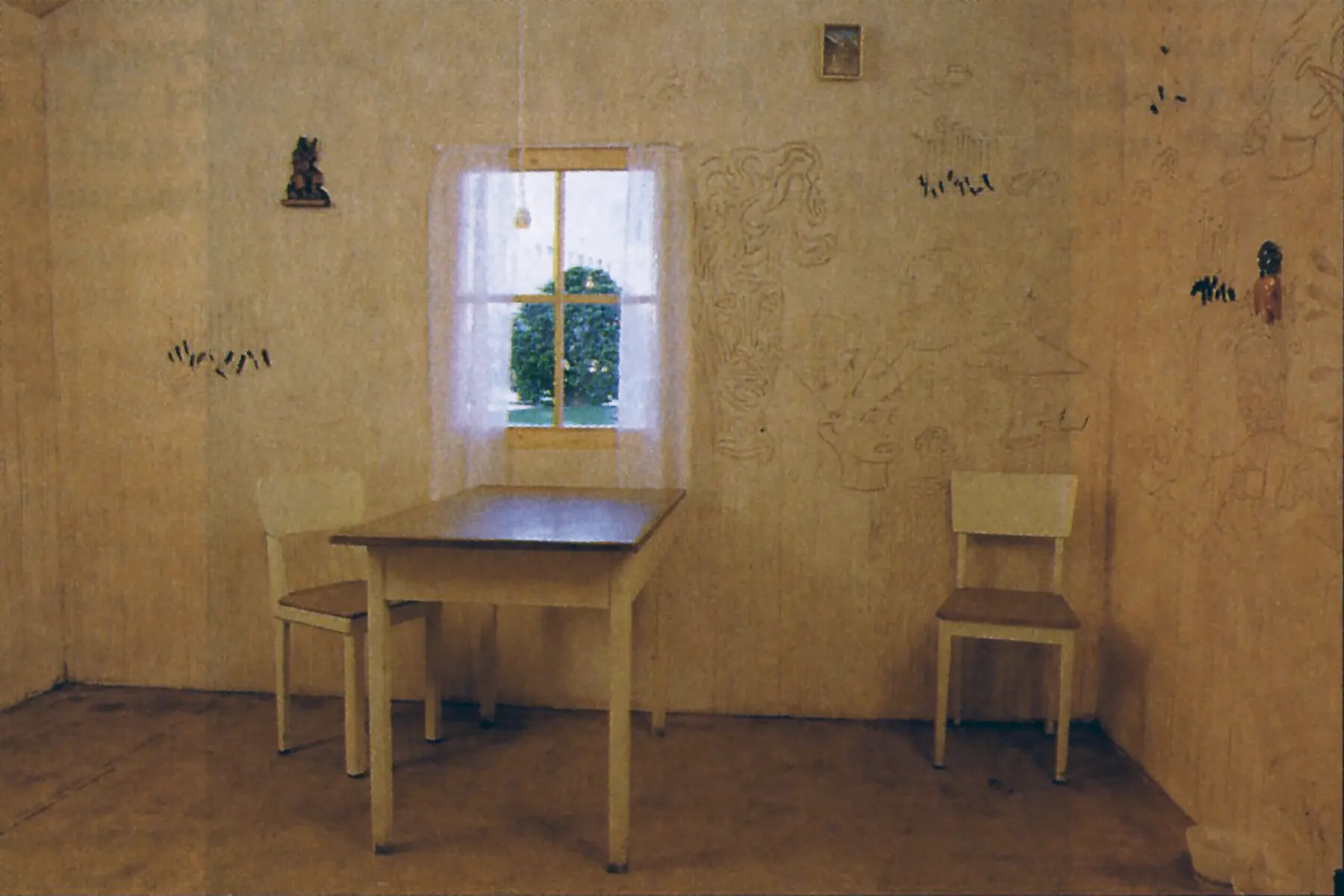
There was a first group made up of artists who were fully aware of the different nature of the space and the commemorative act which they were supposed to adorn (the brochure said that most of the works were inspired by the Universal Declaration of Human Rights and the respective articles of the United Nations Charter). This combination of sacred space and meaning mediatized through the commemorative act could only result in confrontation, irony, or unconditional surrender. An installation by Carlos Capelán consisted of a small country house, containing a rather austere number of things. An intimate, bare room with a tiny window through which its owner could, on returning from the fields, contemplate the Cyclopean, almost fascist architecture of the Palais des Nations, as he drank his coffee and fondled his sheepdog. The subtlety enabled Capelan to raise a number of rather sarcastic dualities: the intimate sphere violated by global politics, the supposed enlightenment vis-à-vis the supposed lack of culture of the petit bourgeoisie, and personal aesthetics versus the bombastic aesthetics of power.
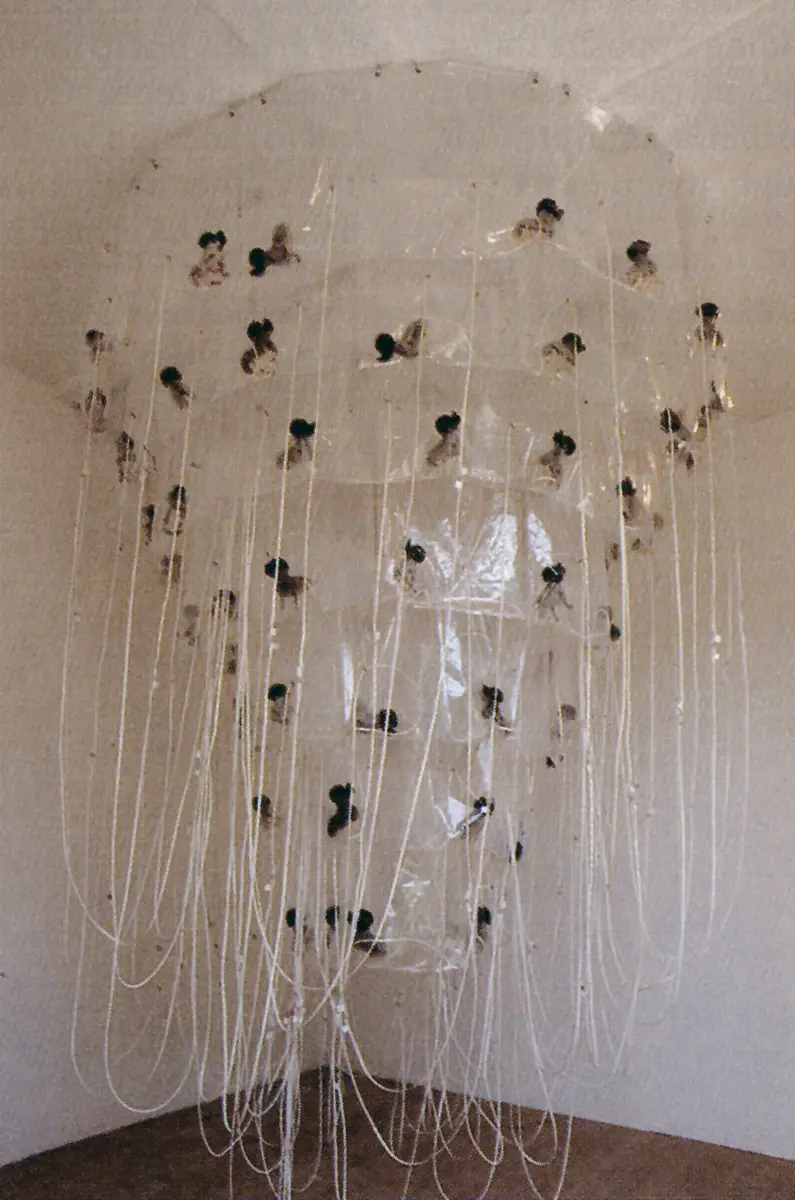
At another level, a large group of participants did not question the semiotics implied by such an event organized by the UN, but rather made ironic observations about its effectiveness. The Portuguese artist Francisco Rocha, in a work entitled Welcome to Wonderland, proposed a kind of inverted Tower of Babel filled with transparent plastic receptacles; inside could be seen the mechanical parts of toy gods, which began to bark in strident cacophony as soon as anyone came close. More pious was the work by the Chinese Chen Zhen, a round table with which we size up what is opposite, must give due importance in terms of interpretation and consciousness to the differences of the other. Just one step forward, and these variants lose their transcendence and become superficial. This is perhaps the world of sand so livingly spread out and arranged by the Indo-American artist Joe Benn, or the sudden Merveilles by Jordi Colomer. Of course, there is disagreement, which is both real and mortifying, but we will not overcome difference without recognizing it.
One may, without doubt, question the political effectiveness of describing conflict and its horrors, the virtues of impact on the repentance of nations at war—doubt without which the curators would have had to invite Oliviero Toscani with his Benetton advertisements. On the other hand, we cannot ask art to engage in such descriptions, even though this may be what Adorno called preached to the saved. Alfredo Jaar, determined to retain this belligerence in his work without concerning himself with aesthetizing purism, is an expert in searching out the channels that lead to those who are really responsible. His was one of the works not placed in the park, but inside the buildings, and the only one at the end of the bridge which connects the main building of the Palais des Nations with the reception area. This prevented the work from being sterilized within an artistic laboratory, enabling it to be seen by visitors in a utilitarian context, seemingly separate from the special exhibition and placed furthermore at a strategic point through which many tourists, diplomats, and officials passed. It consisted of receptacles filled with broaches with a refrain from the 1960s: La géographie ça sert, d'abord, á faire la guerre (the main purpose of geography is to make war). It was a new reference not to effects, but causes, with the sense of urgent imprecation characteristic of Jaar's work. It implied a taking up of a specific attitude by anyone who put on one of the brooches, suddenly transforming him or her into a spokesperson and part of the resulting critical context.
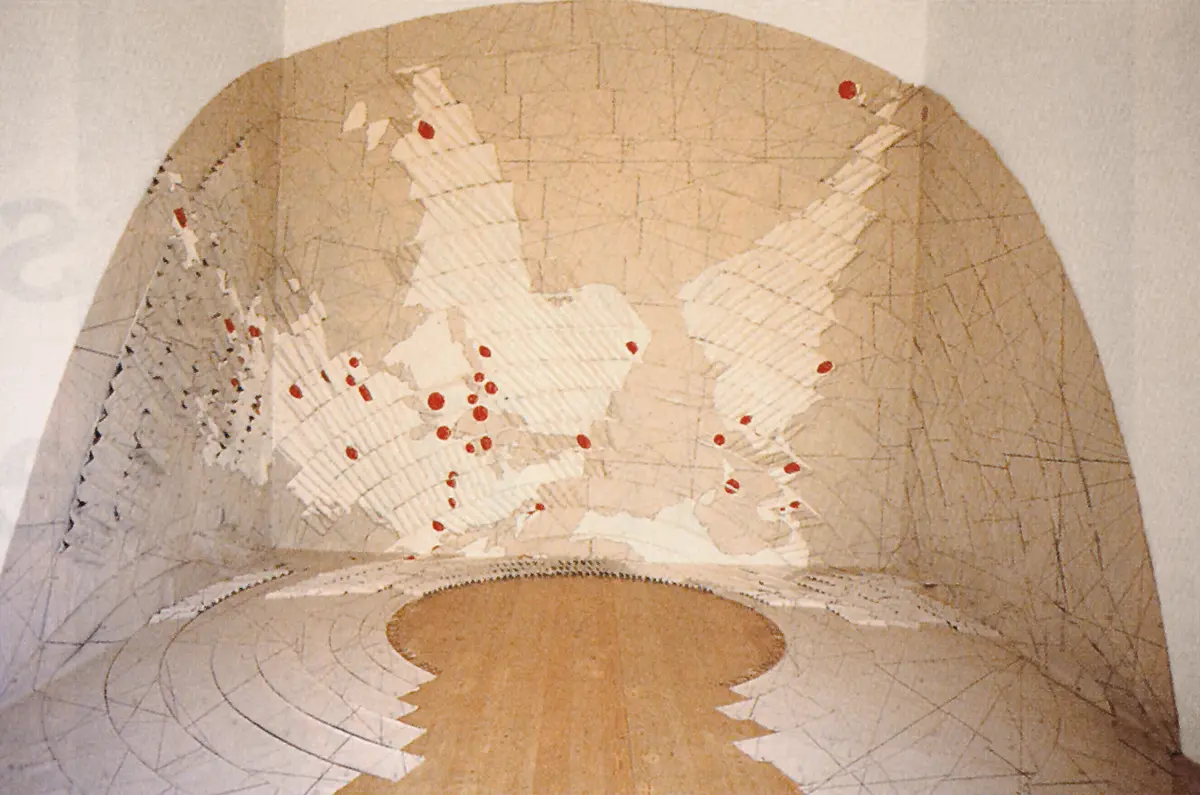
The installation by Miguel Ángel Rios was to some extent based on a similar concept. In one of the claustrophobic cubicles designed by Tadashi Kawamata in the park for works that could not resist the elements, the Argentinian artist presented one of his maps folded into a fan. A white mapa-mundi in which the only lines were those separating the sea from the land, filled with enigmatic red dots which represented the places in which frontier disputes have arisen in contemporary history. The spectator involuntarily noticed that the best perspective could be gained from the North Pole, which was achieved in the map through a reversal of conventional rules. Everything, therefore, depended on and originated in the individual: it is here that peace is forged or violated—the individual is the center.
The fundamental problem is without doubt the individual and his own consciousness, not a positive or negative or negative consciousness, but as something separated from a consciousness of the totality to which he belongs. This is what has led to the failure of our understanding of the East.
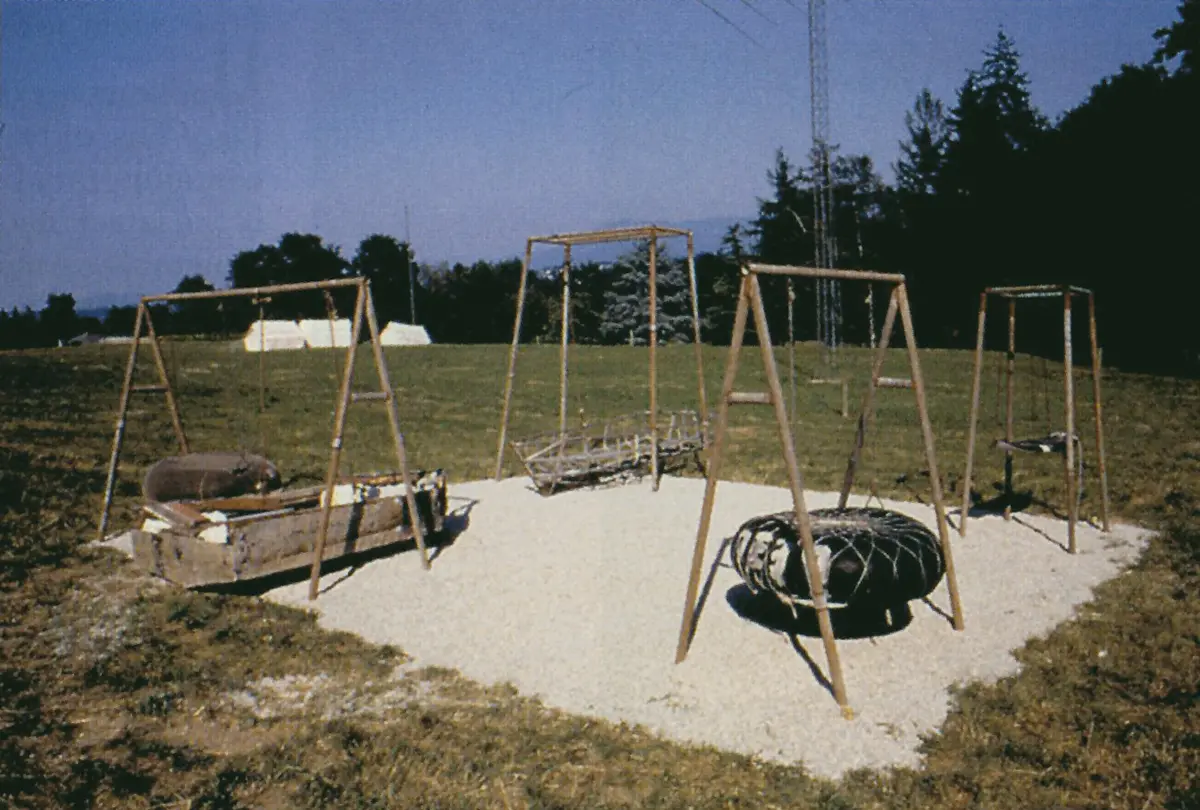
For this reason, perhaps ingenuity can lead to a discovery of peace in the poetics of everyday life (as in the case of the surprising Georges Adeagbo, from Benin). Kcho, the Cuban artist who has recently come to the forefront of attention, returned to the subject of the boat people, the migration theme, this time with a playground in which the swings were replaced with tires, makeshift boats, and all sorts of improvised nautical vessels. The sense of urgency leaves no time for what is important, runs an old refrain, and indeed, the United Nations has become an assembly of firefighters running around the world trying to put out fires.
Hence, the relevance of art in pointing out that life is elsewhere. A final group of invited artists decided to show themselves simply, that is, to show what is hypothetically called their identity, their region, their origin, their ethnicity.
KLAUS STEINMETZ
Costa Rican art critic. Managing Editor of ArtNexus.