Enrique Rentas, one of the artists represented by the Prinardi Gallery in San Juan, is currently painting pictures that reflect the emotions he feels when he works: they therefore constitute a kind of intimate journal. But the initial intentions soon acquire an additional dimension, as the artist explores the contours of memory which affect his life, answering the inner voices which inspire his creation.
The brush strokes generate an organic texture, which is eloquent proof of the artist’s enjoyment of his theoretical experiments. He creates areas of light which provide the appropriate setting for spiral-like presences which have an incisive appeal to the spectator, snail-like forms which cast deep glances, penetrating and bringing closer the space between the painting and the spectator. In this way, Rentas merges into one the ephemeral presence of human life and the infinite course of eternity.
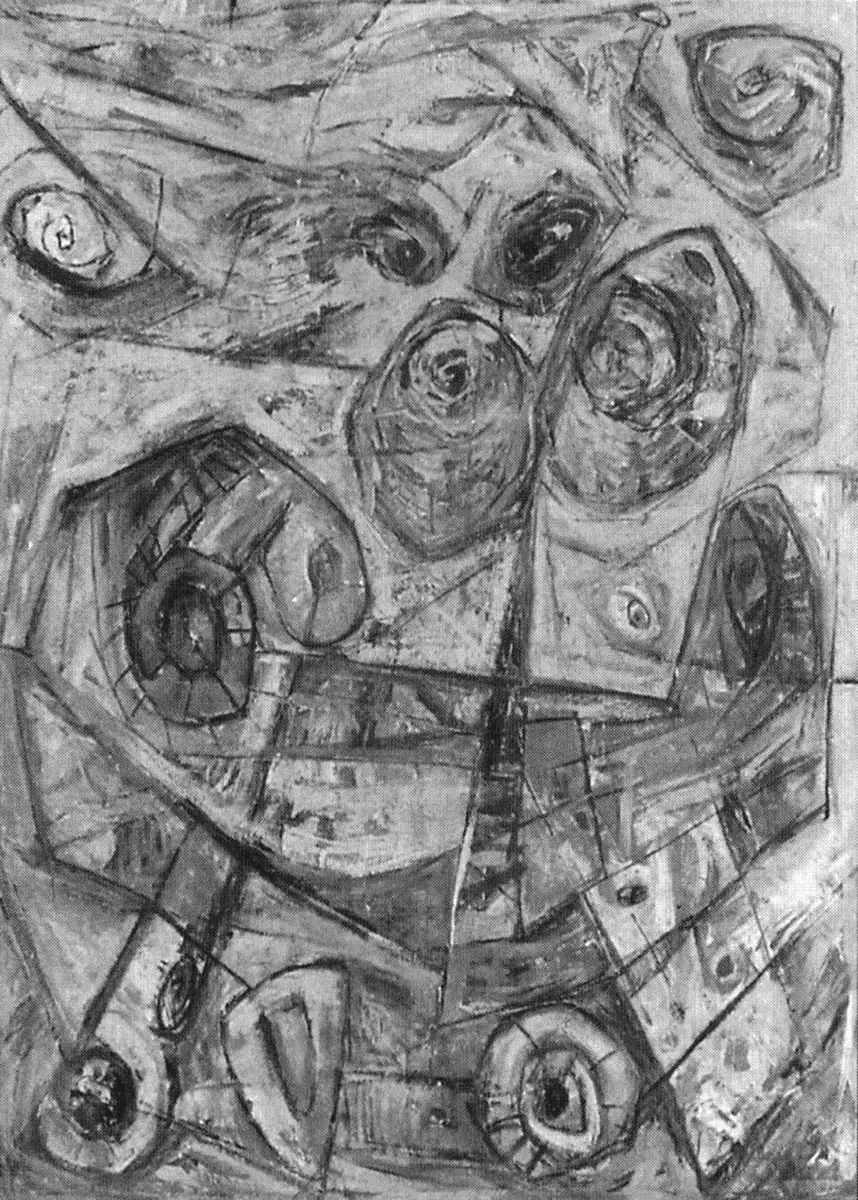
The artist is now in a position where he can begin to develop the resources enabling him to express his sense of concern. His present work can be seen as an attempt to chart his own course within a trend that has had some distinguished representatives, such as Wifredo Lam. In the case of Rentas, the skillful handling of serigraphic techniques, which he learned under the direction of Jose Rosa, has enabled him to perfect his painting. He sees these techniques as a means of partially covering forms, which he subsequently exposes to suggest the various elements that lie beneath the oil. Indeed, we must go back and see his paintings again after a certain time has passed, because the chemical processes at work in the pictorial elements bring about certain changes from within up to the surface. The brush strokes create further tensions on the physical perimeter, which are a source of pleasure and anguish to the spectator.
Enrique Rentas evokes aspects of the Latin American personality through the various ethnic groups that make up our cross-bred nature. He also invokes the presence of long-disappeared generations that are part of our collective consciousness, like archeological remains whose discovery is of topical significance, linking past with present, even though the past has remained hidden for a thousand years. In this way, he reveals significant aspects of our culture and the history that shaped that culture. For Enrique Rentas, painting is as important as any physiological need. Art for him is an essential part of his life, a means of exercising his liberty. And each picture which he paints is part of that living process, a register of events and experiences.
JOSÉ ANTONIO PÉREZ RUIZ