
In a recent exhibition at the Bronx Museum of the Arts, Cuban-American artist Gladys Triana addressed the issue of memory in a paradoxical way. Indeed, the title of her installation was The Path to Memory, and it allegedly referred, according to a statement that the artist made in relation to another piece from the same series, to "...a search for roots- a link with that which has true meaning and escapes in the nebulousness of time."1 The statement is also insistently quoted by the curator of the exhibition, Marisol Nieves, in the brochure that accompanies the exhibit.2
According to Nieves, the emphasis in the work of Triana as a whole is on the recuperation of a past and its origins, on the reconstruction of identity, and on the artistic process as symbolic healing and spiritual transformation.
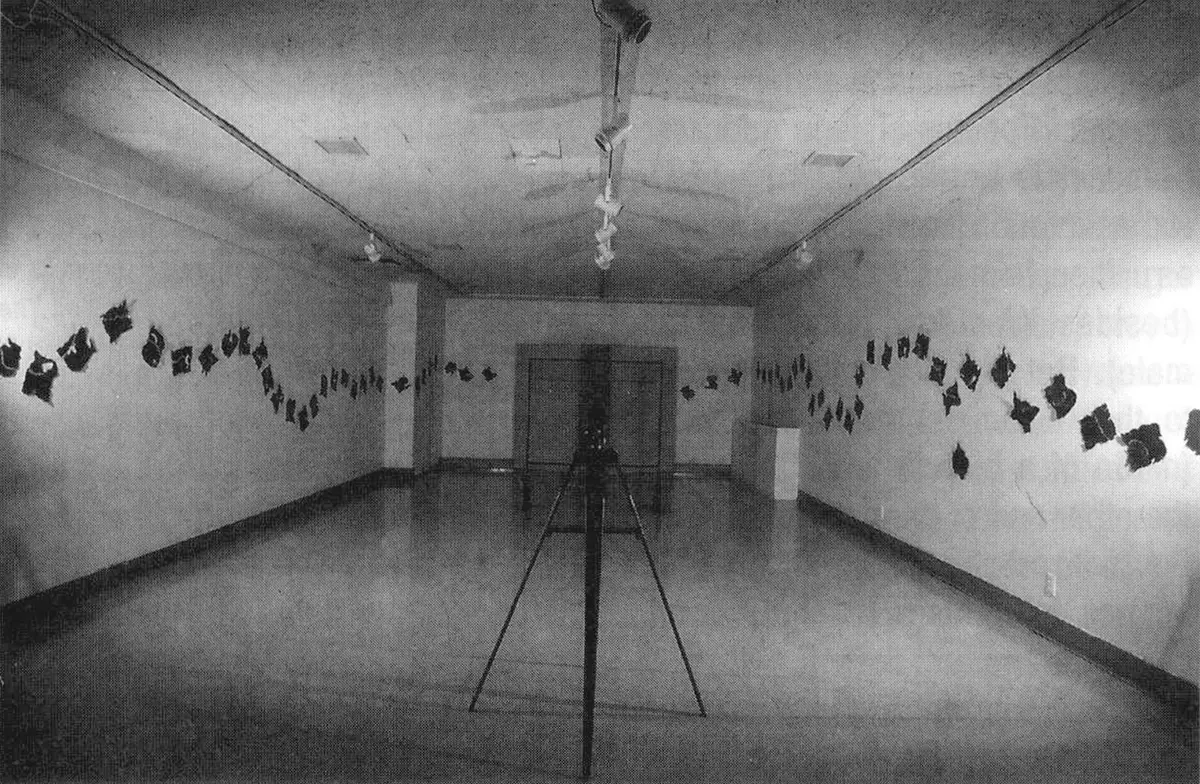
Indeed, the artist, exiled from her homeland, Cuba, in 1969, has addressed the issue of recuperative memory in her work, an issue pervasively explored by many Cuban contemporary artists in the eighties and nineties. Precisely because of this tradition in the visual arts of representations of Cuban memory in exile, I expected, in Triana's memory piece, an approach to the issue based on an iconography that has been identified with Cuban identity in exile: the land, the Caribbean sea, the Afro-Cuban culture of the island, political repression, the family left behind, the home. But Triana's piece, and this is why I think her representation of memory is paradoxical, is removed from the idea of the icon, of the image, of the sign, as calling forth the presence of the signified. In other words, this installation does not seem to trust the power of artistic images to represent memory and identity or to promote symbolic healing and spiritual renewal. On the contrary, T riana's piece problematizes the notion of a truthful representation of memory and identity and insists on the discursive elements that shape and structure our perceptions about the island.
In entering the space of Triana's installation, the spectator, searching for images — family portraits, landscape depictions, or cultural icons that may express the artist's memory of her homeland— found an utterly different visual arrangement.
Inasmuch as the artist's statement quoted above seems to express a nostalgia for roots and true meaning, Triana also seems to recognize that these origins and roots are lost in the nebulousness of time. For me, this emphasis on the discursive aspect of public memory is one of the most relevant aspects of the piece.
The installation consists of a large-scale open book placed against the wall, on whose spine a miniature inverted map of Cuba was drawn. Traditionally, the book has been the depository of historic memory. Here, by facing the wall of the gallery as if negating to the spectator its contents, it seems to pose the problem of who writes and how history is written. The spectator is supposed to look at this small map inscribed on the book through a telescope placed on a tripod. A structure of Plexiglass framed in wood is found between the telescope and the viewer, a structure that represents the scheme of one-point linear perspective paradigmatic of Western visual representation since the 15th century. The idea of one-point linear perspective is articulated with the perfect linear progression between the eye of the viewer behind the telescope, the midpoint of intersecting lines drawn on the Plexiglass, and the map inscribed on the spine of the book. Another device, consisting of "...black cords projecting from either side of the book and converging on the tripod,"3 intends to signify a perspective emerging from the island. The idea seems to be to fuse points of view and thus question the idea of a monolithic or truthful representation of identity or memory (this is reinforced by the inverted map as the result of a logic viewing process).
As opposed to an essentialist notion of Cuba, the emphasis of Triana's piece is on the fragment and the multiple social apparatuses that construct a concept of the island and its natives in exile. For this, Triana addresses perspective as the oldest system of representation that conceives of space as unified, homogenous, and thus ideal (besides Western, Caucasian, and male). But she also makes reference to the telescope and the compass (made of a bicycle wheel located at the other end of the gallery) to signify the civilized objects of modernity that, in their intent to master the world, claim to represent it as it is.
The artist's response to the unified perspective and monolithic representations of the island is an emphasis on fragments and the impossibility of reconstructing identity. This is articulated in two canvases — composed of fragments of the map of Cuba — located at both sides of the compass. Furthermore, Triana has added amorphous collages composed of newspaper clippings of stock market listings scattered throughout the two walls of the gallery space. Media and the market are thus incorporated as discourses that determine the economic and political situation of the island.
I would suggest that Triana's emphasis on the structural and discursive devices that have, since the beginning of modernity, shaped our perception of the world, underlines the constructive character of memory and identity. While recent artistic production and much of contemporary criticism have focused on art as a redemptive process and a way of representing national and cultural identity,4 works like Triana's seem to think of art in terms of contingent models of representation always bound to the discursive structures of society. Here, identity should be conceptualized as self and not as sameness. The terms are those used by Paul Ricoeur in his dialectical scheme of personal identity. According to Ricoeur's thesis, identity in the sense of sameness favors permanence in time and possesses a constitutive character. On the other hand, identity in the sense of self is grounded in change and variation, and it incorporates otherness as a constitutive part of the self.5 It is a problematization of identity and memory, always mediated, never pure, which we find at the core of Triana's installation.
NOTES
1. Statement of the artist written on the walls of the gallery space in her installation entitled The Path to Memory at the Museum of Modern Art in Santo Domingo, 1991.
2. Marisol Nieves, The Path to Memory. An Installation by Gladys Triana, The Bronx Museum of the Arts, New York, February 17 - June 11, 1995.
3. Idem, p 3.
4. This model seems to ignore the institutional rhetoric on which discourses on national identity are predicated. Furthermore, it responds to the desire for a unified experience by means of fixing meaning through visual representation, Cuban identity depictions of the island, Afro-Cuban symbolism, etc. This approach promotes the idea of an authentic aesthetic that limits the cultural production of communities and reduces their artistic practices to a project of cultural revindication.
5. Paul Ricoeur, Oneself as Another. The University of Chicago Press, Chicago and London, 1992,
p. 116.
MÓNICA AMOR