
While painting has for decades been the paramount category of the visual arts in the Dominican Republic, and traditional sculpture has stagnated or declined, the polyvalent installation has been developing over the last ten years, helping to strengthen the international image of the country and proving a source of interest to the local public. Installations usually consist of three-dimensional elements, graphic features, painting, and ready-made objects of an everyday, serial nature. Moreover, the best installation artists have usually turned to the medium after having worked in other media, mainly drawing and printmaking, as can be seen from the successful arrival of Jorge Pineda in the world of installations.
Pineda recently presented a series of such works at the Museum of Modern Art. This young artist is probably the best poster designer in Santo Domingo, although he has wanted to underplay this aspect of his talent. His designs imply an excellent sense of drawing, which he has known how to update and conceptualize. He subsequently surprised us with his print-making skills. Now, with his installations, he has discovered an unexpected source of potential, as could be seen in his Island of Husks and Shells, part of a memorable show entitled Other Visions, along with three other artists. With its piles of fruits from the flamboyant tree and its firm oars shown as if sprouting from the earth, the message was clear: when natural resources are exhausted and lose their fertility, what other option is there but to challenge destiny and set off for the promised land, or death?
At this one-man show in the Museum of Modern Art, Pineda returned to this theme and its connection with the voleros, broadening it and making it even more magnificent, giving it the dimension and name of the Hurricane’s Eye, where the oars are much more numerous and pull along the vortex. Beyond the reference to the natural world, the work is a metaphor of the fundamental social and human problems of the Caribbean region, problems of incalculable consequences.
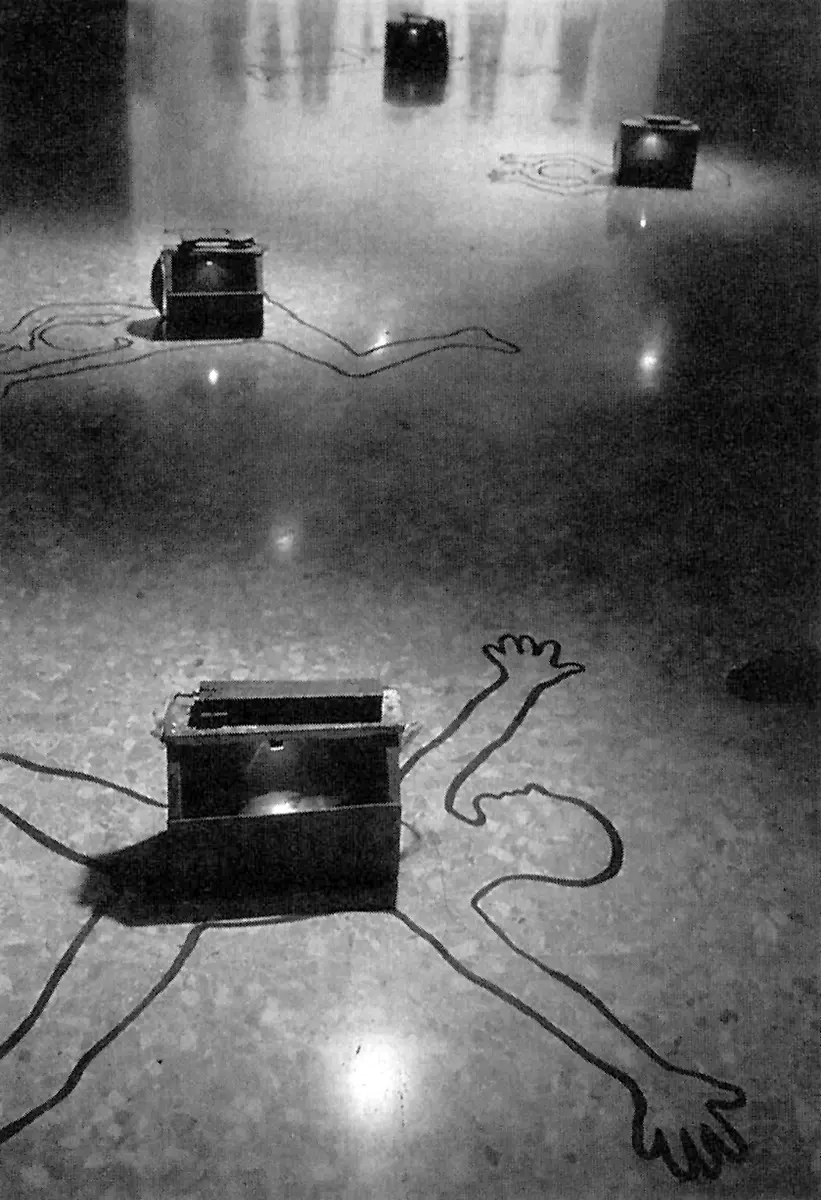
Nearby, there is the small death, or rather the death of the small ones, raising questions and evoking an air of tragedy. On the floor, both together and separate, the outlines of children’s bodies lie, like the drawings which the police make on the ground when someone is cut down in an act of violence. Within each body there is a boot-cleaner’s box, a little wing with white feathers. Particularly striking was the anatomical drawing, the rustic and crude nature of the objects, the heart-rending signs and symbols, and the powerful composition, scattered over space but contained within a specific area. The title is short, mystical, atrocious: Limbo, evoking the specter of the unprotected children of Latin America, be they boot-cleaners roaming the streets of Santo Domingo, the urchins of Bogota, the garbage-dump children of Lima, or the child delinquents murmured in Brazil. This was an installation for history.
Jorge Pineda is a champion of those who are weak and beaten, the condemned of the earth. He is on the side of these victims, but does not name their tyrants. Everything is said with humor, poetry, and emotion, and with a great sense of beauty. Similar compassion is shown for the situation of women, sexual objects who are mistreated, mothers, workers, prisoners, prostitutes, and mutilated. Successive layers of wood reveal iconographical testimonies in a work which is both subtle and incisive.
Jorge Pineda’s installations cannot be seen quickly or in haste. Such an approach would make them into a group of serial designs done with poor materials to create a sense of anonymity. What the artist seeks is the active physical participation of the spectator. In another environment, Pineda invites us to look for the key in the panel which will open the mysterious cupboard, enabling us successively to discover a variety of atmospheres encompassing kitsch, bad taste, eroticism, triteness, a miniature gift shop, etc. We are forced to spend both time and effort as we survey the different kinds of exploitation.
Finally, in each of the eight installations in this show, Pineda creates an epic based on the old myths in their relationship to new myths, with a profusion of indications and connotations which generate a kind of Caribbean arte povera, aesthetically rich, meaningful, and full of surprising allegory. Unlike what happens in the advanced industrialized countries, where readymade objects and waste materials of nature are used in works of art in a kind of reverse situation, such elements are used by the artists of the Third World as part of their everyday life and popular culture. They transform them into dramatic, fantastic, and sophisticated proposals, just as Jorge Pineda does with his machetes, husks and shells, feathers, boxes, and pieces of plastic, all of which are conceptually recycled.
His current break with traditional supports and his customary language has given his creativity an entirely new dimension.
MARIANNE DE TOLENTINO