In December 1989, Luis Caballero said to Damián Bayón: "I am going to sound rather vain, but I think and hope that my paintings in the future will be much better. I say this because I am not yet satisfied with my pictures. What I want to do is to create an image full of meaning, like a religious picture: like an icon, a sacred image. To create images of bodies which are as moving as real flesh and blood bodies..." (Luis Caballero, Works on Paper, Juan Martin Gallery, Mexico City, 1990). In May I99I, in reply to a question by the journalist Francisco José González as to whether he felt he was still too young for a retrospective show of his work, Caballero replied: "To be frank, yes. I don’t know if I am very young, but the holding of such an exhibition implies the rather disagreeable sensation that one feels old. The word retrospective evokes the idea of old age. I also believe that I will paint my best pictures in the future. So the show would have to make it clear that this is not all the work by Luis Caballero. This retrospective merely presents a period in my work. It is fine to do a show as big as this; but that does not mean that one is going to die, or that one is going to stop painting, and even less that one has painted one’s best pictures" ("Arrepiéntete Luis," Sunday Supplement, El Espectador, Bogota, June 2, 1991).
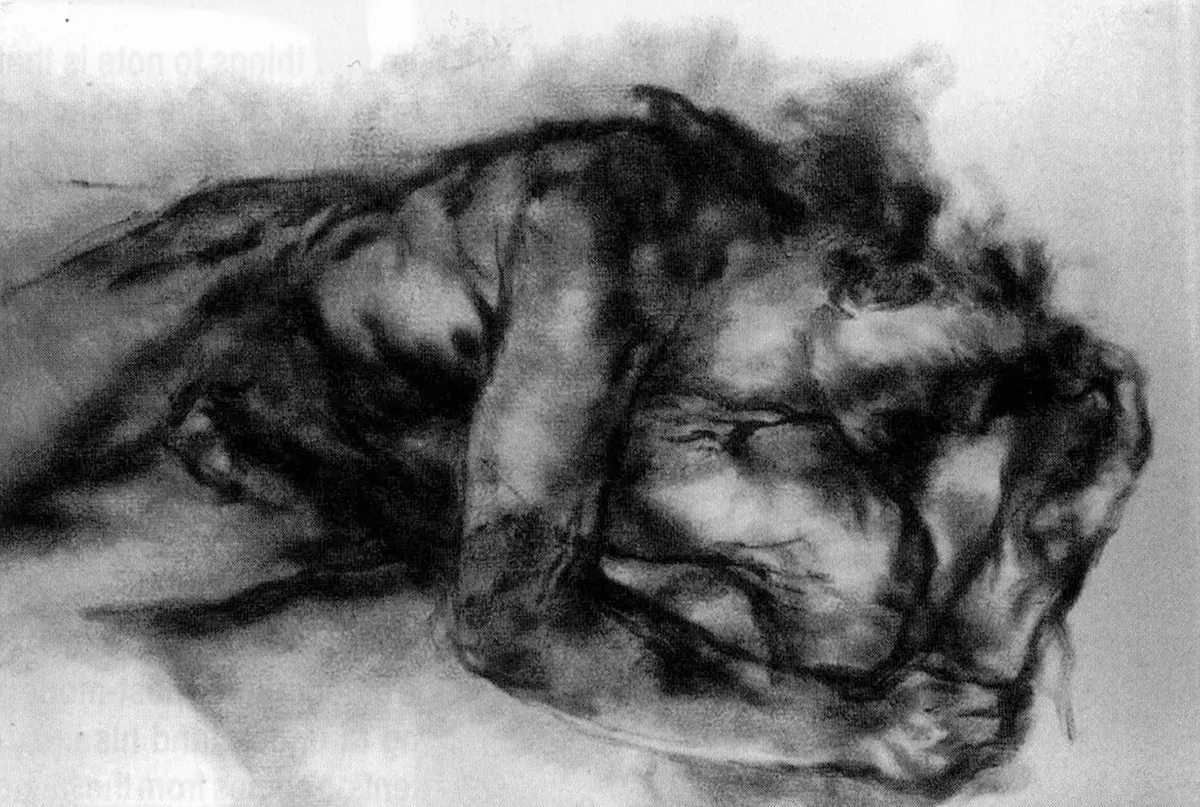
Caballero had no idea at that time that he would very soon be prevented from continuing his work and that he would die in I995. But his words spring to mind precisely because the Luis Angel Arango Library in Bogota was presenting an exhibition devoted to his work on paper less than a week before the death of this great draughstman and painter who, like the best artists of all periods, had doubts about his production, wanted to paint better pictures and, quite naturally, had done some pieces which were minor or even of secondary importance. Like many of the works which were not excluded from this show and which, although not absolutely mediocre, would not perhaps have been included by Caballero himself, since they lacked the qualities of excellence to which he aspired in all his work and which are certainly visible in other pictures in the show. According to the press releases from the Library, the show was not intended in any way to be a retrospective and was organized on the basis of works that the artist kept in his Paris studio. They included two pieces in graphite with color washes from 1972, a moment of transition between his first synthetic period and the beginning of naturalism, both tense and nervous; two inks done with a brush, of poses by Germán Rivera, with few indispensable lines; a charcoal portrait of Terry, heavily characterized; an oilwork from 1986 entitled Portrait, an example of Caravaggesque chiaros euro; an oilwork with graphite from 1987, Portrait of Vincent, a handsome oblong composition full of violence; and two charcoal works with color wash from 1990, Self-portraits, painful images of someone screaming (with pain or pleasure?). These works, among others, illustrate the great virtues of Caballero’s art, which was based above all on drawing and carried out in various media, and in which the nude male body was repeated with great emotional strength. While Camilo Calderon in the catalogue text was quite right to point out, recalling Hauser, the artist’s mannerism, we can also say, without being excessively bent on classification, that Caballero was also a camp artist (according to Susan Sontag’s definitions).1 Caballero himself once said that "these expressions and positions of the figures are perhaps the most recherche part of any of my paintings. The least direct and the most artificial ...I am looking for a pose that will clearly say what I want to communicate, but the pose will not say things clearly, because what I want to say is neither clear nor simple. Hence the ambiguity of the attitudes, which may encompass both pleasure and pain at the same time, love and war, or death and ecstasy" (from an interview with Ramiro Ramírez, published in a catalogue from the Garcés Velásquez Gallery in 1978). It is clear that in most of his drawings and paintings, there is a conscious sense of artifice. Caballero had an almost exclusive interest in the
aesthetic phenomenon, the presence of a beautiful body, whether living or dead, but always erotic and provocative, where the artist always revealed a sensibility for stylization, non-conventional arrangements, prodigious images, i.e. all those things characteristic of exquisite minorities satisfied only by what is extraordinary and singularly attractive. The tendency towards camp never made Caballero’s work banal—and there is no reason why it should have done so. Thanks to his innate talent and determination to achieve excellence, he produced an important body of work which obviously remained within the lay, unbelieving world of the twentieth century. Using such different sources as figures of Christ sculpted in wood in the baroque style, newspaper photographs of young men who had been assassinated in the country, and his own Polaroid photographs of sexual relations, Caballero—always pursuing his search for a “real” image, one which was pure and without any narrative— managed to create work which explored in a very lucid manner the mystery of existence and human form without any religious convictions—the very opposite of another artist of the male body, Miguel Ángel Buonarroti.
NOTE
1. Susan Sontag, in her "Notes on camp," in Against Interpretation.
GERMÁN RUBIANO CABALLERO