When we discover the presence of a creative artist, our error often lies in attributing what we see to what we believe to be a source of influence. This is not the same thing as highlighting the inevitable affinities that arise in what could be called a process of historical logics. Furthermore, as is the case in our country, the number of references is usually extremely limited. In discussing portraits, no one remembers Clegg and Glutman, Sander, Avedon, or a torso by Weston, but everyone has Mapplethorpe’s name on the tip of their tongue.
What does Luis Morales have to do with any of this? Absolutely nothing. In his first exhibition, Morales was after another kind of aesthetics, that of the unusual, and wanted to transform the human face and figure into what the surrealists called an unusual object.
How can one destroy the body when terror has already done the job? Have we not seen how Cindy Sherman dilutes the old notion of the body in the phantasmagoria of a new allegory? Surrounded as we are by the religion of prohibition, the negation of enjoyment of “political objects,” as is the case in our “culture of death,” are we not confronted by a telluric face? How can we speak of an “urban face”?
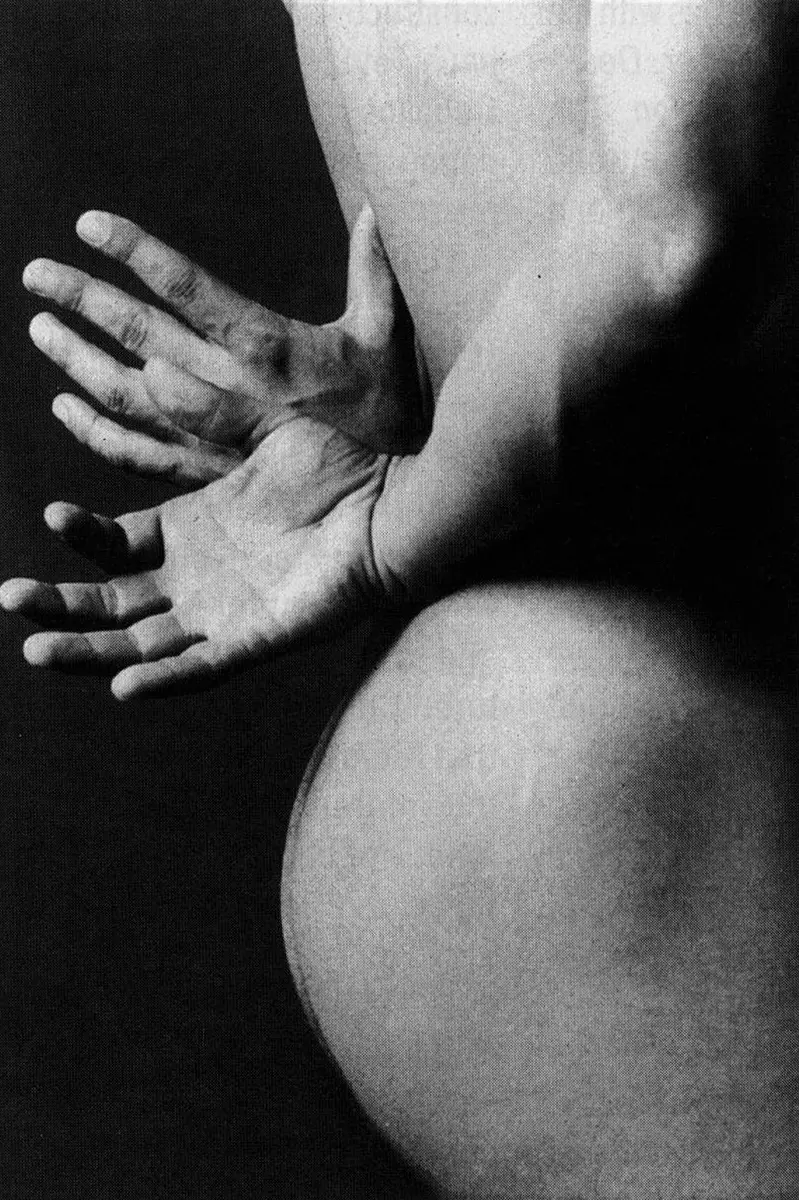
Where has this body become material, when was It recognized for its beauty? When it veered enthusiastically towards narcissistic recognition, a decisive step away from just being magma? In this new exhibition, Morales sought out this affirmation by stressing above all his sense of craft. And while in his first exhibition the concept of metamorphosis seemed inevitable, this time it was the narcissistic body that seemed important. Hence, the masterly use of something which was inevitable: ambiguity.
The Nadaists had already introduced this ambiguity into their texts and poems and indicated the way towards the city, the farewell to the face, which was only a social chronicle rather than an individual face. Here Morales also incorporates something important: the new gestuality, the new decoration which is not seen but implied in what each look, each equivocal gesture seems to indicate.
Is it perhaps the planetary dimension that rock music provides by universalizing our faces? Is it the face of the Hegelian “historical being”? In Morales’s pan-sexuality, there is an exaltation of sensuality as an indispensable path towards jubilation. An ecstasy where prohibition and taboo disappear along with History, where we can recuperate the lost dimension of passions, the sole basis of what is rhetorically called diversity and difference, with the latter being reduced to the reclamations of exclusive minorities dominated more by a sense of expiation than pleasure.
Although not all the videos were successful, they did suggest the creative presence of an artist who knows that the image is not limited to just being a support but is something that must be sought out where the creative eye sees it as a source of horror and poetry.
DARÍO RUIZ GÓMEZ