
An artist who pauses to retrace his steps is thus able to re-evaluate his work, make syntheses and changes, without losing his links with the past. Although this was not the purpose of the most recent exhibition of work by the young artist Miguel Hernández (1961), part of the show did signal a return to the theme of drawing, illustration, and vignettes of a social, narrative, caricaturesque, and expressionist kind reminiscent of the chronicles of the nineteenth and early twentieth centuries. They are amusements, recreations, and exercises which highlight the characteristics underlying this artist's work: his extraordinary capacity for drawing and expressive form, his sense of composition and design, and great subtlety in the treatment of the human body.
Some were a chronicle of the artist’s nightlife in bars in the company of friends; others paid homage to people, including the artist himself, as in the illustration entitled Between Friends, Fernando Calvo, Stephen Greene, the Writer V.A. Mora Rodríguez, My Father Miguel Hernández, and Myself. Finally, several vignettes recreated sordid scenes of certain kinds of “exoticism” and folkloric settings, in which tourists are shown in a critical light in grotesque and murky situations.
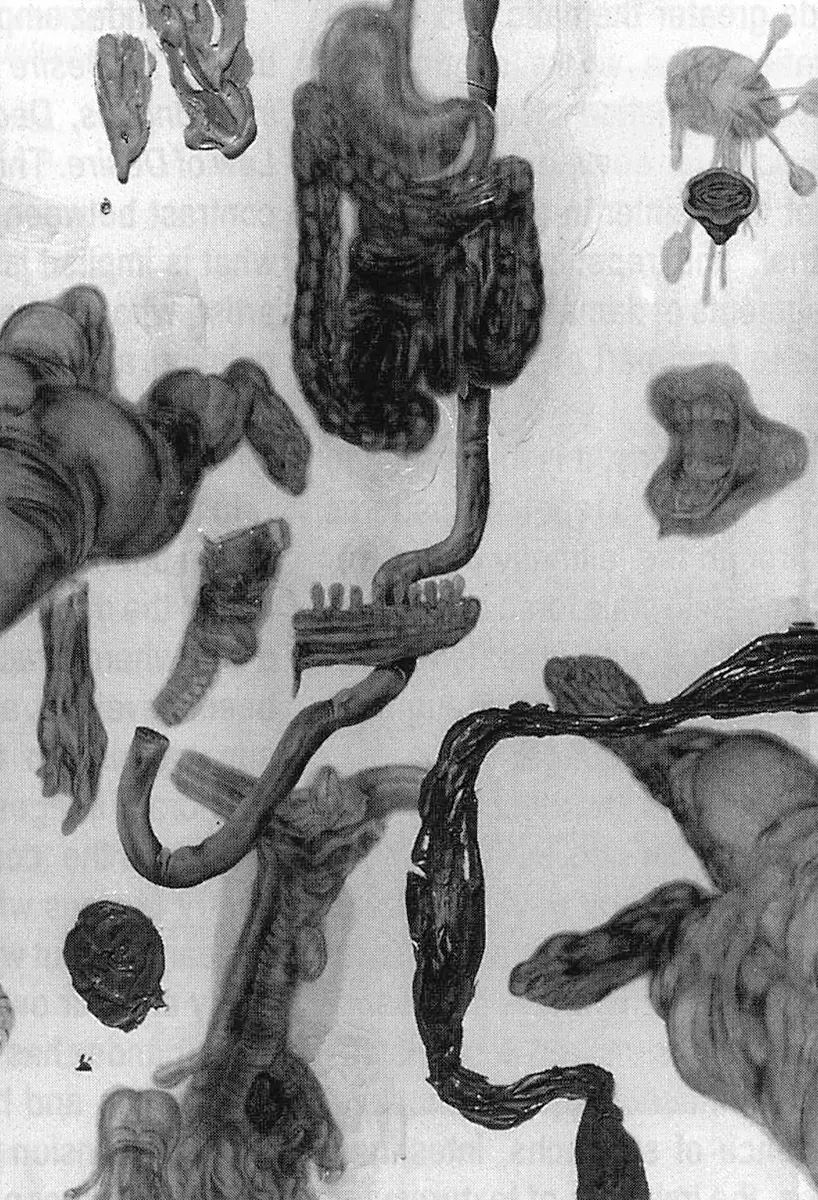
However, the most important part of the show was the painting, for which Hernández is known internationally. In his most recent work, he has used several signs and references from his previous production to make an intimate and selective journey to the innermost recesses of the human body, stripping the skin, with striptease theatricality, from the emblematic male torsos characteristic of his work to leave bare the muscles and skeleton, along with the digestive organs.
Without mention of any “evolution” (least of all in the Darwinian sense) in his unconnected, dislocated, schizophrenic, and post-modernist narrative, governed as it is by the two apparently contrasting concepts of non-objectuality and figuration related ambiguously, the artist seems to have moved towards greater thematic and formal integration. The works continue to show a combination of sensibilities, with a contract between the manual skills of the painter in the traditional, industrial, and repetitive sense and the fragments of damask added to the canvas to form part of the work as a whole.
In the same way, it is interesting to note the allusion to repetitive patterns - not through the leitmotif of the Renaissance style male torso or the fragments of fabric with repeated kitsch drawings of flowers, but through the signs of a new language.
Within his work, the artist has gradually gone deeper into the form of his discourse, in a literal way: from idealized torsos separated from the spectator by sublimating layers of transparencies, he has moved towards the most extreme nudity, the shocking appearance of stomachs, intestines, tongues, the imitation of textures and colors evoking feces and other body wastes, and fluids which have now replaced the abstract stains, combined with the naturalism of the body and providing a sense of contradiction with other styles of painting.
Hernández has moved from an aesthetics of surface, contemplation, and to some extent abstraction, toward the guts of the body. Historicist sensuality has given way to the re-invention of another, more internal and equally anatomical kind, drawn with the same precision and realism, but with greater vitality.
A consummate draughtsman, Hernández uses his skillful linework to depict the different organs as if they were illustrations from some biological study, endowing them with sensual realism. In this way, he creates a sense of tension and aggression, which subsequently gives way to a refinement of forms through the use of soft and transparent tones in the charcoal drawings. This new “classicism,” depicting what is both apparent and disagreeable, is in fact an expression of our most intimate passions.
Passion here is seen as something more enveloping and exuberant: although it encompasses what is physical and sexual, it also extends to things and to all aspects of our lives.
Hernández emphasizes this with his titles: The Desire of the Other, Desiring Tongues, Decorative Union, and The Law of Desire. This sense of irony and contrast between what is shown and what is implied is emphasized by the artist, who seems to take pleasure in painting an obscene game in which desire is sublimated in eschatological terms.
In this way, Hernández constructs a subtle poetics through symbols referring to the dirtiest parts of the body. At a time when attraction and desire have been devalued and even converted into banality in the confusion of a plethora of images, Miguel Hernández proposes the corrosive beauty and poetry of signs, which are shocking in appearance but which confirm his sincerity and our own hypocrisy.
Hernández has achieved a sense of sublimation and has given it an academic dimension through his unusual way of being conventional and of referring to the perfectionist humanism of the Renaissance. The human body continues to be present as his main theme. Narrative is abandoned, and this time, the sense of alterity, what might presumably be seen as an iconoclastic attitude, becomes a kind of classical romanticism, where contemplation is less violent, less ironic in its contrast between theme and representation, veiled but less contradictory and confused.
None of this is an exercise in caprice. Of all the young Costa Rican artists, Miguel Hernández is one of the most coherent in his creation of a strong contemporary discourse, which he has continued to explore within his own thematic range and logic.
DERMIS PÉREZ LEÓN