
The show presented by Óscar Páez at the Der Brücke Gallery had the virtue of making us reflect on what critics have said about the aesthetic intentions of this young artist.
The thirty works in the exhibition, which included sculptures, object boxes, canvases, and paper works in mixed media, offered a panorama of the proposals of this artist from Córdoba, born in 1953. The themes of the works and the quality of their finish have not varied in comparison with his earlier pieces—although perhaps this time there was greater freedom in the execution, the product of Páez’s greater experience and professionalism.
From his early shows and prizes in the salons, almost twenty-five years ago, Óscar Páez has transformed found objects, in particular those which take us back to some undefined antiquity, a search which reflects his concern for man and the traces left by man in his life on earth. The execution of the works is not under discussion—but rather their meaning.
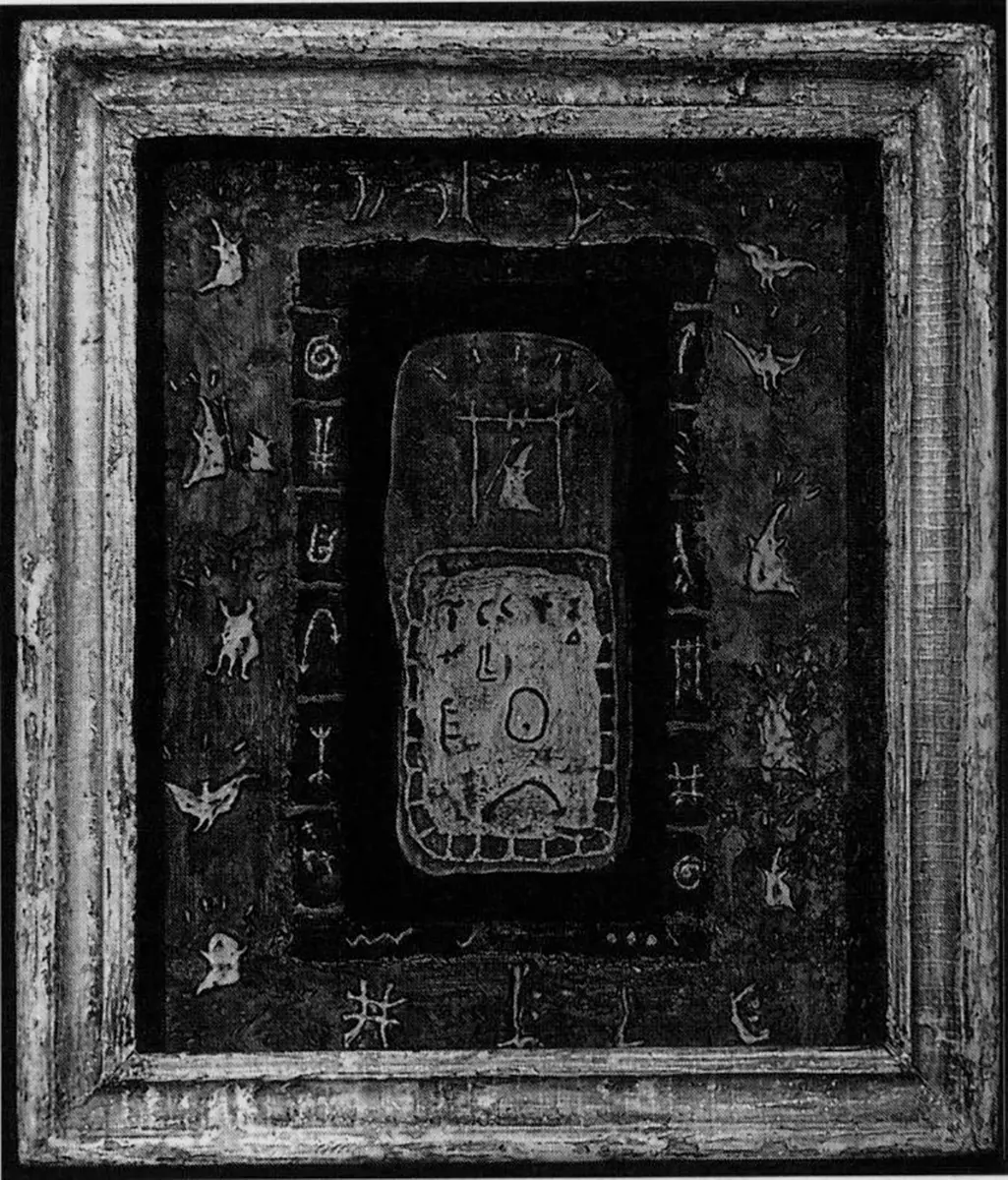
Looking at these works makes us think about questions that are old but still remain valid today, concerning the relationship between form and content. Critics have emphasized the mystical and esoteric qualities of his proposals and have traced his roots back to pre-Columbian cultures and the Far East. This situation suggests that Óscar Páez is a kind of demiurge, with more of a witch about him than an artist. It is worth asking whether such claims have any truth in them.
The question is also interesting because many other artists have followed a similar path, and their intentions have been seen as similar. They are seen as combining a certain archeological and anthropological inquiry with concerns of a metaphysical kind. It is at this point that the question of form and content arises when we examine the works that have such motivations in common. This is perhaps one possible way of understanding the poetics of Páez.
One of the first things to note is that Páez skillfully exploits the collective imagination of a peasant culture that lies hidden in our large urban centers; in this sense, it is correct to say that he has links with ancestral cultures. But in using specific objects - stones, wood, threads, or graphic scripts, such as the Japanese, Páez’s intention is of a formal kind, without the transcendent dimension which is so absolutely assigned to him. And it is in this sense that coincidences exist, which allow us to apply the categories of post-modernity in trying to understand his imagery. The intention comes from the found object, its atemporal nature and lack of transcendent meaning reinforce its on wood, ambiguity. Thus, the formal interplay becomes the protagonist.
Good examples of this include Writing No. 1 and Board with offerings, in which the subtle treatment communicates sensations of an almost inanimate kind, which indeed would suggest some kind of link with metaphysical intentions.
ALBERTO COLLAZO