
In two provocative installations at the Center of Contemporary Art, Miami artists Teresita Fernández and Quisqueya Henríquez have created intriguing spaces with seemingly minimal arrangements of objects and photographs. Dividing the gallery space at the museum, the artists invite viewers to experience a variety of different dimensions of conceptual interplay between time and place, the objective and subjective, and the real and the ephemeral. Although the installations are separate projects, both challenge the viewer to participate in what may be, for many, new sensations and responses to artists working with visual constructions and their surrounding spaces. Asking the question, “What is real?”, the artists elevate the notion of what type of object is significant to the creation of a work of art to new heights of interpretation. At the same time, the objects, including the details of a gallery’s architectural space and environment, become secondary to the purpose of the installation. The spaces of the galleries become as ambiguous as the objects and images the artists have placed on and within the walls.
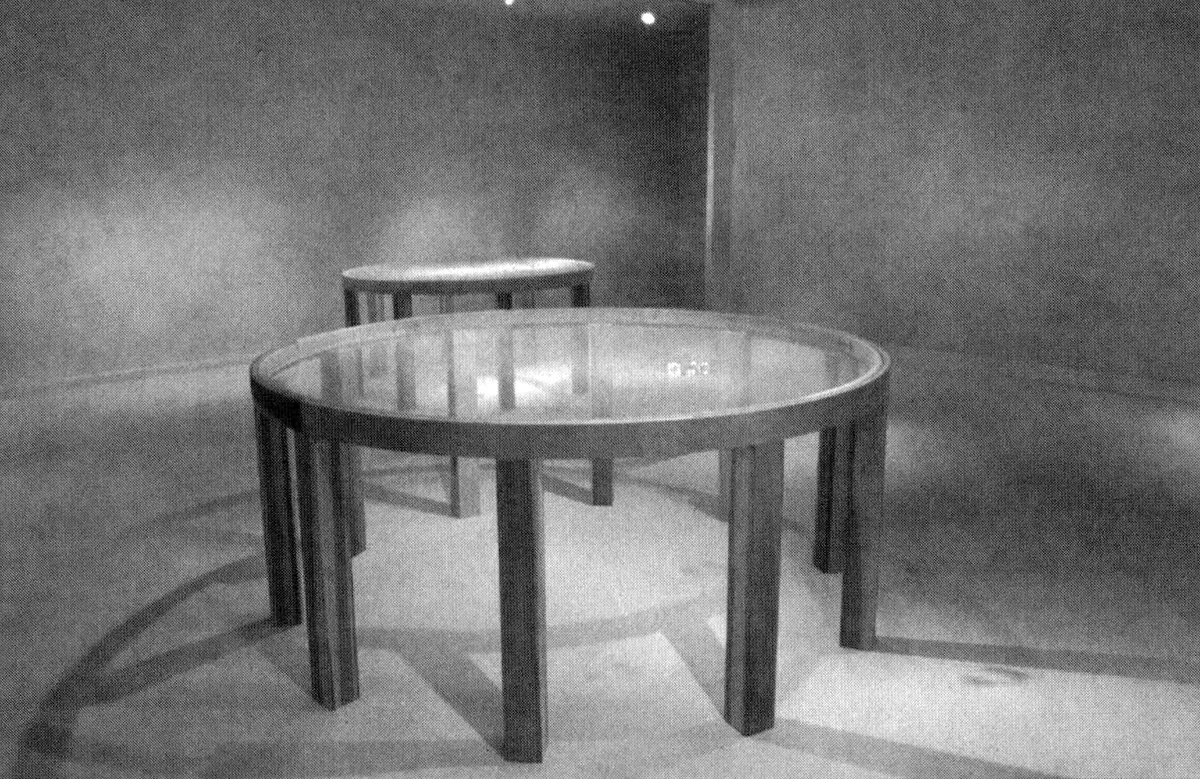
Teresita Fernández transforms her space by painting it in subtle tonalities of creamy hues and then placing two wooden table frames with mesh tops in the area for a minimal arrangement that confounds the senses. Further complicating the illusions created by the tables and their relationships in size and place, the addition of a melting ice cube, a theatrical prop, engages the viewer in a game of deciphering each element like pieces in an optical puzzle that has no solution except in the imagination.
Quisqueya Henríquez elaborates on her Project with related installations at the artist’s studio and at Fred Snitzer Gallery in Coral Gables. With photographs documenting the three contexts for the display of her art, she captures the architectural details of each location. Playing with texture, surface, and wall and floor juxtapositions, she records a journey from place to place that intrudes upon a viewer’s memory of space and affects change with every visit. The arrangement of the photographs in each location repeats grid-like rhythms in a cadence of black and white and shades of gray, occasionally interrupted by color. Whether fascinated by the elegant beauty of one unique image of an ordinary detail or the still-life quality of a collection of images that results in another kind of visual experience, the viewer is seduced into the space and faced with a complex of sensations.
In both the installations, Teresita Fernández and Quisqueya Henríquez complicate issues of past and present, memory and actuality, and an existence more real than reality. They confront the viewer with the mechanics of illusion and question art and the artist in time and place.
CAROL DAMIAN