The inauguration of a new museum always generates much expectation and excitement in artistic circles, enveloping not only artists themselves but galleries, critics, and other museums in the field. This is mainly because the new museums that have been founded in recent years have been trying to find their own respective paths, through specialization or a distinct museological approach involving not only the creation of a permanent collection but the preparation of a program of temporary exhibits. This open and imaginative spirit is all the more important when we bear in mind the degree of cultural decentralization in Europe as a whole and in Spain in particular over the last decade, with the emergence of a number of small museums and art centers in small towns or in places far from the major traditional art centers.
The inauguration in Badajoz (Spain) of the Extremadura and Ibero-American Museum of Contemporary Art at the beginning of last May not only marked the creation of yet another museum of contemporary art, but the affirmation of a museological project which will indeed be a novel one if it is carried out over time through a rigorous program in keeping with its initial principles and inspiration. The actual name of the museum establishes in a sense one of the main guidelines of the project: it will be a museum which seeks to concentrate on the broad artistic geography encompassed by the term "Ibero-American," including art created in Spain, Portugal and the Latin American countries, but without excluding all those artists who live and work in the United States but whose roots are to be found in this same cultural context.
Another characteristic is the time frame of the museum, which begins with the decade of the 1980s and is open-ended towards the future. Such a project is perfectly in keeping with the historical traditions and geographical conditions of the region (the city of Badajoz is located right on the frontier between Spain and Portugal), offering a first-class opportunity for cultural dynamism and exchange in this somewhat peripheral and off-the- beaten-track city which has until now found itself distanced from the main artistic currents.
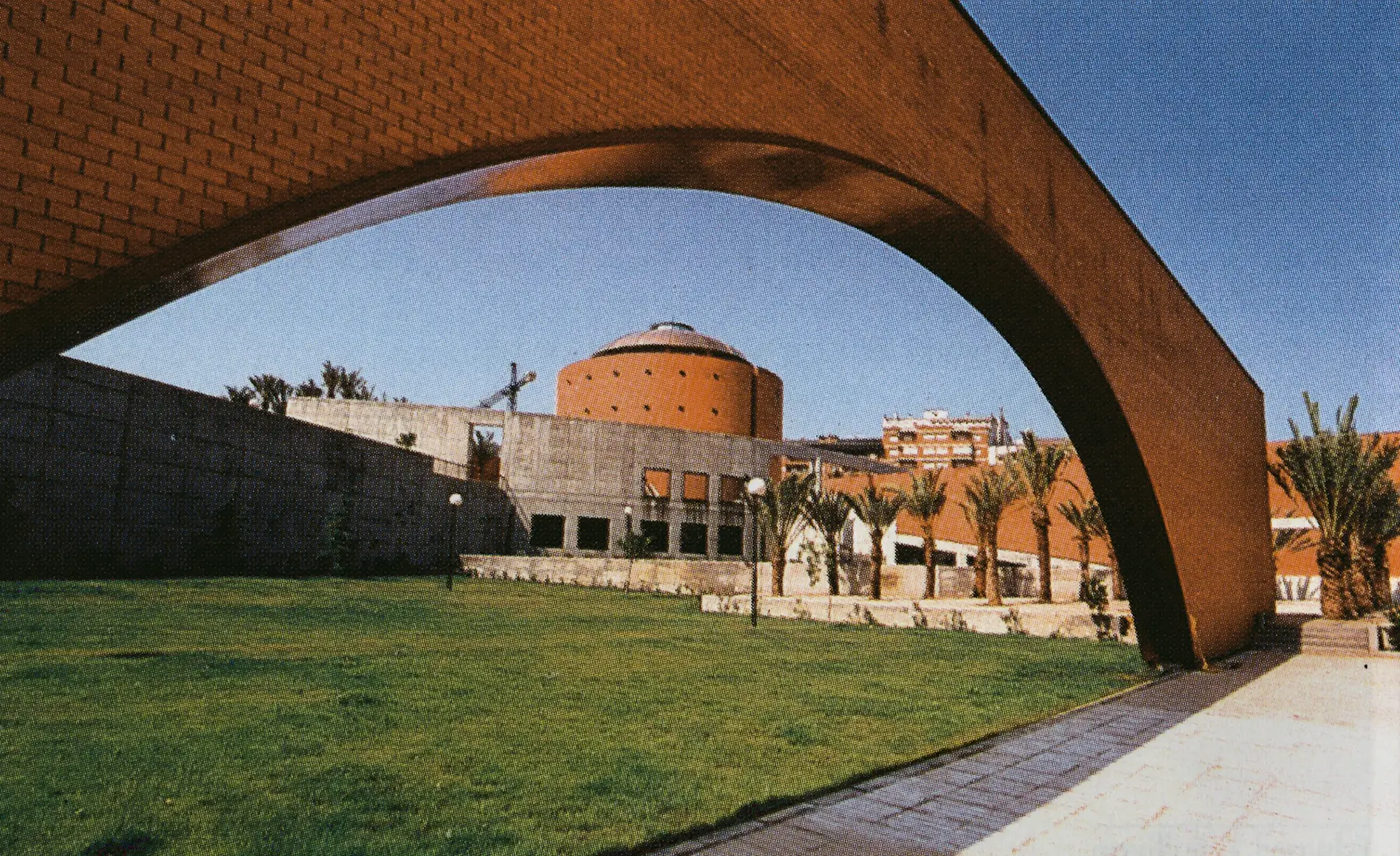
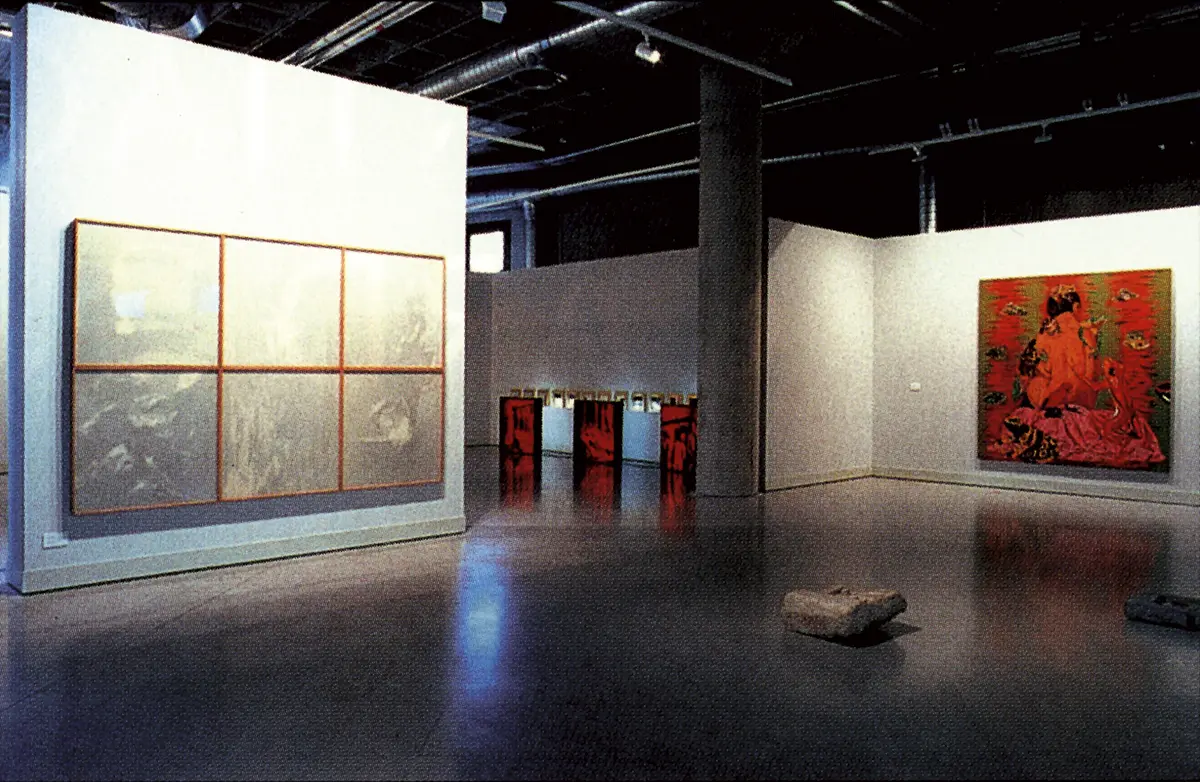
The museum building, located on the same site which, until a few years ago, was occupied by a prison, has been designed and constructed by the architect José Antonio Galea, who has respected some of the formal characteristics of the earlier structure, such as the unusual central conical figure, which has become the emblem of the building. However, the effect, which the architect seems to have sought, of transforming metaphorically the prison into a museum, is in the end an unnecessary rhetorical device that does not give the interior space any additional advantage, but only disadvantages. As is unfortunately now too often the case, even in work by well-known architects, the architecture of museums pays less and less attention to the needs and requirements of a center which is intended to house exhibitions of art and of the characteristics of the artworks themselves. The architect plays an excessively protagonistic role and the solutions adopted are often poor and inappropriate: wide exterior spaces are lost in complicated and unfunctional gardens, while the inside of the conical building is full of circular walls, which are not very good places to hang pictures. The rest of the exhibition rooms are designed as open spaces with concrete walls, with the ceilings being supported by columns, which leave the air conditioning system visible. To make these rooms habitable and suitable for presenting the collection, they have had to be remodelled through the use of large mobile panels, something which could have been avoided if the architect had thought about the museum rather than his own pet ideas.
The Badajoz museum was inaugurated with a show of its collections, which clearly indicate the objectives and orientation of the museum. The most notable feature, perhaps, is its open-ended character, as can be seen in the names of the artists included.
The conical body of the museum will permanently house the section of twentieth century art from Extremadura, including not only local artists of a certain importance, such as Juan Barjola, who donated an important set of works to the institution, Mon Montoya, Orellana, or Canelo, but other artists who in one way or another have links with this region: for example, Wolf Vostell, who recently created his own foundation with assistance from the regional government in the town of Malpartida de CÁceres, where he usually spends part of each year.
The sections on Portuguese, Spanish, and Latin American art form an embryo that could be consolidated into a collection extending out to contemporary artistic currents and providing support for an ambitious project of temporary exhibits, which will be a necessary complement to the main collection.
A committee of specialists, including Fernando Huici, Miguel Logroño, Rosa Olivares, Antonio Bonet Correa, Fernando Castro, and Miguel Rojas Mix, will establish the criteria governing the acquisition of works for the collection. From the results achieved so far, the project is still at an early stage. The acquisitions to date have been made over a short period of time, and, of course, a major collection needs time and very careful planning. More attention should thus be given to the works rather than the artists. Undoubtedly, there are many absences, but time will help resolve this problem. At first sight, painting appears to predominate, which in part is a result of the current recuperation of pictorial language, although it is important also to stress the place of photography, or works which make use of this medium, for example, those of Leonel Moura, Mario Cravo, Jorge Molder, and Javier Vallhonrat. At the inauguration, these three sections of the permanent collection were not presented separately. On the contrary, an attempt was made to inter-relate them, something which at first might appear to be rather difficult. However, the result is to some extent an anticipation of the most interesting projects in the program of temporary exhibits at the museum: to present various exhibitions by two or more artists from different spheres (creative, cultural, geographic), thereby establishing a kind of dialogue or contrast to create new avenues of understanding and analysis of the characteristics of our contemporary art.
Although it was of course essential to include a careful and important selection of works by Spanish artists (with pieces by Miguel Navarro, Susana Solano, Juan Uslé, Sicilia, Eva Lootz, and Sinaga, as well as interesting projects for the exterior by Nacho Criado and Jaume Piensa), and although the Portuguese section includes works by Julião Sarmento, José Pedro Croft, Álvaro Lapa, Gerardo Burmester, and an exterior project by Pedro Cabrita Reis, thus filling an inexcusable gap in current Spanish museology, it is the Latin American section which is the most significant, both symbolically and effectively, and which could well become the most emblematic feature of the museum in the future.
For a number of years, we have been witnessing the recuperation of Latin American movements or individual artists whose work, despite its importance, has not been properly appreciated within a global context. This is not the place to analyze the causes of this situation, but it is worth noting that this recuperation process is occurring at a time of extraordinary artistic vitality in the Latin American scene, coupled with a weariness apparent in the solutions being proposed from Europe or the United States.
The intention of this new museum, which is to assemble a collection of contemporary Latin American art, as reflected in its recent presentation of an important group of 24 initial works, including pieces by Ray Smith, Alfredo Jaar, Guilllermo Kuitca, Manuel Ocampo, José Bedia, Juan Dávila, Julio Le Parc, Saint Clair Cemin and others, signals an important attempt to set these works within the general current of contemporary art. It will perhaps become the most important collection of Latin American art in Europe, the interest of which will undoubtedly increase over time.
SANTIAGO OLMO
Spanish art critic and historian who lives in Madrid.