Tony Capellán is the artist who has, among his colleagues from the Dominican Republic, travelled the most and won the most awards. He recently presented an exhibition of installations in the ancient Casa de Bastidas in the colonial part of Santo Domingo. Capellán is an artist who works enormously and adores his country—with its magic and disasters offering a wealth of inspiration without which he could not live. This love of the islands, which is a characteristic of all the Caribbean region, makes it “compulsory” for him to prepare works for Santo Domingo, to present exhibitions for his compatriots as a primordial obligation.
The fundamental aspect of his themes is communication—the communication of not only morphologies which can be identified with the artist’s personality, but with crude and at times cruel reality, synthesized and made metaphor in his work. Capellán’s art thus stretches his creative possibilities to the limit...as well as the spectator’s receptive capacities. The three dimensions of width, length, and volume, extended over space, are now his means of expression and investigation, allowing him to raise questions and offer “small truths.”
This recent exhibition by Capellán was very strong and one of his most mature in a long time. Its polysemous title was Forced March, which refers to the decisive and resolute journey of the visitor, the fate of the new underprivileged generations, and the objectual elements that form paths or walls. The four installations were placed in the most unwelcoming of rooms, with full advantage being taken as on other occasions of the museum space and with the small number of works encouraging analytical examination and a sense of precise recollection. In this case, given their sharp dramatic potential, in which Capellán refuses any truce or humorous relief, any further emotional charge would have been too much.
The works were four elegies in three dimensions —in an almost etymological sense, except that the compositions, which are a lament for events worthy of tears and cries, are expressed without words through objects. The first installation, entitled Future Immigrants, expresses compassion for children, already the victims of misfortune, symbolized in stains on their school uniforms, destined as they are for forced exile, carrying their souls and their hearts in their little cardboard cases—with transfer drawings of empty plates. Shirts and skirts of future immigrants who are as yet unaware of their future as “cabaret dancers” or “servants.” The sadness is bathed in tenderness and innocence.
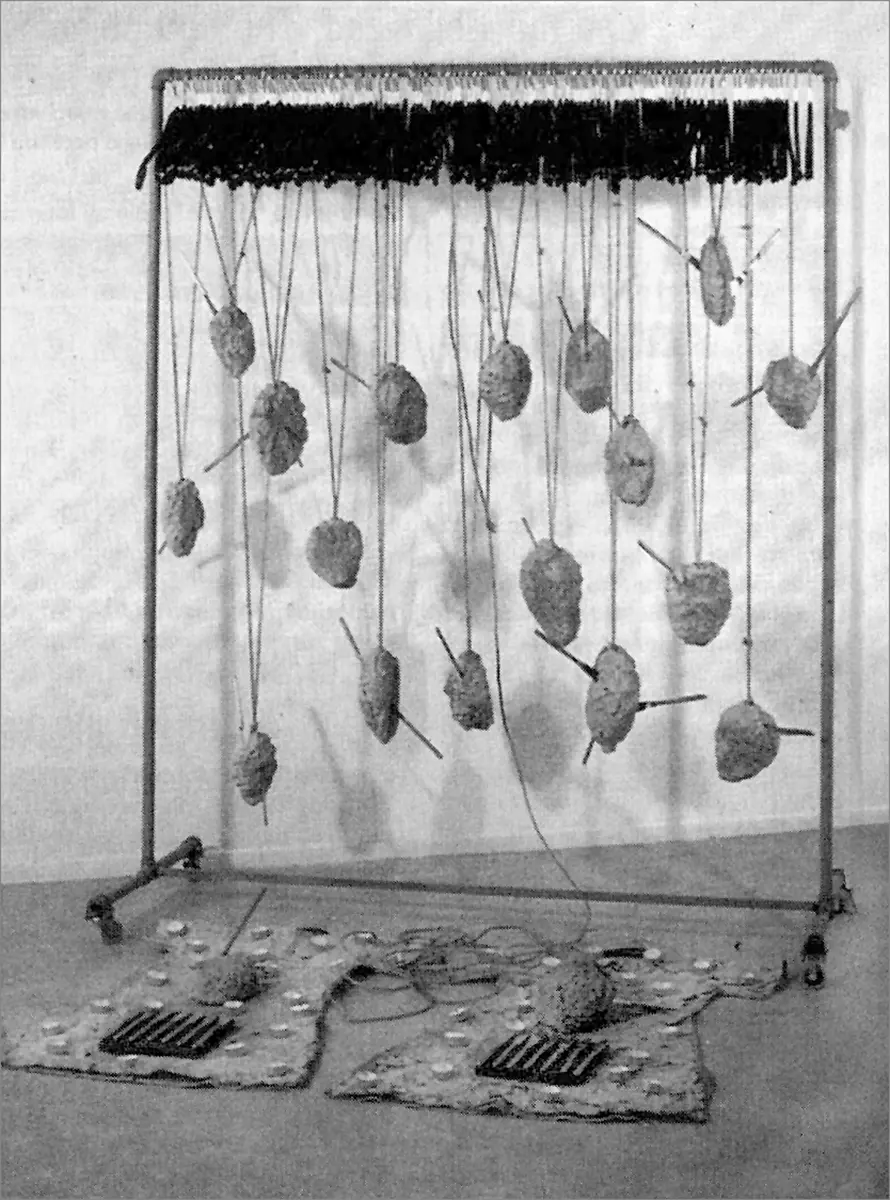
The second installation goes beyond the elegiac to raise a repeated cry of pain and denunciation, which is more effective than any long reportage. Within the space of a few square meters, Market of Abuses recreates in tangible terms a prison-like world, with unscalable, interminable railings and the marks of violations. There is a contrast between violence and suffering, brute force and defenseless fragility, the allegory of the aggressors and the victimized. Through objects, we become eyewitnesses to the horrors of the La Victoria prison... and how many others are there like this in other countries and continents?
The third elegy, which represented the artist and his country in The Right to Hope in London, was entitled Small Hope. In the pockets of shirts hung out on a line to dry, there are pieces of bread and pencils... the “bread of knowledge”. Is there hope for a better future? We do not know, since fragility continues to rule, although these shirts on the line do form a wall, suggesting that hope can become a source of resistance.
The fourth installation, Fragile Fruits, formed a monumental conclusion to the exhibition, in which Capellán gave full rein to his new work in ceramics, which he initiated in Holland recently, using giant blackish hearts in clay. The Organ Market, with its sign-objects, was both magnificent and provocative, aimed at and achieving a sense of indignation. Hanging from barbed wire above each heart and its cardboard box, light bulbs recalled the universe of the concentration camps. The work conjured up the atmosphere of a morgue, and the effect was both shocking and moving.
We spoke of three dimensions... in addition to volume. There is a physical, formal, and structural dimension in this work, arranged both vertically (aggression/power) and horizontally (passivity/lack of defense), creating a “sensitive geometry” which facilitates our reading of the work. There is also an emotional and intellectual dimension, which motivates the artist in his negation of puritanism and trite sentiment, stipulating the spectator’s indignation and enabling these familiar objects to communicate their messages of “militant art”. There is also a third dimension—contemporaneity—and here once again Capellán has managed to fuse local aspects with universal topicality, art with life, by capturing situations artistically “in the act” in his Forced March. As the artist himself has said, "at present, any kind of material or everyday object can be used to tell a story in visual terms."
MARIANNE DE TOLENTINO