The most recent exhibition in New York of the work of Alfredo Jaar was based on a dynamic interplay between presence and absence in an attempt to explore the problems of photographic representation. Photography as a medium has not only been one of the most frequently used tools in Jaar’s work, but is one that he has most examined at the conceptual level. From its invention, photography has, of all visual representations, become the one that offers the closest portrayal of "reality." Despite the high degree of codification that the photographic image undergoes at each stage in the production process (composition, take, developing, publication, presentation), the final result is generally perceived as something both true and reliable. This phenomenon is the result of a common attitude towards photography, the final image of which is, thanks to the chemical conditions of its production (in which light hits the emulsion of the film and thus generates a trace of the photographed subject on its surface), perceived as an indexical sign. The notion of photography as a direct, unmediated impression of the object goes back to the literature of its invention. In 1844, Talbot described the new invention as "...images produced totally by the new art of photogenic drawing, without any assistance from the artist’s pencil. The emphasis was on the mere action of light on sensitive paper."1
In his seminal book on photography, Roland Barthes examined this equivalence between photographic image and reality on the basis of the idea that photography carries with it its own referent: "any photograph is in a certain way co-natural with its referent... in photography I cannot deny that the thing was there."2 This partial illusion of identity between perception and representation, reality and image, is what makes us believe that photography is a kind of "message without a code." But representation produces signs; it does not produce the thing in itself. In other words, re-presentation does not depict the original thing once again, but abstracts, decontextualizes, and composes it to produce specific meanings. It is this inherent ambiguity of photography, whose images are perceived as unmotivated signs, although in fact they are set within an entire series of codifications, which was most fully explored by Jaar in this recent exhibition.
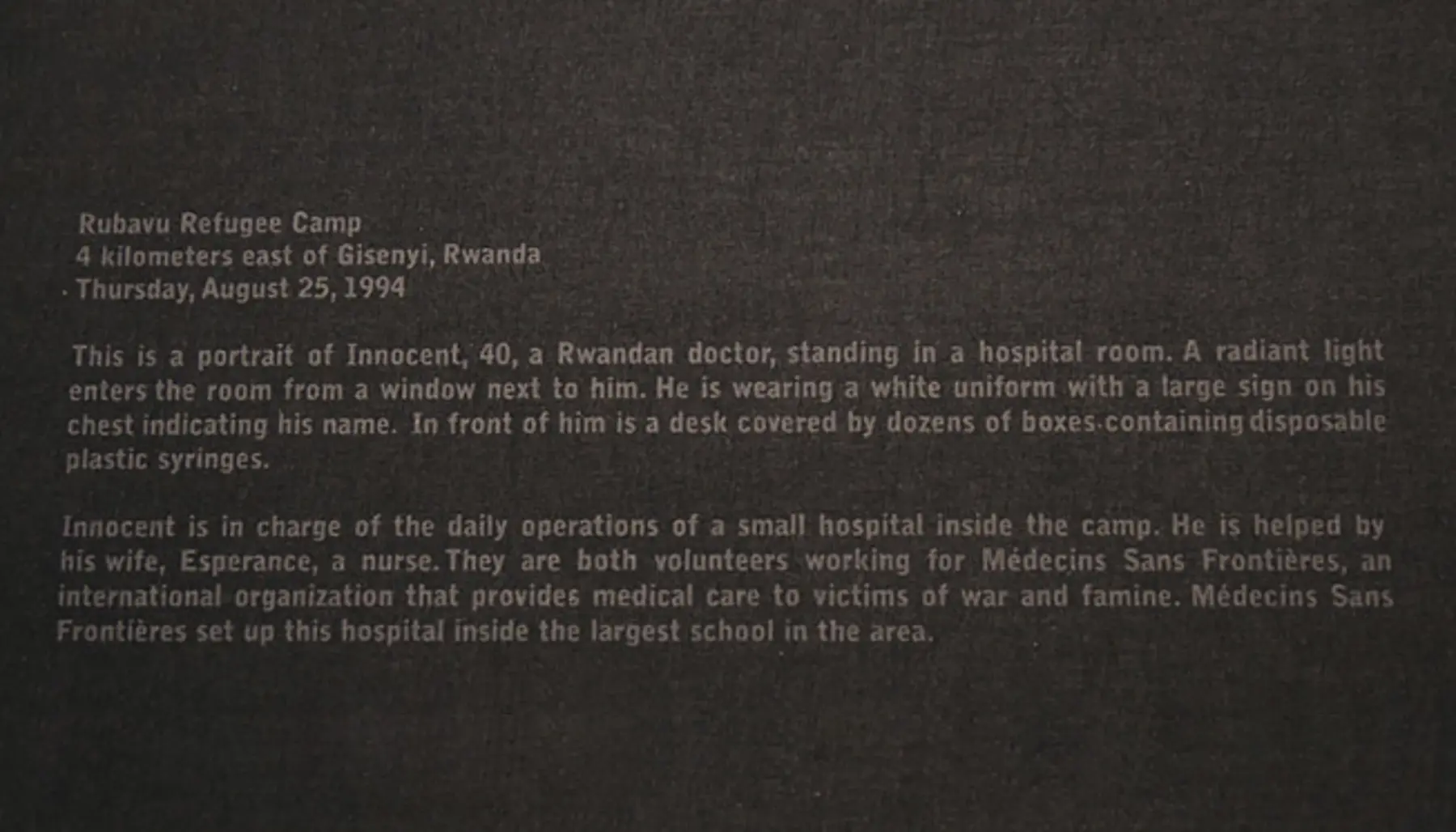
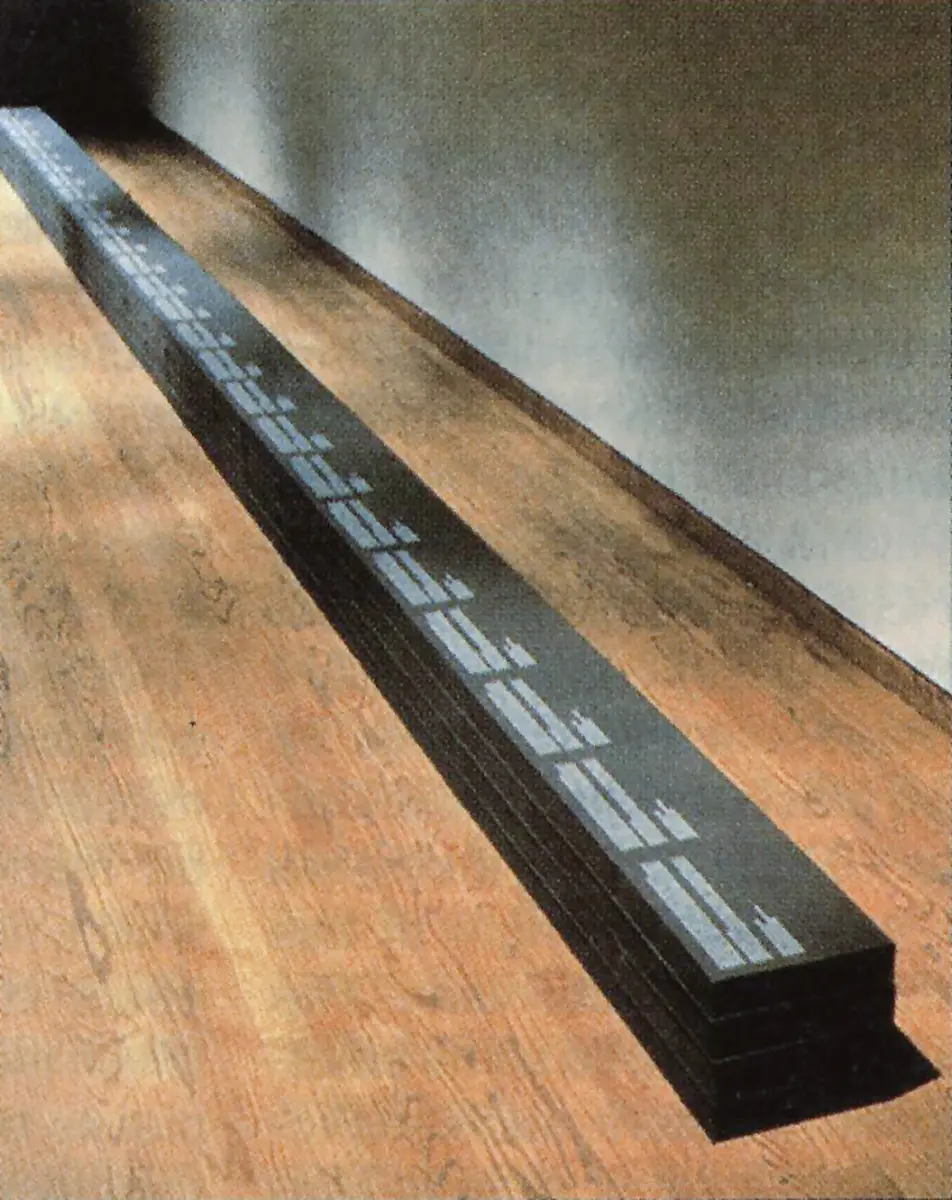
The show was made up of seven pieces laid out in the gallery under a soft yellow light. All the pieces were made up of lines, piles, or grids of black filing boxes used to store photographs. In each box, the artist placed a cibachrome photograph measuring 8 x 10, with a text describing the image on top of the box. All the images used and described refer to the civil war which broke out in Rwanda in April 1994 as a result of the historic conflict between the Hutu and Tutsi tribes. The massacres caused by this socio-political event led to the death of between 500.0 and a million people. According to research carried out by Jaar himself, the indifference of the international community and the world press towards this region devoid of strategic interest only compounded the serious situation and stifled any discussion of what was in fact a veritable genocide.
In the face of such horror and human disaster, Jaar’s works did not show any bloody bodies or desperate scenes. The artist completely obliterated the visual image in an attempt to explore the problems of the idea of faithful representation normally associated with photography. This also means that he obliterated any possibility of fetishism and emancipation of the medium. As Christian Metz has pointed out, thanks to its small format and potential for contemplation, photography is well-suited to function in terms of fetishism. A fetish not only acts as a substitute for something which is absent, but displaces the eye and replaces an absence with a presence.3 In most cases, the fetish maintains a link with the absent original and is its derivative. Through its persistent decontextualization of the whole, photography cuts up reality into fragments, freezing the image to make it definitive. The spectator has little or no reference to the off-frame reality to which the image once belonged; the strategy used by Jaar eliminates the possibility that the spectator should have any knowledge of the socio-political reality of the event through the simple contemplation of the photographic image. Metz adds, "...the off-frame effect in photography is the result of a singular and final cut, which means castration through the 'click' of the shutter. It marks the place of some irreversible absence, a place from where the eye has been displaced forever."4 This displacement from the less visual, more structural reality in which the events in Rwanda are set is what Jaar’s works are trying to avoid. They are an attempt to avoid desolate images that inspire momentary compassion, preferring to explore the total structure of representation of that reality.
But the off-frame reality from which the photographic image has been extracted is not just made up of a complex socio-political situation set within a series of historiographical events. The off-time reality also comprises the many personal and contingent histories of the communities, families, and individuals affected by the war. This concern with personal history, which is never expressed in the official representations of the event, is reflected in Jaar’s work in the different descriptions made by the artist of the same photographic image. Some of the works repeat the description of the same photograph in serialized form, voiding the conventional content of the text of its meaning. Benjamin, which is made up of 64 photograph file boxes, arranged in grid form on the gallery floor, was one such work. Others, such as Emmanuel, superimpose the boxes in the form of a column crowned with the description of the image. Finally, others, such as Nyagazambu, offer different descriptions of the same image. Jaar thus stresses the contingent nature of the readings and the fragility of the descriptions of these images, pointing our attention towards the journalistic distortions of news events, but also towards the rampant impersonalization which these events undergo through the construction of official narratives. Thus, Nyagazambu describes the distribution of food rations by the Red Cross in the refugee camp of the same name, 49 kilometers to the east of Kigali. However, the descriptions vary. In the first two texts, the emphasis is placed on the general survey of the scene, and the subjects depicted are "refugees." In the other two texts, on the other hand, mention is made of specific individuals, including their names, and the reading of the image becomes more personalized. The same procedure is repeated in Ntarama, where we move from a description of a massacre that has occurred to a narrative of the personal circumstances of a woman appearing in the hidden photograph.
The content of the texts printed on the boxes contrasts with the minimalist aesthetics of the works. This explicit reference to such an aesthetics seems to substitute the absence of a visual image with the presence of a phenomenological relationship between the work and the spectator, which was one of the principal objectives of Minimalism. The search for a reaffirmation of the perceptive subject is a response to the modernist logic based on the idea of a purely sensorial approach to the work. The incorporation of a clearly political theme within the gallery subverts this premise. At the back of the gallery, a small room contained information material on the war in Rwanda and on such institutions and support groups as Amnesty International. At two different points during the duration of the show, there was an audiovisual presentation lasting 21 minutes, narrating, only with texts, the main events of the genocide which occurred from April 1994 in Rwanda.
In this way, Jaar has given public notice that his works are not intended to function as a means of emancipation within a society in which change in the current socio-political situation will require much more than a critical cultural practice. Neither in the show nor in the supporting material were the events that happened in Rwanda depicted better or worse than in any official version. The objective of the show was to explore the problems of representation in itself and to draw attention to the gulf separating the "reality" of the event and its visual representation. The situation in Rwanda is a response to a long series of historical, cultural, ethnic, political, and social factors that it is impossible to represent. The photographic representation of the events and their public inscription through different semantic and institutional networks can only resolve part of the problem of representation. Thus, one of the main motivations of the show was to raise questions rather than to provide any simple solutions. This important and radical change in Jaar’s work confirms the artist’s concern to pursue an artistic practice that is firmly committed to the constant appraisal of the representational models available for the construction of cultural meanings.
NOTES
1. Talbot, The Pencil of Nature, London, 1844-46.
2. R. Barthes, "Camera Lucida," The Noonday Press, New York, 1981, p.76.
3. C. Metz, "Photography and Fetish," October 34, MIT Press, Fall 1985, p.86.
4. Op.cit., p.87.
MÓNICA AMOR
Candidate for Ph.D in Art History at the Graduate Center of the City University of New York.