
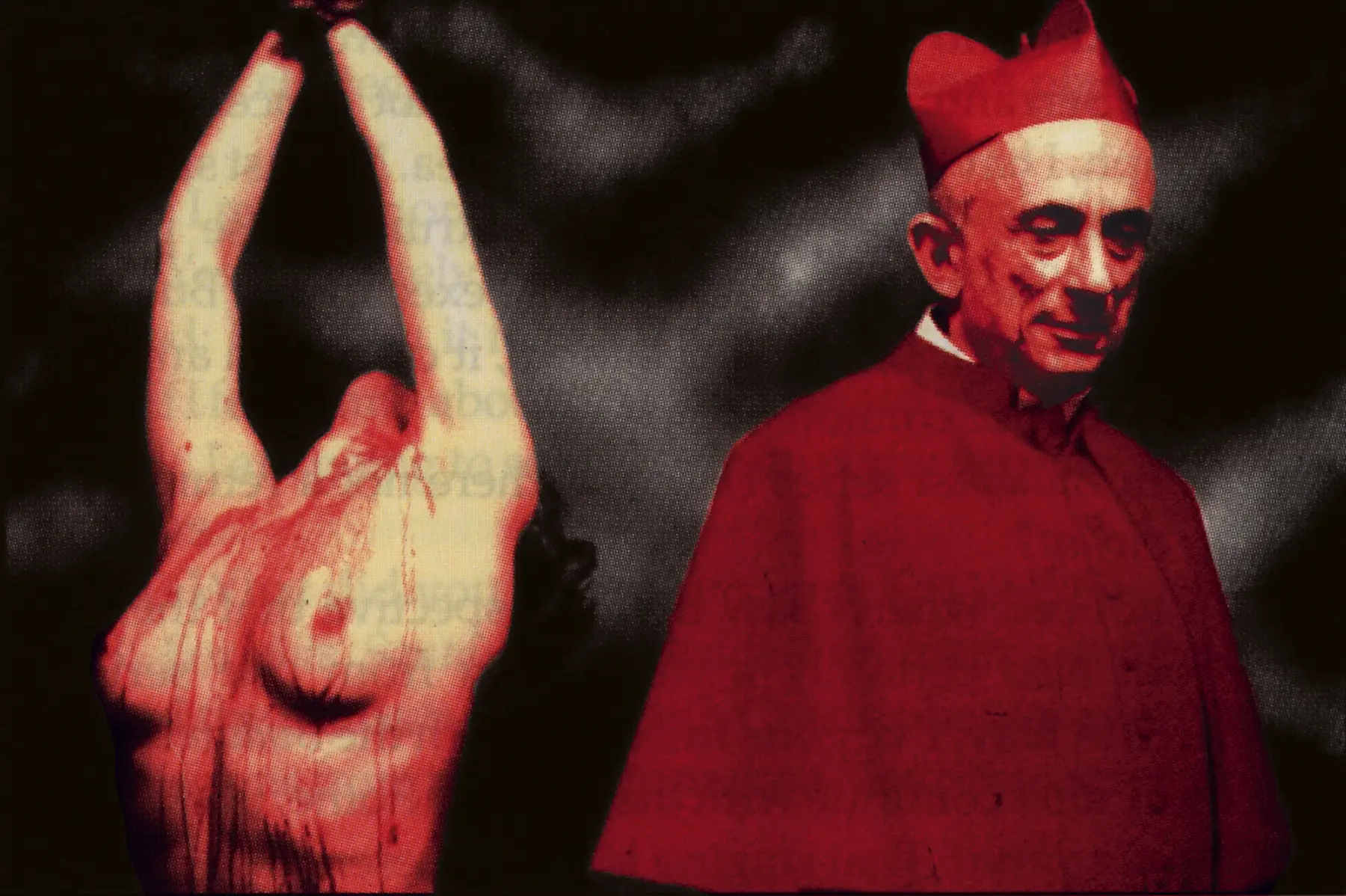
Andrés Serrano (New York City, 1950) considers himself a conceptual artist whose medium is photography. As Bruce Ferguson has noted, Serrano is aware of the photographic process as a rhetorical device and plays with actualizing its potential as fiction.2 Representation, rhetoric, and power are interrelated. After viewing Serrano's ten-year survey,3 one realizes that what makes him a real provocateur is not so much the nerves he touches of a set of values and political agendas of right-wing Christian fundamentalism in the United States, but how he undermines the means of representation itself. The very dynamics of how the subjects and objects are represented are what give his work power. Serrano's work expresses a cunning and sharp edge of a social imaginary out to subvert the signs and cultural context from which he draws them. Estranged from their normative and domineering location, the hyperchanged socio-cultural signs are no longer attached to one meaning and symbol. In Serrano's visual language and style, other versions of recognized and shared signs receive their homecoming, triggering layers of signification along the way.
More than an artiste maudite, Serrano is concerned with questioning the established identities of art making, and in particular, their relation to the state of photography. The aura, which, according to Walter Benjamin's foundational essay, disappears when art is mechanically reproduced,4 is still the object of desire coveted by art photography. The one-way street from where there is no point of return is that the aura only radiates in the presence of a unique work and in a given reality. Art photography pretends to achieve such a presence through fixed notions of formal purity and self-referentiality as a modernist stance. Postmodernist strategies, in contrast, engage in fashioning presence from the copy and shifting notion of reality, including its simulation; in this manner, subverting and exceeding photography as art.5 Serrano belongs to a generation of artists that challenge and seek to undermine the nature of art photography, as well as the confines established by modernist discourses and institutions regarding media and forms, and relations to mass culture. More specifically.
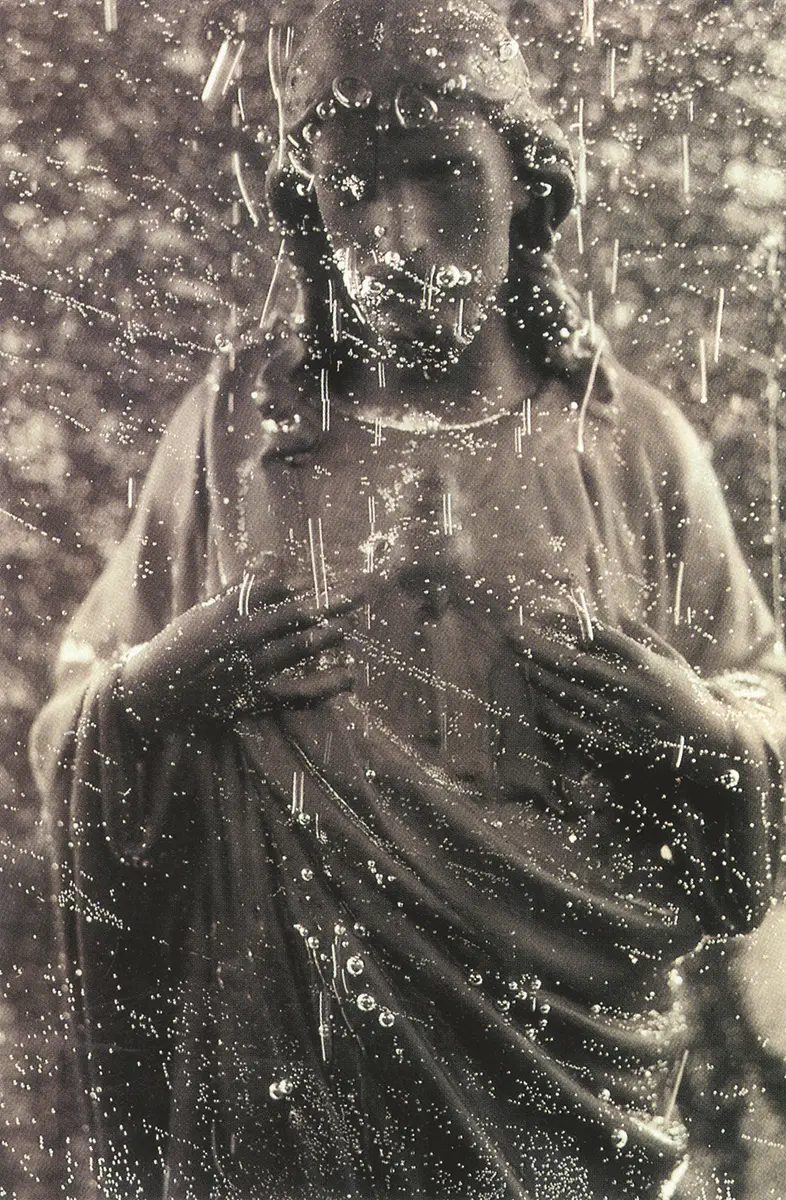
Contemporary artistic and critical practices engaged in issues of visuality, part from concerns with the gaze.6 Spurred by Michel Foucault's work on seeing (voir), and contained ontologically in power (pouvoir) and knowledge (savoir), contemporary artists address the problematic of ocularity outside the confines of mere seeing. In contrast to many of his contemporaries who use other senses as sources of hybridity and formal solutions to ocularcentrism, Serrano questions visuality from within. Serrano does not use photography to engage in text-image relations, and appropriation involving mass media and/or gender based and generated claims to authenticity and uniqueness. The hybridity that Serrano engages in is based on blurring boundaries between painting and photography. From his early staged works influenced by a Buñuel-like theatricality to his recent tableaux vivants in the Budapest series, the illusion painting pretends, along with the truces of memory photography, tends to collapse.
Not content with undermining established boundaries and hierarchies, Serrano has also questioned and shaken the constructs regarding figuration and abstraction. Once more, he does so from a tense and problematic relation involving tradition and innovation. Bruce Ferguson has emphasized that Serrano belongs to a group of artists who are characterized by working "within tradition itself by bridging that false antagonism between figuration and abstraction."7 Robert Storr, too, has located Serrano among a group of artists, "who in one way or another, address themselves to the classic modernist problem of abstraction, making radically simple but objective paintings or nonobjective pictoral surrogates for paintings."8 Drawing from and referring to early modernist abstraction, through using body fluids as subjects and materials, Serrano evokes diverse fields of sensations as well as calls attention to their charged figural content as such.
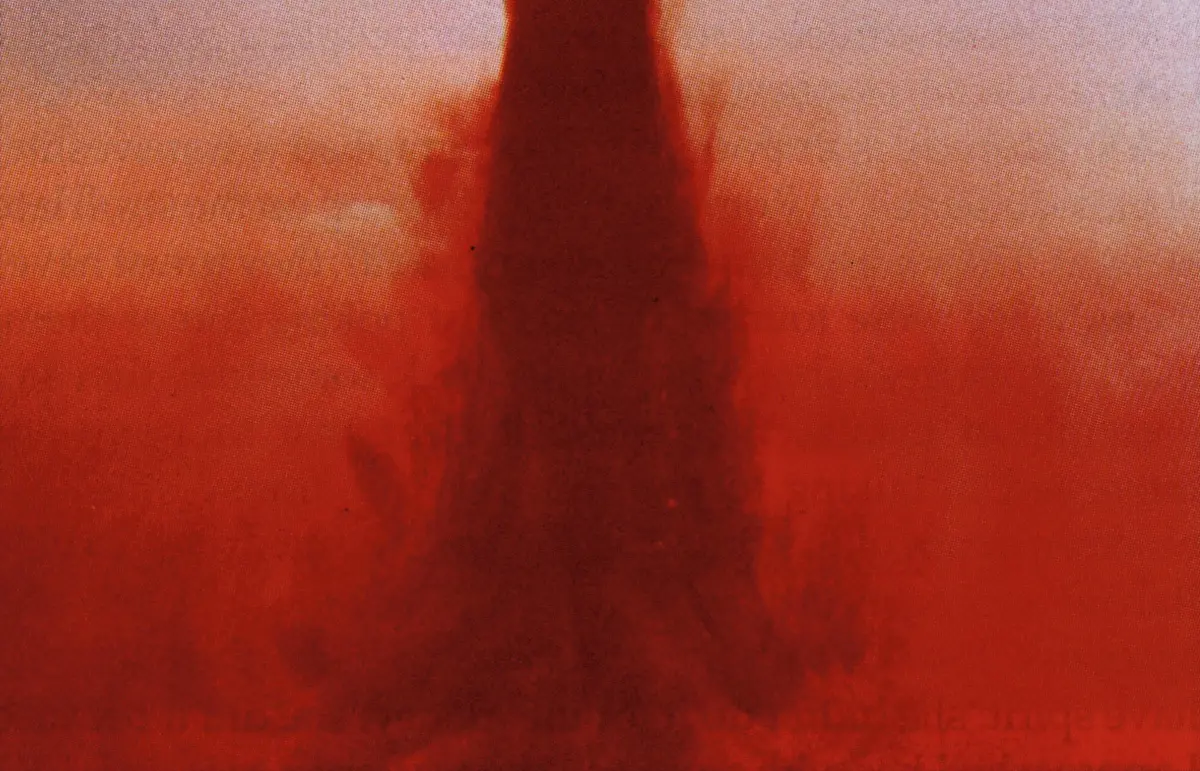
Serrano reiterates shifting balances between materiality and spirituality, and between the body and the soul. Regarding his immersion series, Amelia Arenas has observed that, "The sight of the body fluids disturbs us because it threatens the fantasy of our self-containment and corporeal stability. By reminding us of our body orifices, it makes us seem permeable, literally, likely to lose ourselves."9 Similar visceral reactions are triggered, also revolving around memory, by the Morgue series. Through direct titles, Serrano addresses the viewers and gives death a social referentiality. Vanitas, memento, and social being fuse: death is both a natural and social act as well as a process. Through transgression and celebration of the body, conceived as a historical and cultural site, Serrano inscribes himself in a somatic discourse loaded with signification of difference.
Serrano belongs to a culture of survival and resistance where the dynamics of self-representation are not only aesthetic choices and stances. To be sure, self-representation involves the fashioning of identity as an exercise and process to create others as well as qualitatively different forms of signification. To continue to only situate an artist and his/her practices, though they may stem from difference and produce it, solely in terms of identity, is once more to (re)produce reification. Yet to forget the origin, location, and movement of an artist and his/her culture, especially one marked by its translational and transnational character, affirms once more operative ethnocentricity from which neither modernism nor current constructions of postmodernism are exempt.10
As Lucy Lippard underlines, "Serrano's work intentionally raises more questions than it answers...Serrano's respect for difference exposes contradictions that cannot and should not be resolved."11 Experience, whether directly anunciated or estranged, depending on his specific project, infuses Serrano's work. Like Baudelaire's flaneur, Serrano wanders about, only doing so in postcolonial spatialities and temporalities, "Sniffing at every risk filled corner for a rhyme/Stumbling over words like cobblestones."12 Utilizing minimal elements and a sense of the baroque admiratio, a rhetorical device to induce astonishment, Serrano examplifies that if the artist and his work do not move, they gather dust.
NOTES
1. Roland Barthes, "That-Has-Been" in Camera Lucida, Richard Howard (trans), (New York: Farrar, Straus and Giroux, 1981), p.76.
2. Bruce Ferguson, "Andrés Serrano: Invisible Power" in Andrés Serrano Body and Soul, Brian Wallis (ed.), (New York: Takarajima Books, 1995), unpag.
3. Andrés Serrano: works 1983-1993, exhibition catalogue, Patrick T. Murphy, curator, Institute of Contemporary Art, University of Pennsylvania, Philadelphia. The exhibition itinerary includes: The New Museum of Contemporary Art, New York City, Center for Fine Arts, Miami; Contemporary Art Museum, Houston; and Museum of Contemporary Art, Chicago. The catalogue published for the occasion includes essays by Wendy Steiner, Robert Hobbs, and Marcia Tucker.
4. Walter Benjamin, "The Work of Art in the Age of Mechanical Reproduction" in Illuminations. Hannah Arendt (ed.), Harry Zohn (trans.), (New York: Schoken Books, 1973).
5. Douglas Crimp, "The Photographic Activity of Postmodernism" in Postmodernism: A Reader, Thomas Docherty (ed.), (New York: Columbia University Press, 1993), pp. 172-179.
6. See Hal Foster (ed.), Vision and Visuality, Dia Foundation Discussions in Contemporary Culture Number 2. (Seattle: Bay Press, 1980); Jonathan Crary, Techniques of the Observer, (Cambridge: The MIT Press, 1991); and Martin Jay, Downcast Eyes, (Berkeley and Los Angeles: The University of California Press, 1994).
7. Bruce Ferguson, "Paradoxical Images," Abstraction in Question, Exhibition Catalogue, (Sarasota: The John and Mable Ringling Museum of Art, 1989), p.28. Among the pertinent examples of artists that Bruce Ferguson lists as engaged in this vein of work are: Rosemarie Trockel, Wallace and Donohue, Haim Steinbach, Ross Bluckner, Christopher Wool, Diana Formisano, Judy Pfaff, and Annette Lemieux.
8. Robert Storr, The Devil on the Stairs: Looking Back at the Eighties Exhibition Catalogue, (Philadelphia: Institute of Contemporary Art, University of Pennsylvania, 1991) p.21. Robert Storr includes Andrés Serrano along with Brice Marden, Allan McCollum, Robert Ryman, and Sherrie Levine as a subgroup within the exhibition he curated.
9. Amelia Arenas, "The Revelations of Andrés Serrano" in Andrés Serrano Body and Soul, op. cit.
10. See selected papers of the International Conference, Artistic and Cultural Identity in Latin America, in particular those presented by Gerardo Mosquera, Mari Carmen Ramírez, and Nelly Richards in American Visions/Visiones Americanas, M.J. Jacobs, Mosquita, and N. Tomassi (eds.), (Saint Paul: American Council for the Arts, 1994).
11. Lucy R. Lippard, "Andrés Serrano: The Spirit and the Letter" in Art in America, (April 1990): p.245.
12. Charles Baudelaire, Flairant dans los coins les hasards de la rime/Trebuchant surles mots commes surles pavés, Le Soleil, in the section, Tableaux Parisiens, Le Fleurs du Mal.
VÍCTOR ZAMUDIO TAYLOR
Ph. D. candidate at Princeton University, is an independent art critic who lectures at the Museum of Modern Art, New York. As of January 1996, he will teach Latino-American Art at the University of Texas at Austin.