
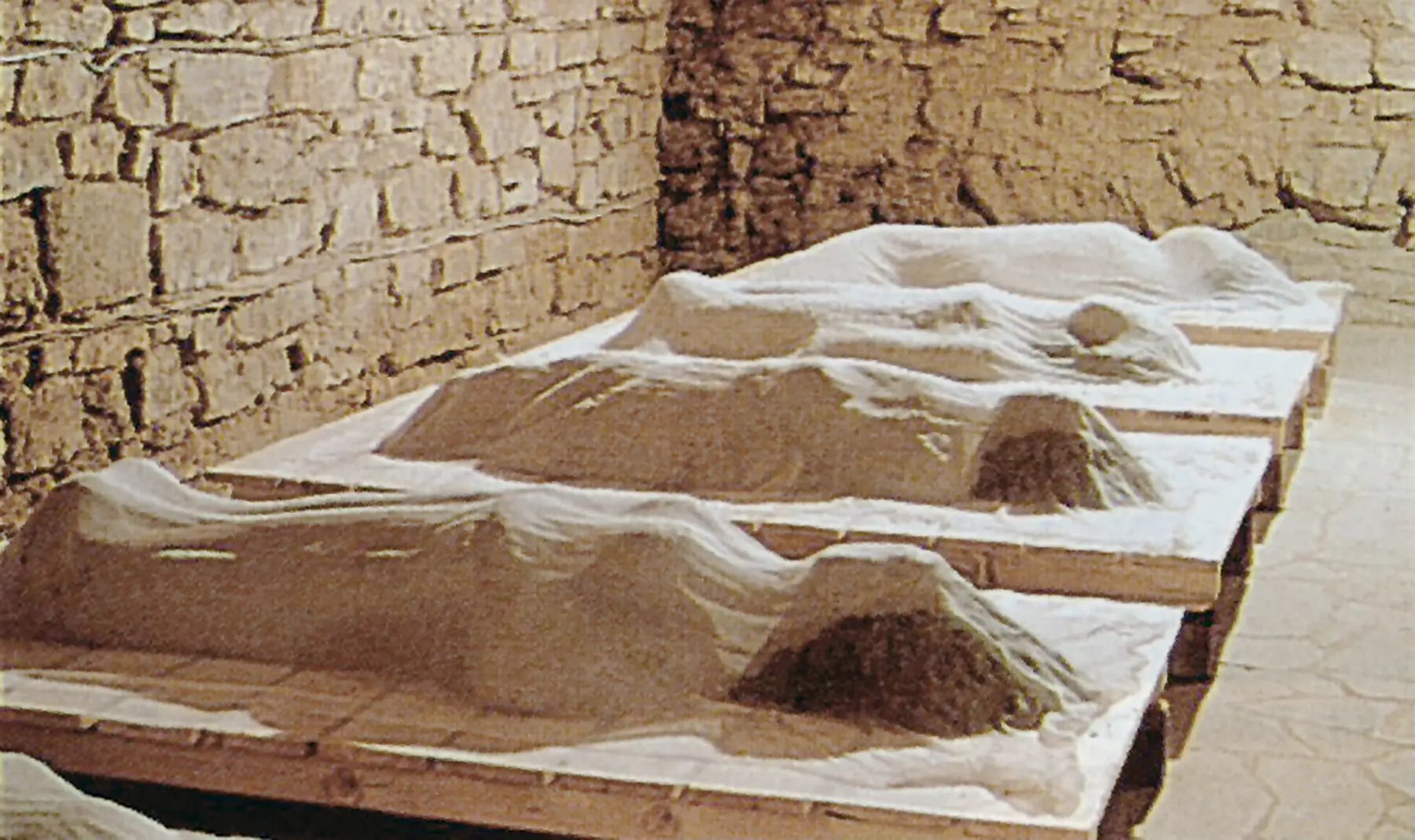
Erfurt is situated approximately in the middle of Germany. It is the capital of the state of Thuringia, which was part of the GDR prior to reunification. From 1974, it began to organize a Quadri-annual exhibition of manual arts of the socialist countries. When these exhibitions disappeared, the structure of the Configura Project was used to develop an exhibition format in 1990 based on a new concept of art. Continuing the four-year rhythm, a major international exhibition has just been organized, with other experimental and unconventional shows being presented in the intervening period.
Breaking with all kinds of limitations was part of the underlying concept of Configura 2. The first major exhibition in 1991, Configura 1, convened participants from 22 countries of Europe and Cuba (a final act of courtesy to the permanent guest of the four previous quadri-annuals), in an event centering on the theme "of artistic creation at the limit between manual arts and free arts." The show was still a matter of East-West exchange in Europe. Configura 2, on the other hand, was based on a much broader concept. Between June 10 and September 10, 1995,160 works from 135 artists from nine countries were presented (Egypt, Brazil, China, India, Greece, Mexico, Nigeria, Russia, and the United States). In addition, 450 daily objects were on show, 50 from each country, highlighting the idea of centers of cultural currents and civilization processes. Indeed, the interest of the artistic directors, Peter Moller and Detlef Pilz, was to avoid the limitations of current Western exhibition practice centered on the United States and Europe, and to propose a "dialogue of cultures" in fully equal conditions. However, by announcing that their goal was to present an international exhibition which would rank with the Kassel documenta or the Venice Biennial, they succumbed from the outset to an illusion. It is practically impossible, from a peripheral position and on the basis of the concepts used, to achieve a level of recognition similar to that of the established institutions within the framework of an artistic circuit still based on the hierarchy of the West. Even so, better use could have been made of the existing mechanisms to make Configura 2 an event of major importance. In this sense, the organizers wasted a valuable opportunity.
The exhibition certainly merited greater attention. With the assistance of the co-curators, the show not only gathered together a set of interesting works but also achieved an unusual presentation of art in the context of the thematic organization governing its conceptual structure. Each module was placed in a different exhibition area, all very close to the medieval center of the city, which gave a special atmosphere and unforgettable appearance to Configura 2.
At various points in the city, temporary structures were built with large, but not completely closed, windows. In each of these, an artist from each of the participating countries presented an altar of cultures. The Mexican Felipe Ehrenberg proposed an installation which referred to Tzompantli, consisting of wooden rods with the skulls of dead fighters, which were hung in the sacred places of the Mexicas. In the "altar" by Antonio Dias from Brazil, entitled All the Colors of Man, penis-shaped receptacles made of Thuringia glass were filled with gold lamina, water, pigments, and wine.
The section on Assured Values was presented in the Gallerie am Fischmarkt, a reconstructed Renaissance-style house
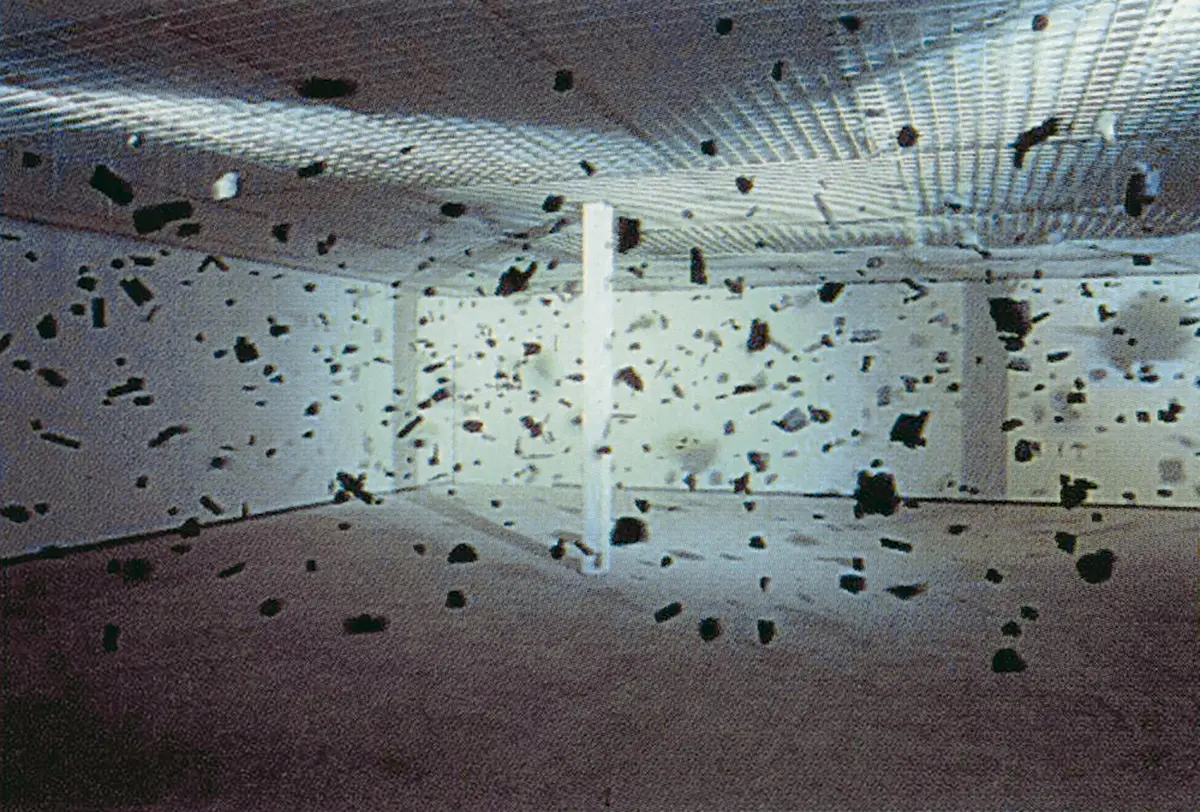
and the focal point of the exhibitions. Here, the artistic directors wanted to present values that were generally accepted by all and which had helped define the various cultures. The Brazilian Antonio Manuel da Silva Oliveira presented the most convincing work in this segment, an installation entitled Oh Phanton, consisting of around 900 pieces of coal hanging from the ceiling and a photograph of the "Phanton," which the visitor reached after passing through the pieces of coal. The work created an indefinite sensation halfway between statis and movement, power and lightness. The Mexican contribution consisted of photographs by Lourdes Grobet and a drawing by Naum Zenil referring to the presence of masks in Mexican culture and in the day-to-day life of the country.
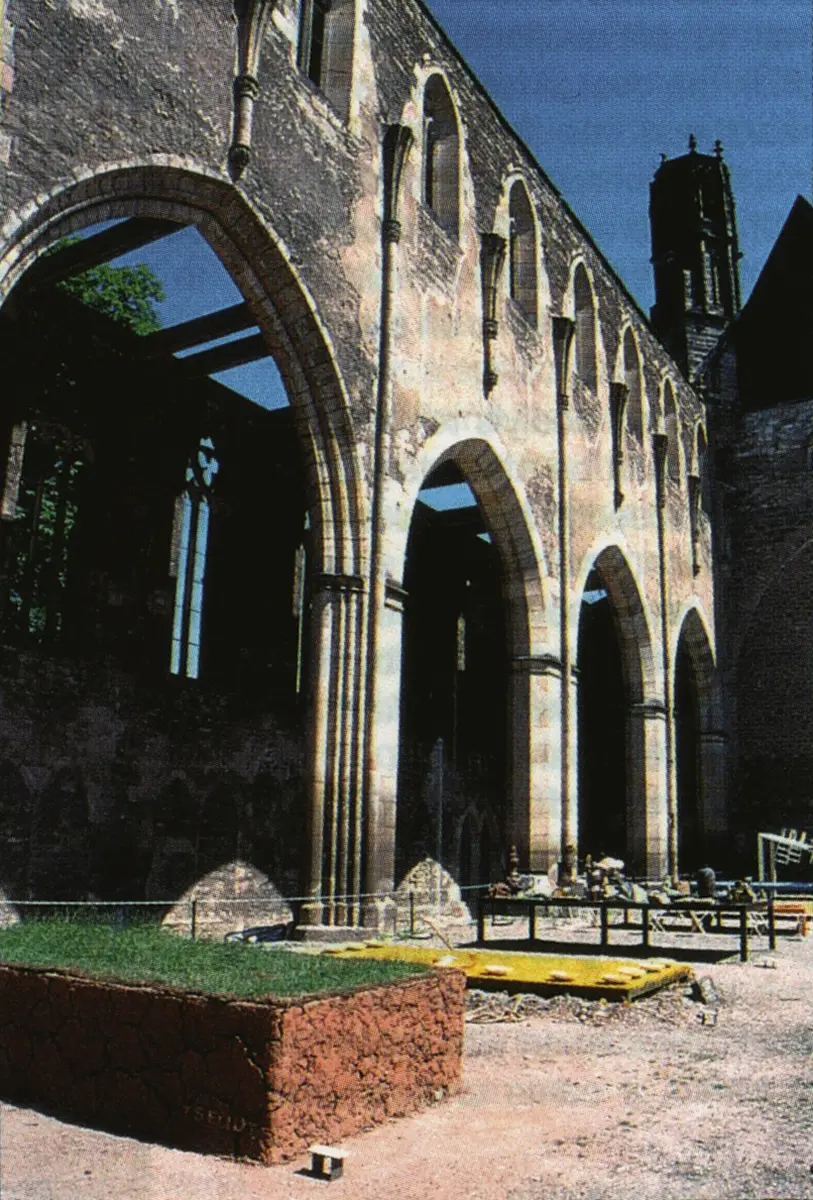
Another section was entitled The Covered Table. In the ruins of a church which offered an open-air setting, nine works explored the idea of the table as a place that linked together the ideas of eating, drinking, and communication. The Mexican artist resident in Milan, Raymundo Sesma, made an interpretation of the table of the Last Supper, which was about to be buried. It was an evocation of the collapse of cohabitation and community feeling between men characteristic of contemporary society, increasingly bent on rational and utilitarian values. Cecilia de Medeiros, a Brazilian artist resident in Cologne, constructed a "table" with mud and grass, creating the impression of a piece of raised earth. The idea referred back to a quotation from T.S. Eliot, to the effect that whatever we set out to seek, we always find ourselves back at our starting point, the still turning point.
The most impressive exhibition area of Configura 2 was in the Felsenkeller in the Cathedral Square. At the foot of the hill on which the Gothic Cathedral and the Severus Church form an impressive whole, a flight of steps leads up to a double dome with an intensely dramatic atmosphere. It was here that a number of sculptures, objects, installations, and videos presented "the image of man" in various ways. There was a long corridor with large niches, forming lateral chapels, in each of which a work was presented; although some of the pieces succumbed to the imposing setting, most were works with considerable strength of expression. They included pieces by the Brazilians Famese Andrade Neto, Jorge Barrao, and Betty Leirner; Mexico was represented by the torsos of Mónica Castillo, sculptures by Sergio Hernández, Manuel Marín, Adolfo Riestra, and Reinaldo Velásquez. Germán Vanega presented a large wooden relief, and Marta Palau showed masks done in amate paper.
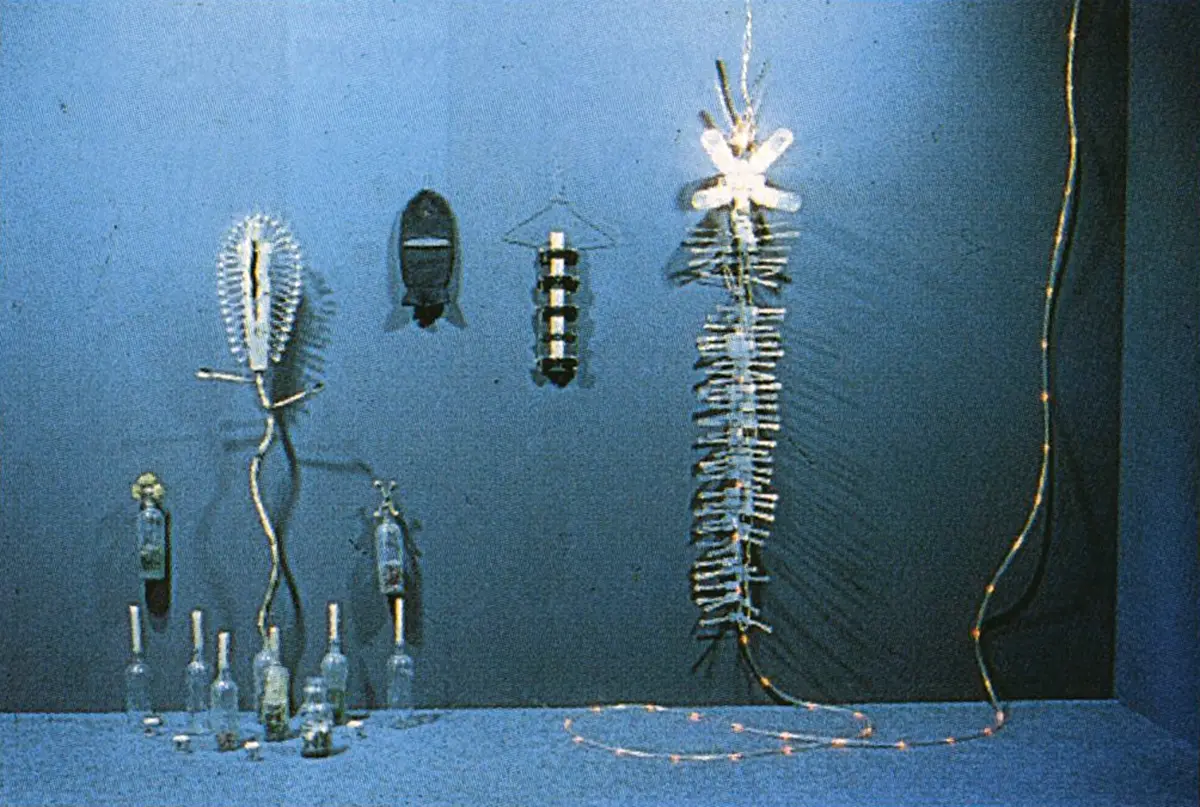
Another spectacular sight was the house Zum güldenen Krönbachken, whose history dates back to the twelfth century. A large patio grouped together several structures, which included a part of the show entitled The Magic of Things. It consisted of ready-mades, sculptures, installations, and other three-dimensional works that used everyday objects or their functions, which were reflected or at least suggested in artistic terms. The idea behind this section was to show to what extent nowadays communication is achieved through objects. There were approximately one hundred works in this part, including pieces by the Brazilian artists Famese Andrade Neto, Cecilia de Medeiros, Alex Heming, Betty Leirner, Cristina Maria Pape, Lygia Pape, and Luciano Vinhosa Simão, as well as by the Mexicans Eduardo Abaroa, Mónica Castillo, Abraham Cruzvillegas, Helen Escobedo, Humberto del Olmo, Damián Ortega, Marta Palau, Néstor Quiñones, Sofía Taboas, Eloy Tarcisio, and Francisco Toledo.
Configura 2 had something very special to offer in its final part, entitled Signs of Life. In the Anger Museum, amid gothic sculptures in the Fayense room and in the rococo space, 50 objects from everyday life from nine countries were placed on equal pedestals. The objects belonged to persons and families of different social origins. In most cases, there was a short text on the owner, explaining why the object had been selected and what meaning it had in the person's everyday life. In this way, the exhibition offered a mosaic of genuine testimonies about the concepts and forms of life of the different cultural communities.
GERHARD HAUPT
German art critic, resident in Berlin.