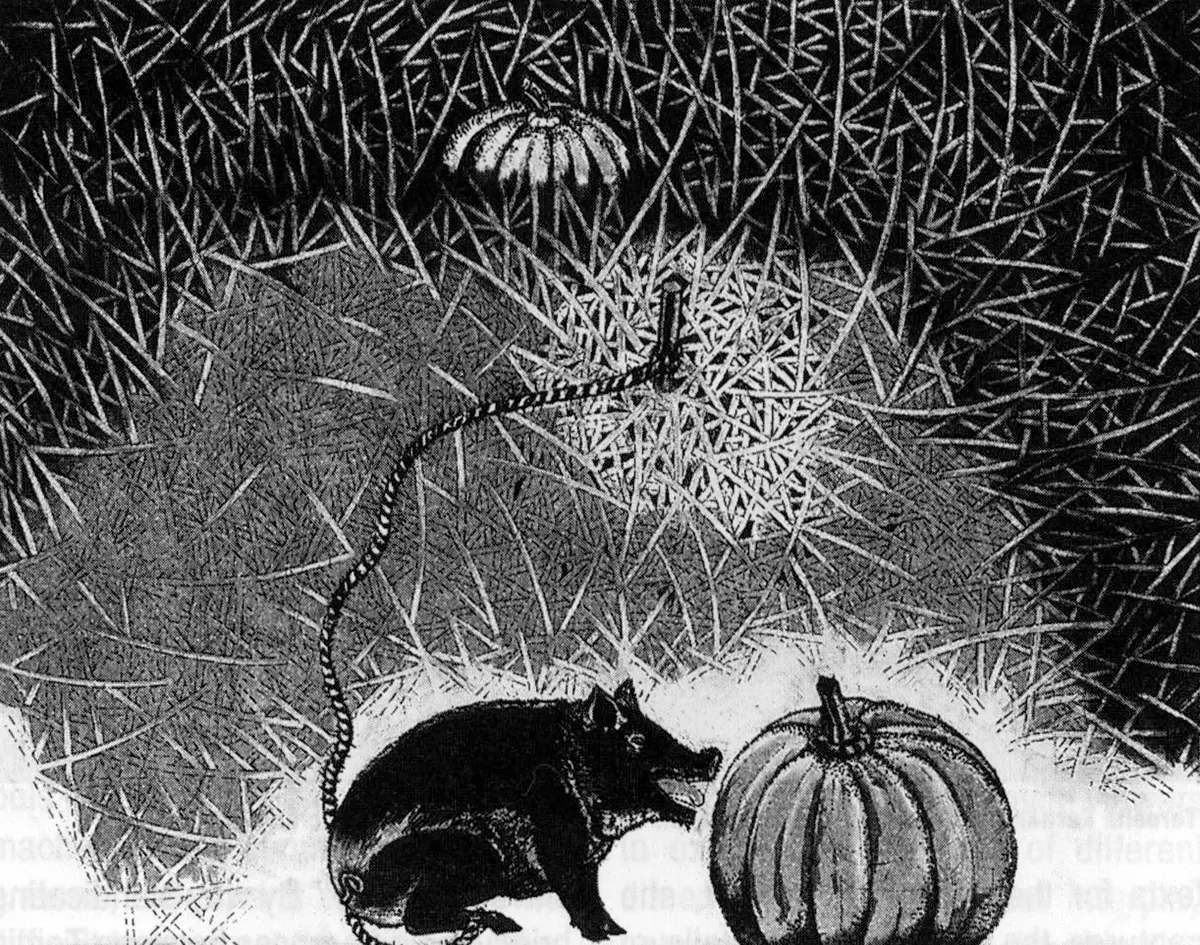
Intimacy, pleasure, fantasy, boldness, freedom, professional respect, love of his fellow beings, of animals and nature, in general, are some of the words that might be used to describe the strengths of this exhibition by Francisco Toledo in New York in the first half of this year. The retrospective show of graphic work by this universal artist born in Oaxaca, Mexico, in 1940, was presented at a gallery renowned for its serious interest in modern classic works. Associated Artists had been planning the show for some time and the decision to concentrate on the artist’s graphic works reflects two special facets: Toledo’s devotion to the various techniques of this medium and secondly, given the artist’s enormous production (which also includes painting, sculpture, objects, drawing as well as prints), the impossibility for one gallery to cover more than one area of production.
Before discussing his creativity, it would be advisable to mention the wide range of identities that make up this rich country with its Mixteca, Maya, and Zapoteca (and other) traditions. Using such sources, Toledo has remained independent of aesthetic and commercial modes and fashions, although he has never tried to free himself from his ancestors or relinquish his interest in experimenting with materials that allow him to respect his traditions. In addition to creating marvellous things with his work, Toledo is a savage thinker, both vital and lethargic, now baroque and now bordering on the conceptual. The various facets of this work - in terms of literature, art, and dance, at various degrees of intensity - highlight the link between that work and its creator. Toledo has a deep interest in education and sharing, in making many options accessible, including those of an artistic and historical nature. Undoubtedly, this is why he attaches so much importance to the advances made in the printmaking sphere. Such a lesson is important in a city like New York, which, despite all the hype about Equal Opportunity Employment, has disregarded any of its intrinsic responsibilities. Toledo’s graphic work is extremely rich in its creative use of symbolism and its historical and metaphorical sources.
Before turning to the exhibition itself, I would like to make one or two remarks about Toledo’s work in general. This work is not the result of any use of ancestral sources, but is an individual spring which must be interpreted as such. "Both in art and science, we find the same desire to advance towards the truth. But this truth in artistic experience is not the same as that of positivist epistemology. The metaphorical reference is a twofold one which can encompass a second meaning, over and above the literal meaning."1 I would add that the scope of metaphor is more than twofold and can encompass many different meanings. As Paul Ricoeur has said, the problem is precisely that of knowing whether poetic language aheads light at a pre-scientific, antepredicativs level, in which the very notions of fact, object, reality, and truth as determined by positivist epistemology are called into question through the ambiguity of the literal reference. In the works of Toledo, such a process occurs naturally and without any affection.
There was no sense of artifice in the selection of works presented at this show, because there is no such artifice in the works themselves. Each work establishes a set of inner relationships between the earth, air, water, and history. Of the almost 50 works on show, special mention must be made of those in which religion is particularly evident, as well as those very sensual works highlighting the living forms of nature. Christ and Drum, both from 1981, are examples of Mexican reality. The indigenous mythology combined with Catholic ritual resulted in a symbiosis that is a profound testimony of the everyday religious faith of the Mexican people. Contemporary art is nurtured through the affirmations and negations of the severely religious education that all Mexican children have received, almost up to the present. However, any sense of artistic clash with these Christian principles is rarely found in artists of Toledo’s age and is more characteristic of the following two generations. In the small marvellous works produced in editions of 25, the sins are accompanied by the sounds of the drum; the faithful burn without pain and open up umbrellas to prevent the blood of the crucified figure from extinguishing the fire of the sins. Descriptiveness is a characteristic of people with strong beliefs, and there are some very detailed descriptive passages in Toledo’s work. But there are also others that are much starker and more sober. The baroque element is by addition or subtraction, but in both cases the baroque subsists, in the tragedy and action, in the concentric lines and diagonals, in the fractured frames and the appearance of life and death (symbolized by the infinitely repeated human sexes). The metaphors also exert an economic effect of suggestion, limiting the place of direct statement. Nothing is disregarded, and what counts is not the technique or materials used, but the sense of authenticity and creative honesty - what the work can communicate today, which Toledo achieves, is the same as that which distinguished his ancestors, since there is no greater modernity than that of the latter.
The Goat (1969) and His Cart (1970) illustrate Toledo's early period of work. In the first, there are areas full of caves and doorways which evoke the combination of past and present, and the second highlights the artist’s enormous drawing skills. A catalogue was published, with good text by Dr. Baquedano and Emilio Steinberger, although Toledo deserves a longer study of his graphic work. Since Liza Hagani works with the gallery, it might have been useful to have included a text by her in the catalogue, along the lines of her work on Rufino Tamayo. It is important that a gallery managed by young people, alternate the generation, origins, and techniques of those who exhibit here.
NOTE
1. Elena Oliveras. La metáfora en el arte, Ed. Almagesto. Buenos Aires, 12/1993, pp. 254-255
GRACIELA KARTOFEL