
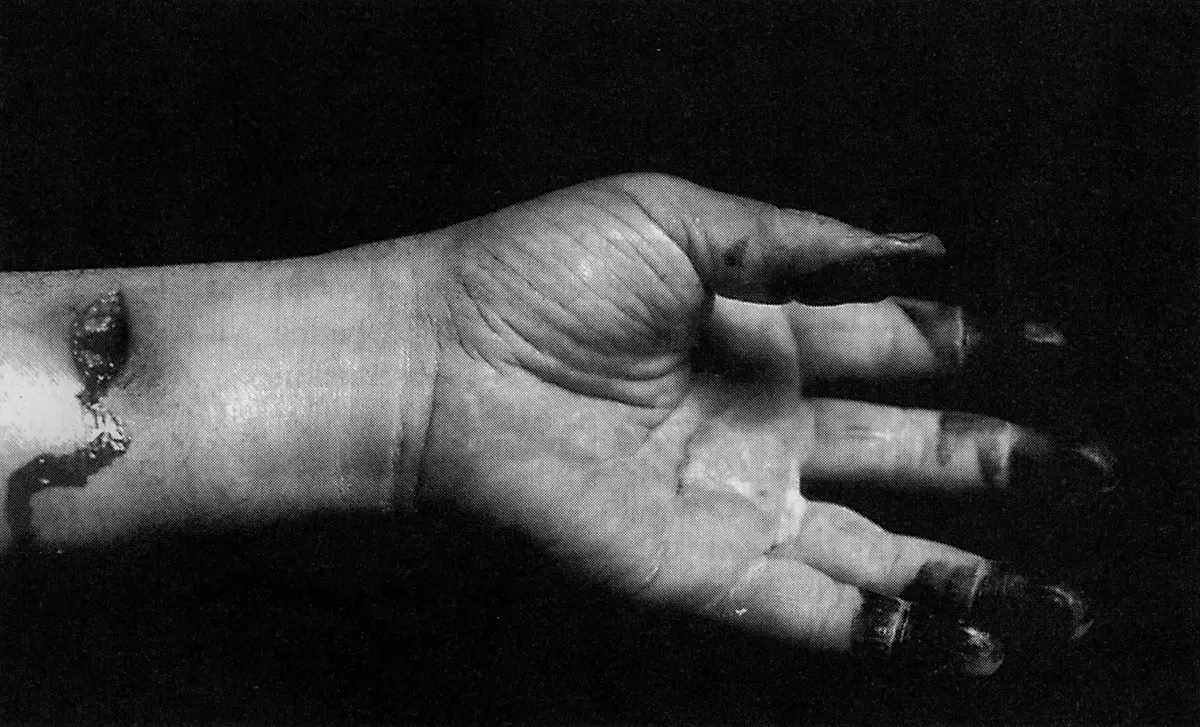
Víctor Zamudio Taylor: Do you always work in a series?
Andrés Serrano: Yes. Nowadays, I do not conceive of one photograph; I have a theme, a general idea. My last show was called Budapest; the only thing that strung those pictures together was the fact that they were all executed in Budapest. The name is magical; it's like Istanbul, it can mean anything, it has all kinds of connotations.
VZT: In the Budapest series (1993), is there not a return to the tableaux vivants?
AS: I noticed when I saw my retrospective that there is a range, but also certainly a connection from one series to another. In a way, I've gone full circle with the Budapest work; it's a tradition I continue with the work in Rome, that is to say, the tableaux vivant. That staging is present in my earliest work, except now the props are real, the people are real, and the landscapes are real, instead of painted backdrops, I have real interiors or real exteriors.
VZT: And instead of having friends like León Golub pose, you have an adolescent, an older lady, a couple...
AS: Yes, non-art types. I hope to be able to explore this (concept) of (working) with different people; people that we don't normally associate with being beautiful or being sexual or erotic even. I am certainly looking for those kinds of people.
VZT: What attracts you to everyday people, a certain attitude, a fierceness, resistance?
AS: Attitude is important. I photographed a transvestite, not a transsexual, in Rome. We picked her up on the stroll late at night. They saw us approach them in a car; they (must have) thought we were tourists or kids just poking fun at them, looking for a freak show; they pulled back, sometimes they say a couple of insults, they make it clear that they are not interested in talking to you. But this one transvestite was nineteen years old, a Brazilian; my friend the driver (who's Italian) approached her, about doing a photo shoot, and she was agreeable. I mean, that's the kind of people I like, the ones who have spirit: she didn't do it for the money, she did it because I approached her with a project, she was open to it.
VZT: Are you looking for a certain kind of «aesthetic,» a "beauty"?
AS: A lot of times I am looking for beauty...certainly there are some people that I feel I cannot photograph well. Looking at that show and looking at the Nomads (1990), the homeless portraits that I did, I thought one thing to myself: I really lit them well. It's important to light people well; it brings out the best in them. I am not in any way a real photographer, at least I don't regard myself as such. I am not a technical wizard, although sometimes some of the criticism that I get against my work is that my work is too pretty, too aesthetic. They (the critics) make it seem like I'm a master and technician, which I'm not.
VZT: You mentioned finding beauty, dignity, fierceness, resistance in personages, characters who, socially, we do not associate with having it. Through your gaze, in the Nomads, you gave them a dignity in the portrait that in «real life» they do not have, or that in real life we don't give them.
AS: I always feel like they have that dignity. I just lit them well and brought them out. All I asked from those people was to look to my left or to my right. Those portraits were specifically inspired by photographs of Edward Curtis and what he did with Native Americans. Although I didn't give my models specific instructions on how to look, only where to look, it's uncanny how they have the same feeling that the Curtis portraits do, dignity and elegance. That's something they had all along (the sitters), it's just that I was able to focus on it.
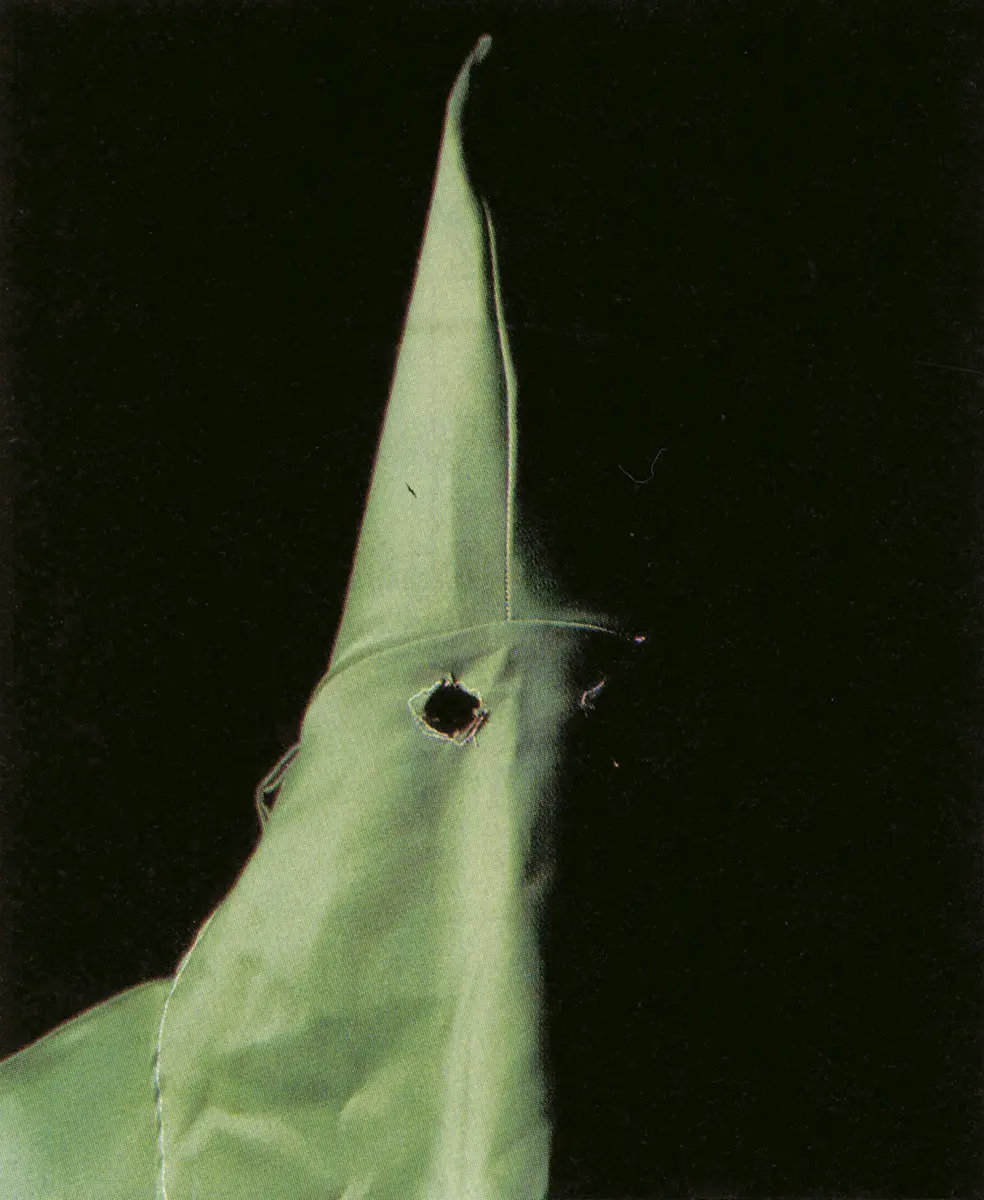
VZT: I remember the opening of the Nomads series; in the exhibition, there was also the Klansman (1990) series on the other side of the gallery space, which was disturbing for lots of us; why did you show them together?
AS: After I did the Nomads series, I decided that I wanted to continue to do portraits. I wanted them to be unusual. I immediately thought about masks; this is sort of like going against the grain of portraiture. A portrait is supposed to be some sort of signifier for individuality; it (should) bring out a person's character. If you are masked, hiding behind a mask, that's going against what the portrait is all about. So when I thought of masked people, I thought of the Klan. Given who I am racially and culturally, it was to be a challenge for both of us; we had to work together. Showing the Klan, especially the first time by themselves, was a little too problematic, a little too ambiguous. So I felt that the Nomads and the Klansman needed to be shown together for the first time, and (create) a balance. After that, the Klansman and Nomads went their separate ways. One (series) is about extreme prejudice, the other about extreme poverty. As such, they are different sides of the same coin; in both cases, you have people who are outcasts and outsiders in this society.
VZT: For example, your series work with fluids and immersion of religious icons is reminiscent of Spanish Baroque Art: the ecstasy of pain and martyrdom, profane and sacred love, of a sensualized and heightened spirituality, what do you think?
AS: People can certainly read those things into it. I almost feel like I've taken in a lot over the years, a lot of art, a lot of art history, and looked at a lot of photography. At this point, it doesn't matter to me to make direct references. When I want to do something relating to or making reference to a Renaissance painting, I don't go looking for a specific painting to mimic. I mean, certain parts of it fit more in that classification than others. It's the same (regarding my cultural identity), some people see it as Lucy Lippard did, in an excellent article that she wrote years ago. When people try to see some ethnicity in the work, which I don't have a problem with, it's not something that I (directly) expound on myself.
VZT: In your work, the symbols are not necessarily attached to one meaning; they free-float around; you bring in references, and all of a sudden, like liquid ice, they just flow right out of you. One can surface, identify, and right as one begins to close in on meaning, it slips right under you.
AS: I like that metaphor.
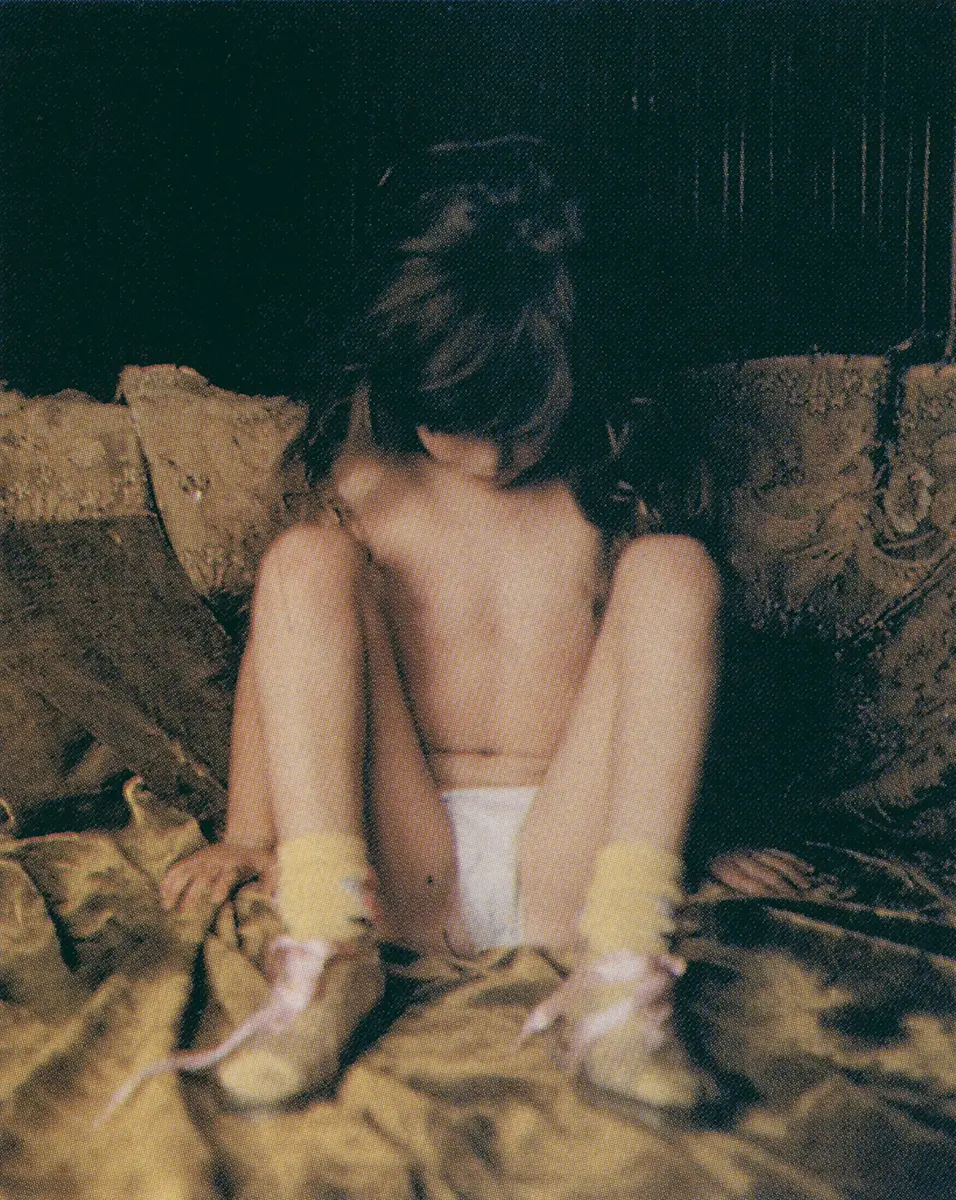
VZT: Let's talk about your Church (1991) series.
AS: My Church series took place in France, Spain, and Italy, the big three Catholic countries. I shot mostly churches in Paris, but also Madrid, Torino, Rome, and even Florence. I made a point of going to about ten European cities.
VZT: You were scouting for churches?
AS: Yes. All the time. And also for the people who inhabit those places: monks, priests, nuns.
VZT: For the Reaffirming Spirituality (1995) show at El Museo del Barrio (New York City), I wrote that you were like an explorer, an ethnographer, or in more literary as well as urban terms, like Baudelaire's flaneur, wandering and looking around, bumping into sites.
AS: Yes. Well, that's certainly me, I'm always wandering and looking. When asked by people, 'Why photograph this or that?' I think, 'well, because I'm curious,' other people are curious too, they want to see. I want to see for myself. Sometimes, I want to see situations that exist in real life, and sometimes I want to explore ideas in my head, but really, I take photographs because that's the only way I can see them, by taking the photographs and looking.
VZT: Did you grow up wandering around New York City?
AS: I used to walk a lot. I remember walking around New York City 100 blocks at a time at night. I would look at everything: antique stores, clothing stores. I was in my teens. I was just looking. I am always curious.
VZT: Nowadays, many times the label photographer is a demeaning one versus the sometimes reverent classification, conceptual artist, aestheticism, what that may mean, usually is a pejorative term. What do you think, given the conceptual nature of your work and your insistence on beauty?
AS: Yes, it almost reminds you of the South, when they refer to a Black man as a good boy, it's like a compliment, but it is actually the opposite; definitely, I have had a lot of negative reactions to my work, I wish I would get more supportive comments. (Yet) I have always said that the work is always open to interpretation. I have to let go of it, like they say, if you can't take the heat, get out of the kitchen. I certainly have proved to myself over and over that I can take the heat from a number of people.
VZT: What struck me in your ten-year survey is the internal logic to your work. Looking back at your work, leaving sensationalism aside, from the tableaux vivants to working with body liquids, in an abstract manner, then lacing and immersing symbolic figures in them, there's a logic and an aesthetic strategy, a sense of quest...
AS: If by strategy you mean that there was a plan, there was no plan.
VZT: I meant more concerns and formal solutions to them.
AS: Yes, definitely. What struck me was the questions I received: like how it felt to have a mid-career survey, I was asked if I felt funny about it. I look forward to another ten years of work. I am going to see what I can come up with in the next ten years.
VZT: What did you do for Site Santa Fe (1995)?
AS: For Site Santa Fe, at Bruce Ferguson's suggestion, I showed the Nomads paired with Curtis photogravures made of Americans from that area to make a distinct connection with the work I did.
VZT: If the Nomads have references to Curtis, do some of the Church series have photographic references?
AS: No, I can't really say. When I was photographing the Klan, I remember when the Imperial Wizard (who was 83 years old at the time) was putting on his robe. I said to Bobby, his assistant for over forty years, "That robe almost looks like a religious robe." She responded that for some of these people, they are, meaning that some of these people see themselves as ecclesiastical figures. One of the things that attracted me about the Church was also the robes, the costumes; I don't want to say that there is a direct connection between the Church and the Klan.
VZT: There are parallels in the symbols and production of power in the attire, the pomp, and the ritual, the spectacle.
AS: Just like Velásquez and these other painters painted those robes and all clothing so well, my job is to light the folds.
VZT: Lucy Lippard calls attention to the painterly aspects of your work, the light and the lighting.
AS: That's the thing, a couple of people make references to my visual presentation as having some advertising slickness. I dispute that, if anything, there is something more classical, more painterly about the way I approach my aesthetic.
VZT: There's also a hybrid and transgressive element in your work. Bruce Ferguson has noted how you challenge the limits established in the notions and practices of abstraction and figuration. In Milk, Blood (1986), and Blood Cross (1985), that relationship is very uneasy. You undermine the limitations constructed by modernism from within. You also question, at times, blur the borders between painting and photography. What is this hybrid and transgressive impulse all about, this subversion?
AS: Certainly, it is my nature to be subversive, that is to say, you give them what they want and what they don't want. Initially, the fluid pictures were all about abstraction. William Olander, the Senior Curator at the New Museum of Contemporary Art, New York City, was organizing a show called Fake (1987) about fake painting. He came to see me. Even though I had no idea I would be in the show, his visit started me thinking about mimicking painting. I decided, since I was using the fluids so much, why not just concentrate on milk and blood. And so the first image that I made, Milk, Blood, not only refers to geometric painting but specifically to Mondrian, the white and the red. With the fluid pictures initially, abstract and geometric, I was doing something really quite rare in photography; I was flattening out the picture plane, there's no sense of depth nor sense of spatial relations, almost an anti-photography. I was not only mimicking painting but also doing something quite the opposite of what photography aims to be. Even though these were tableaux vivants, the distinction between the prop and the background has been completely subverted; there's a lot of color field in the work.
VZT: Yes, in Bloodscape (1987), the blood appears to have the materiality of paint; another level of subversion concerns abstraction: griding, geometry, and flattening, yet the liquids are precious, nurturing liquids, taboo liquids.
VZT: Exactly, sometimes people see taboos that I don't see. Marcia Tucker told me that when she saw Milk, Blood for the first time, it made her think about the taboo in the Jewish religion regarding the mixing of milk and blood, the same with Blood Stream (1987), where I did, in fact, draw blood into milk, another taboo I had no idea I was doing.
VZT: There's a series of medieval depictions of the Virgin squirting out milk to feed lepers, the marginalized, the outcasts; this portrayal later disappears because of the idea, notion of the spilled milk.
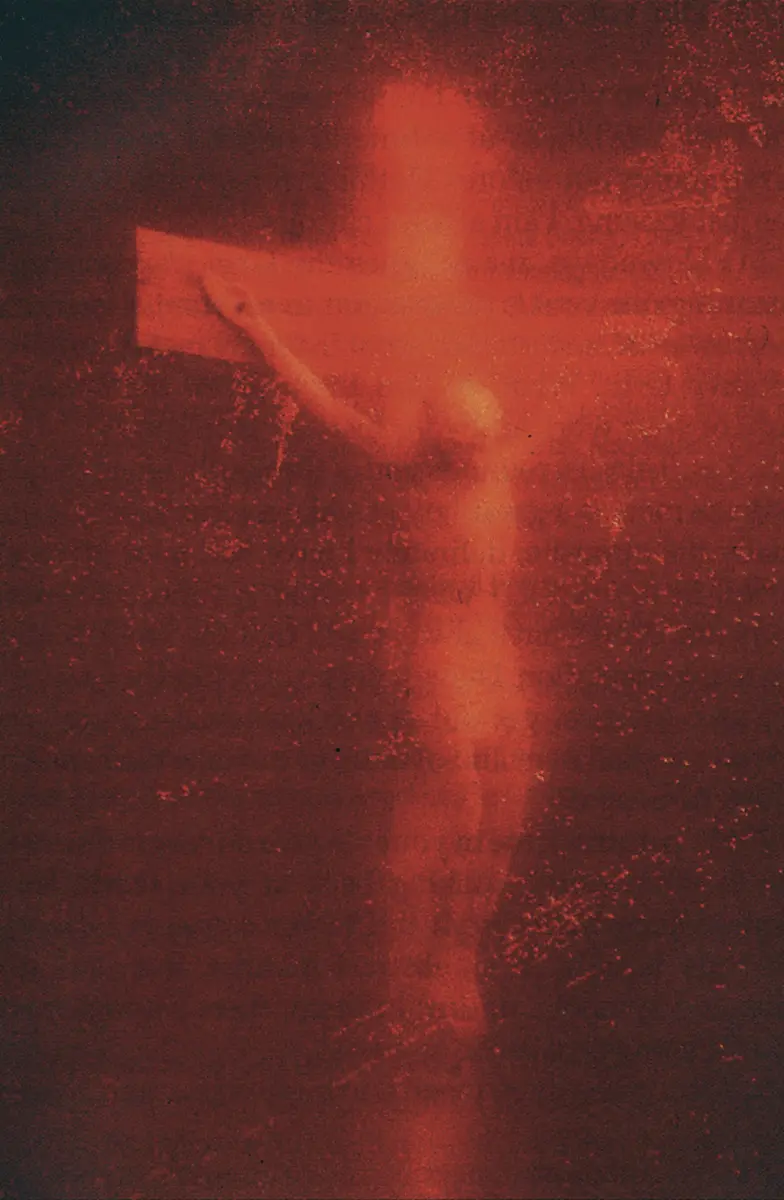
AS: When I was doing the Church pictures, at some point, I tried to get the Cardinal of Paris to pose for me. The Cardinal has converted from Judaism. I had to see his secretary before gaining entry to the Cardinal, and the first thing she said to me was, Why Piss Christ (1987). When I submitted my resume, I didn't say I was the creator of Piss Christ, but these people research you: I had a second meeting with her, and though I never did photograph the Cardinal, at that time she told me two things. Firstly, the Church in France would not want to do anything in contradiction with the position of the Church in the States towards my work. I told her the Church in the States has never denounced me in any way; it was a right-wing fundamentalist (Protestant) group that did. Secondly, "for us—she said—our position is that the Piss pictures don't bother us that much, we have more of a problem with the Ejaculate in Trajectory (1989) works." It's back to the idea of breaking the seed; it seems still to be a strong taboo in Catholicism.
VZT: The Ejaculate in Trajectory series is also a paradox, a shifting work; they appear completely abstract, yet it's semen; if they were not titled, it would leave a lot of room open...
AS: Yes. Because I do work with photographs, even though I don't call myself a photographer, I always like to title the pieces in a way that informs the audience as to what they are looking at.
VZT: It informs the audience and at the same time destabilizes the audience. The specific titles and social references of the Morgue (1992) series are direct and very disquieting. I'm thinking, for example, of such works as Rat Poison Suicide, Hacked to Death II, and Infectious Pneumonia.
AS: I did have people tell me that the clincher was the title; it drove it home. That's all I knew about these people. I never knew them when they were alive, what languages they spoke, what kind of money they had, who their loved ones were; all I knew was the cause of death. First of all, I didn't take the same photographs that they do in the morgue: clinical and detached. I didn't give the works the exact medical definition they do in the morgue, the labeling of cause of death; the causes of death I came up with were subjective and objective at the same time.
VZT: The corpse is dignified; it is not banished; there is a hyper-sensuality in the Morgue series, it's a kind of memento mori, a signifier and reminder of death. The pictures are disturbing, yet so painterly and beautifully lit; one recalls Mantegna's Dead Christ (1466), a very dignified and human depiction, O's also so marvelous with all its green tonalities.
AS: One of the strengths I perceive of my work is that if they were paintings, they wouldn't have the same effect on people. It seems that certain things are more acceptable as paint rather than as photographs. Even if it is set up, it's perceived as real. Some of the criticism that I got with Morgue was exactly that. Many people who are very knowledgeable and intelligent couched their criticism in intellectual terms; the underlying fact was that they were disturbed on an emotional level, they couldn't deal with it, and became hostile.
VZT: Yes, it was said you were being exploitative of the dead.
AS: Yes, so it makes me realize that we try to be very alert, intellectually superior to certain things, but on the other hand, there is no getting around that. Sometimes when things hit you on a guttural level, you might react in a violent way, even if it is in an intellectually violent way.
VZT: The concern for the body in our fin de siecle culture is central: there is another return to subjectivity; the fashioning of the self, which has made us more conscious of the somatic and finitude, along with the distrust in science as well as progress. You really are touching nerves of our cultures and time, you've also found a vein of work in this interest in the body. Through your own experience and cultural identity, the body is both theme and form; it grounds and constructs your visual and aesthetic discourse. You pay attention to the body.
AS: I never thought of myself as doing work about the body. It has only been very recently, maybe as recently as the last two days, that my new work may be about the body. Certainly, the body has been the source of inspiration for contemporary artists for a while now. I do find it, the body, to be a catch-all phrase; there are so many shows about the body. The body is important, the spirit too, but you cannot have the spirit without the body.
The exhibition Andrés Serrano Works 1983- 1993 opened at the University of Pennsylvania Institute of Contemporary Art, Philadelphia, in November 1994. It travelled to the New Museum of Contemporary Art in New York and the Center for the Fine Arts in Miami. Now it can be seen at the Contemporary Art Museum in Houston, or between December 1995 and February 1996, at the Museum of Contemporary Art in Chicago.
VÍCTOR ZAMUDIO-TAYLOR
Ph. D. candidate at Princeton University, is an independent art critic who lectures at the Museum of Modern Art, New York. As of January 1996, he will teach Latino-American Art at the University of Texas at Austin.