
Jaime Palacios held his one-man show at the Carla Stellweg Gallery during the months of April and May. In this most recent series of works by the Chilean artist, Palacios dealt with the question of identity and how it circulates through the body of materials that constitute the art object. Entitled Paper Memory, or Memoria de Papel, this exhibit raises the question of how objects can act as containers for the social and personal conditions that caused their making, providing the viewers with markers of both a personal and a collective memory.
In all of the pieces exhibited, Palacios used combinations of Chinese ink and gouache to draw on sheets of paper. The effect is reminiscent of prints used to illustrate nineteenth-century biological manuals, like the drawings that detail various flora and fauna, such as shells or flowers. The issue of memory is raised through this appropriation of the print-making technique, which is culturally associated with the last century and with a European model of scientific documentation and artistic representation.
That such prints have subsequently been taken out of their manuals and placed into the rarefied spaces of glass frames to be mounted on walls and elevated to the status of an Art Object, suggest a situation where the conditions of aesthetic judgment have been radically revised by the art producing and consuming community, a revision which Palacios is invoking in the pieces of this recent exhibit.
Palacios seems to have taken his cue from the critical discourses which have circulated around two poles, namely the deconstruction of the art object out of a fixed system of materials and meanings, and the sociological critique which applies to him specifically and questions, among other things, the hegemony of a First World aesthetic sensibility over the individual, the local, and the non-European.
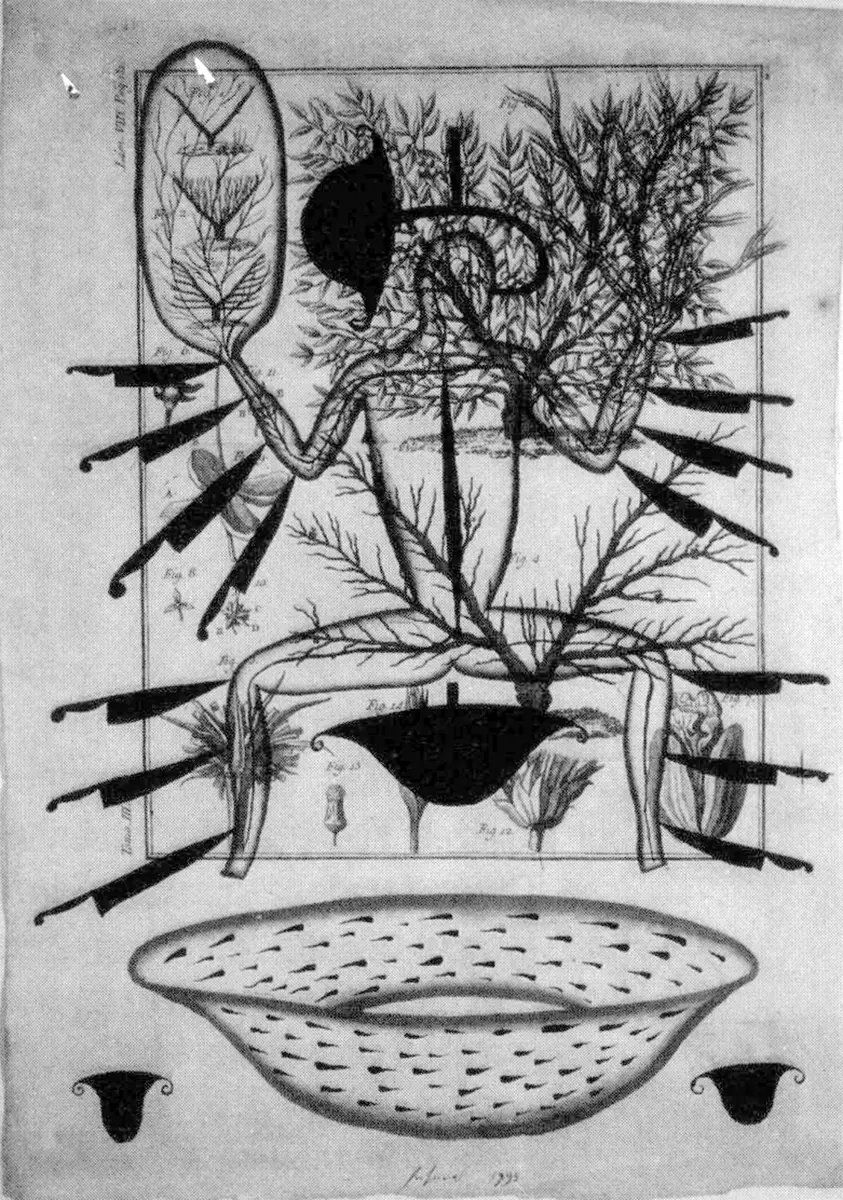
Visually, this exhibit was divided into two main parts: a series of small drawings that lined most of the main gallery walls, and a large-scale installation piece, which was placed directly across from the entrance to the gallery and dominated the tone of the interior of the space. The smaller works, each given titles that suggested they were part of a larger series, are made up of delicately drawn images in an essentially monochromatic palette of black and deep navy blue ink. In Memoria de PapeI SeriesXI, Palacios has drawn, in profile, various biological images of plants and humans: an adult-sized, gender-neutral, human embryo floats suspended below a complex series of roots which transform into veins and arteries; sketched out in a lighter yellow ochre color, and receding into the background of the image as a whole, is a uterus with fallopian tubes, all of which is outlined by a series of droplets of what could be considered to be blood; mixed in with these are shapes, some of which seem unidentifiable and others of which metamorphose into a bowl or an urn form, into a butcher-style knife, or into a string of black birds which fly off the corner of the page. As with all the smaller pieces mounted on the walls, Palacios has worked all of these images over what appears to be the printed page of old scientific manuals portraying flowers shown from both the front and in section. In this particular drawing, each of the elements of this complex image acts as an icon. What is curious about these icons is that while our reading of them is dependent upon a collective memory of how each image signifies meaning, this meaning is destabilized as certain assumptions about what each object actually portrays is dismantled: The human form has no sex, gender, or race; the uterus and fallopian tubes are no longer assigned to a named and gendered person, but significant only in that they evoke productivity and fertility; veins become roots and the human merges with the plant; the abstract, well-ordered text of the scientific manual becomes infiltrated by the disordered specificities of blood, body parts, and the things which make up life in its most visceral sense.
In another piece, Memoria de PapeI Series XII, Palacios has drawn an outline of a human form, this time suspended over a bowl and circled by a series of small black butcher knives, each resting precariously on the surface of the body's form. This image in particular gives a sense of unease, due in large part to the impending threat of the knives so seemingly ready to cut and dismember. Once again, this body is also gender, sex, and race neutral; once again, there is an intermingling of the human with the plant in an attempt to displace what is normatively considered the difference between these species. Here, too, Palacios's drawings are placed over prints from biological manuals, the very manuals produced in the great era of Positivism during which such notions as discipline specificity and scientific empiricism were most elaborately outlined. Palacios's images attempt to transgress boundaries and, to this end, raise the question of borders that define but also separate. Subsequently, of course, the notion of borders infuses our Western culture and articulates all differences: Socio-economic, cultural, racial, etc.
While Palacios's recent works attempt to address some very serious theoretical concerns that have framed the production of art and art discourse for the last several decades, there is an unfortunate effort at locating resolutions in a very essentialist and universalist response. The problem of borders, of limits, of lines drawn between things and people is an issue that has a very specific resonance with an artist like Palacios, who was born in China to Chilean parents who subsequently moved to various countries throughout Central and South America. In fact, Palacios's work is a good example of the kinds of issues raised by critical discussions concerning hegemonic discourses and the relationship of the so-called First World to the so-called Third. As a figure, Palacios himself points up the insufficiency of such an all-encompassing term like Latin American and how truly unrevealing it is when compared to the specific and varied conditions of the individual. But removing all frames of identity and locality is not a solution either. There is the implied suggestion that in the absence of distinctions between species, between genders, between what is personal and what is collective, some righteous place will be found. It is this sort of search for a better place without borders that is, in fact, a subtly veiled argument for Truth, and the belief that a unitary and homogenous space can be found. The implied message of Palacios's works, therefore, ultimately defeats the very effective initial usurpation of images and symbols associated with the powerful.
In Palacios's largest piece, the wall installation, the question of identity was raised in the most unsatisfying way. The piece itself was actually visually powerful because of its large scale and its billowing paper surface, which seemed to breathe in and out as breezes circulated around the room. The installation reached from the floor to the ceiling and was lit from the back in such a way that it had the effect of lighting the room with a somber, yellowish glow, similar to that of candlelight. On the surface of the paper, a large-scale human figure was drawn, off of which were suspended two appendages, one holding a knife and the other a large amoeba-like cell form. Over the rest of the piece, placed at intervals in an almost grid-like fashion, were antique postcards and dumps of hair, all attached to the surface of the paper. Finally, mediating between the worked surface and the room was another strip of paper which covered the whole of the piece like a layer of skin, sealing and protecting, but also see-through and vulnerable. On the floor, at the edge where paper and wood meet, a row of bowls was placed, each painted black and filled with water so that they reflected the light of the piece on the wall. The body drawn on the paper presided over the room like the Ur-Human: without race, culture, or gender, but idealized and powerful nevertheless. The postcards each depict a European town or city and alternately come in and out of focus as the outer layer of paper presses close to the worked surface.
The role of Europe as a structuring and very limiting element within world history is raised as it pertains to the human individual. But Palacios's understanding of how the individual is formed is limited exclusively to a suggestion that identity and selfhood are the products of culture, specifically a colonial and imperialist culture. This piece, and in the same sense the others within the exhibit, do not allow for the possibility of redefining the power structure at a level of the local or the personal that is potentially meaningful. Ultimately, Palacios's critique does not work. It attempts to frame the question of identity and the role of cultural and biological memory within terms that are too all-encompassing, replacing once again the individual story with the meta-narrative.
ALESSANDRA W. GOULDNER