
This exhibition, entitled Round Things, at the Museum of Art in Fort Lauderdale, provided an opportunity to visualize for the first time the analytical process governing José Bedia’s creative process. Through objects from his personal collection, from Africa, Asia, North and South America, as well as works done by him, the artist revealed his own world to the public. It was not just an attempt to show the ethnographical side of his work, an influence which is obvious, but rather to document, with precise and simple examples, the transculturalization process resulting from his approximation to, and in some cases cohabitation with, different indigenous cultures.
The circle was the guiding image of the show, the original idea on which this new project was based. His preference for rounded forms is not fortuitous when we consider the magical, religious, and/or shamanistic nature of the different objects with which Bedia lives and from which, as he says, he is always learning something new. The selection of objects in the show highlighted not only the curatorial skill of the artist but his deep knowledge of the arts and religions of the various cultures depicted.
The journey begins with a vessel for beer from the Bamana culture (Bali), followed by three drums used by the Tahumaras in the Sierra Madre (Mexico), and a Bamileke mask (Cameroon), which personifies an elephant. All these objects have in their original context a ceremonial function, and each of them is integrated into Bedia’s mystical world, in that they inspire and are combined with works created by him. The adjacent gallery contained a vessel for incense from the Lacandon culture (Mexico), a Huichol shaman’s hat from the Sierra de Nayarit (Mexico), a tomb slab from Nigeria, a Ticuna basket from Brazil, and a Naskapi shaman’s rattle (Canada). Here, the objects are used in everyday activities. They are ordinary objects which, as Bedia rightly points out in one of his inscriptions, show a fine sense of design and functionality, in addition to being beautiful in their own right.
The same is true of a series of receptacles created by Bedia and presented for the first time in this exhibition. They consisted of six glazed ceramic works, which the artist gave to his wife Leonor in 1994. The first has a flattened body and narrow neck, painted in blue and black, and illustrates the Yemaya legend. The second, The Warning, describes through black figures on a white background the story of a bird that warns a female bear and her cub of the proximity of a hunter. Four Winds is a plate with symbolic references to the kicongo god Nkuyo (Zaire, Congo, and Angola), responsible for controlling the cardinal points. He Who Sows Corn is a receptacle with a yellow bottom and black figures which illustrate a popular adage. From the narrative point of view, the most complex was an amphora without a neck, entitled Give him Tobacco. It shows two figures separated by two trees: the first figure is a man, with stag antlers, who seems to be smoking a pipe and holding a receptacle and a nganga. The second figure is a turtle, symbolizing Nkuyo, and seems to be holding a machete and smoking tobacco. The final ceramic piece shows a man with horns grasping a knife and broken chains. As in all of Bedia’s works, the symbolism is extremely complex and difficult to interpret unless the multiple referents are known in advance. Bedia rightly points out that the exhibition casts light on the origin of his work, but that the key which explains his work’s function remains a secret, and the “message” continues to be impenetrable.
In addition to the ceramic works, Bedia presented a three-dimensional piece entitled Get Yourself a Good Pair of Blue Ears (1995), two small-format acrylic works on rounded canvas (1994), and a drawing on amate paper entitled Tell Her that I am Thinking About Her (1994). The first illustrates a Latin American song and an Aztec myth. Bedia uses a rounded canvas, which is painted black and decorated with lines that may be influenced by the designs of the baskets and ceramic works of his collection. The main figure is crowned with two rabbit ears, with ribbons hanging down, and in the center of the canvas, there is a circle in which a man is telling the rabbit to be quiet. The drawing shows a pensive figure, surrounded by a series of symbols which include a car, a nganga with stag antlers, and a plane with a dog on top.
Opposite two Amarros shields (Ethiopia), a plaque from the Ifugao culture (Philippines), and a handsome Caribo receptacle (Peru), there was an amate work entitled High Season Outing (1995), dominated by the image of a rubber tire, framed by two figures and surrounded by a number of symbols which include a couple of oars, a machete, a bag of purchases, a boat, a moon, a sun, and a skull. It is not difficult to interpret the work as referring to the problems of the boat people and immigration. However, as in all of Bedia’s works, the true message lies hidden in the symbolism itself.
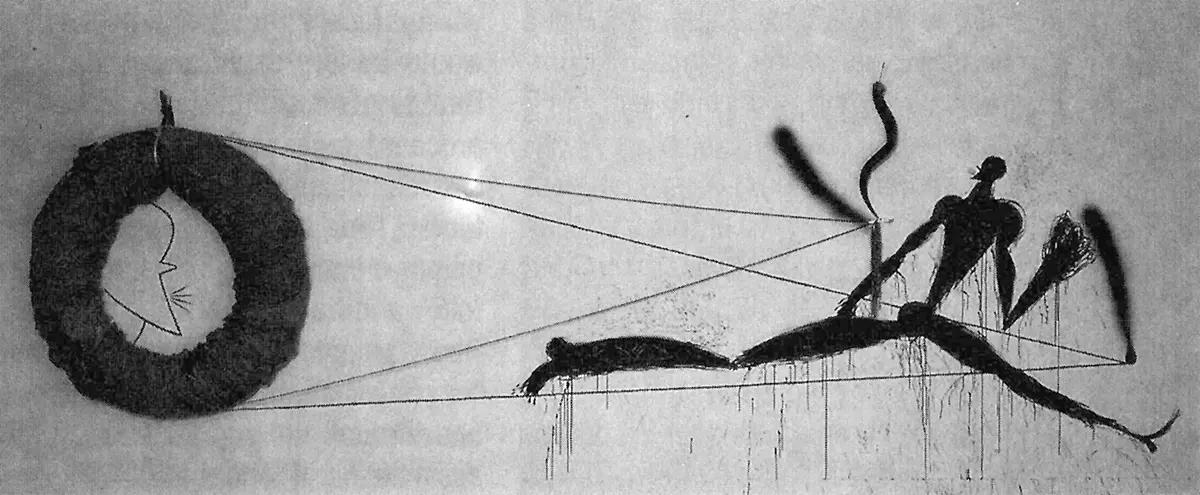
The show ended with another amate work entitled Turtle Women (1995) and with an untitled installation (1995), which, although it could be visited at the beginning, was a kind of synthesis of the entire exhibition. It is based on a circle, in the form of a rubber tire, where there is a “talking” figure. From the circle emerge four lines formed by a chain and its shadow and by two painted lines. The first two end with a car bearing a horn, and from which ribbons are hanging. The other two lines converge towards the same point, from which smoke emerges, and below, a man is running and looking back. One possible interpretation of the work is that it describes the process itself, which the exhibition illustrates - the reality of a cultural syncretism which Bedia wants to establish in reverse. Instead of using development in its various facets (technology in this case would be represented by the car), Bedia opts for a transculturalization process which leads to a discovery of and identification with indigenous cultures. The “look back” is towards the primitive cultures. In his search, Bedia follows different paths, some real (those painted with paint), some imaginary (the shadow created by the chain), and through the compenetration and assimilation of formal (aesthetic) and spiritual (religious) elements, achieves an unusual form of conversion.
FRANCINE BIRBRAGHER