
The Leonora Carrington exhibition at the end of 1994 in the Museum of Contemporary Art (MARCO) of Monterrey, which went on to the Museum of Modern Art (MAM) in Mexico City at the beginning of this year, was undoubtedly one of the most ambitious presentations of the work by a woman whose production is one of the most unusual features of contemporary painting of the second half of this century.
Although most of the works in both shows were the same, the Mexican version was complemented by a selection of graphic works and sculptures. The graphic pieces came from both private collections and the workshops where Carrington executed them, and the three-dimensional pieces were the result of a major project promoted by the physician and editor Isaac Masri, entitled Freedom in Bronze.
The curator, Luis Carlos Emmerich, is also the author of the text entitled Behind the Mirrors, which illustrates the rich interpretation which Emmerich has made of his readings of Carrington's work, as well as the intimate links from childhood and other experiences which began precisely in the house which is depicted in Carrington's picture entitled Crookhey Hall (1947); a second text by Lourdes Andrade, Magic, Mist and Surrealism combines biographical elements with a personal appreciation by the author. This publication provides one of the most complete pieces of research carried out in recent years on the work of Leonora Carrington.
Her painting is reality as seen from the murky terrain of dreams. The figures in her pictures and sculptures are taken from our surroundings, although we do not always see them. With the passing of generations, we have sometimes lost our capacity to explore other forms of life in the universe (their motivations, relationships, and their possibility for benevolent access to our world); Carrington knew how to read these codes, which our ancestors could certainly have interpreted without any problems.
Perhaps these apparently closed codes in Carrington's paintings are the uncovering and undressing of all the features that make up our essential being in this universe. Without any surprise, we recognize ourselves and engage in a very personal act of contrition, a strengthening of our sense of self, and a transformation of our image after the visual act.
For this reason, there was something for everyone in this exhibition: anyone looking at Carrington's work had to identify with one of her marvellous figures, or participate in one of the rituals evoked by the artist.
Hermeticism does not necessarily mean seriousness. To the surprise of many, Carrington proved to be full of humor, as can be seen in the verbal games which she played in the titles of her pictures, and in the situations depicted in those works. The most well-known and direct example of this facet is the work entitled Are You Really Syrius (1953), with its pun referring to the Greater Dog constellation of stars.
This is one of Carrington's many ways of resolving her pictures. When the spectator stops before one of her works, there begins a process of conversation with someone who is absent. It is not that we disappear before her pictures, but rather that the closed codes leave us outside the situation, stimulating in us an almost frenzied interest in deciphering every little sign encompassed in the pictures.
To the despair of those who like to search for explanations, Carrington never chose to do abstract works, preferring from the outset to focus on the most recognizable codes of the real world (persons, animals, houses, everyday objects), without there being any sane or "normal" relationship between them in the painting.
In Down Below (1941), one of the oldest pieces presented in this show, five figures (a bird woman, a green woman, a delicate man with a beard, a woman with a carnival mask, and an angel woman) are conversing in a garden next to a horse in an unnatural guise. In the background, there is a large castle, with an arch and a figure of Pegasus with extended wings, seemingly on the path towards the castle. Meanwhile, one of the women in the foreground is holding a white, decorated mask.
The title of the picture refers back to one of the most moving texts by the painter with the same title, in which she tells of her experiences during a nervous crisis suffered during the Spanish Civil War, when her companion Max Ernst was sent to a concentration camp. As Teresa del Conde has pointed out, this text is a surprisingly clear and even objective description of an underground experience around the idea of freeing Spain from its sickness (which even affected the digestive system) and freeing Franco from his hypnotic sleep-walking.
The narrative jumps from one situation to another, with frequent combinations of past and present; in the same way, the paintings are filled with little scenes which are apparently unconnected to one another, although there is always an absolute coherence within the context in which they appear. As in her texts, "here" and "there" also fuse together, and the specters travel from one place to another in a very unbodily fashion, as though they were mere energy disappearing before our eyes if we touch them.
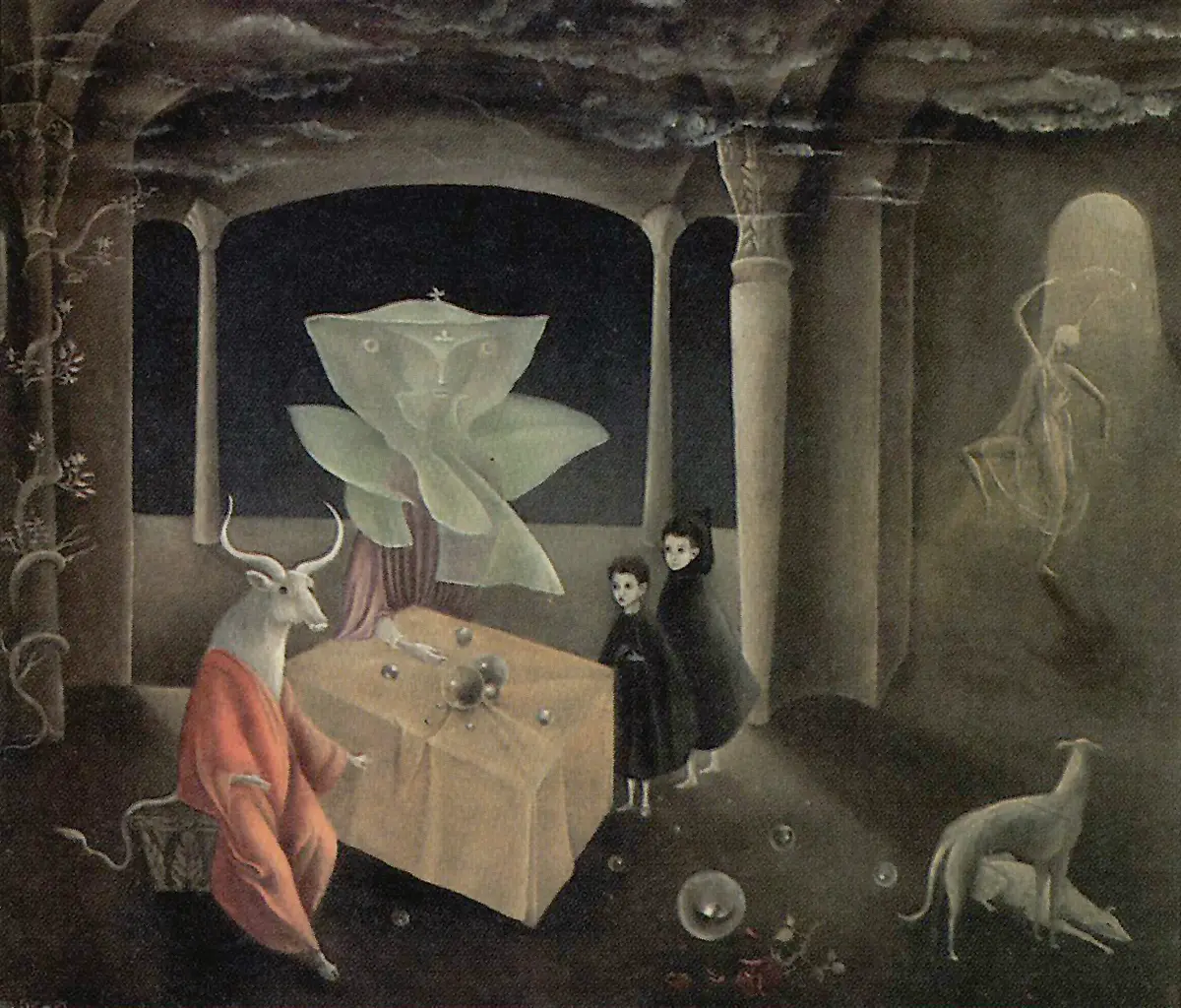
Each of these scenes tells us something important about the incomprehensible and seductive story of something which, although we cannot unravel it completely, remains strangely alluring. Took My Way Down, like a Messenger, to the Deep (1977) is a triptych with a composition which is unusual in Carrington's work, based on lines which cross together from one section to another to form rhomboids or X-shapes.
Although the title describes each section of the panels, it can also be read as a complete phrase, just like the work it describes. In the top part, a woman next to a table sees objects flying around her - shells, garlic, flowers, etc. A figure dressed in brown seems to want to catch some of the animated objects. To the right of this part of the work, a figure with the capacity to move horizontally is pushing the button of what might be an elevator, and behind which there is another figure with one foot placed forward, thus linking the top and bottom parts, as it enters the second panel.
Another smaller figure can be seen between the two pieces of fabric, linking them with its own body. Below and towards the center of the picture, there is a pyramid with its apex full of skulls, crowned with an alder plant, and watched over by a cat. On both sides of the link-figure, two figures are coming down with their heads recently chopped off and their necks all bloodied. Other figures also appear, including one who is descending the pyramid and holding an enormous garlic clove.
The final part of the picture is perhaps the most imposing. Corresponding to "the deep" of the title, it is a kind of inferno with two animals with the heads of gazelles and the bodies of snails, which act as custodians of the scene. Above them, there is a black- clothed figure set against a large red triangle. Further above, there is a half moon (or pale sun?), scaled by animals emerging from the figure to the right with a flower-like face and moving like the dummy animals used for target shooting in some travelling fair, going around and around until someone shoots them down and claims his prize.
There is no other prize here than the opportunity to see, albeit in a fragmented way, parts of a great story whose end we shall never know. Not even the figures created by Carrington themselves seem to be very sure of where they are going or where they have come from. What is true, however, as Leonora Carrington herself once said in an interview, is that "many times the figures just climb into the pictures themselves."
NOTES
1. EM. Cioran, "Manía epistolar," in the magazine El Paseante, No. 12 (Ed. Siruela, Spain, 1989).
SANTIAGO ESPINOSA DE LOS MONTEROS
Mexican art critic and historian. Lives in Canada.