
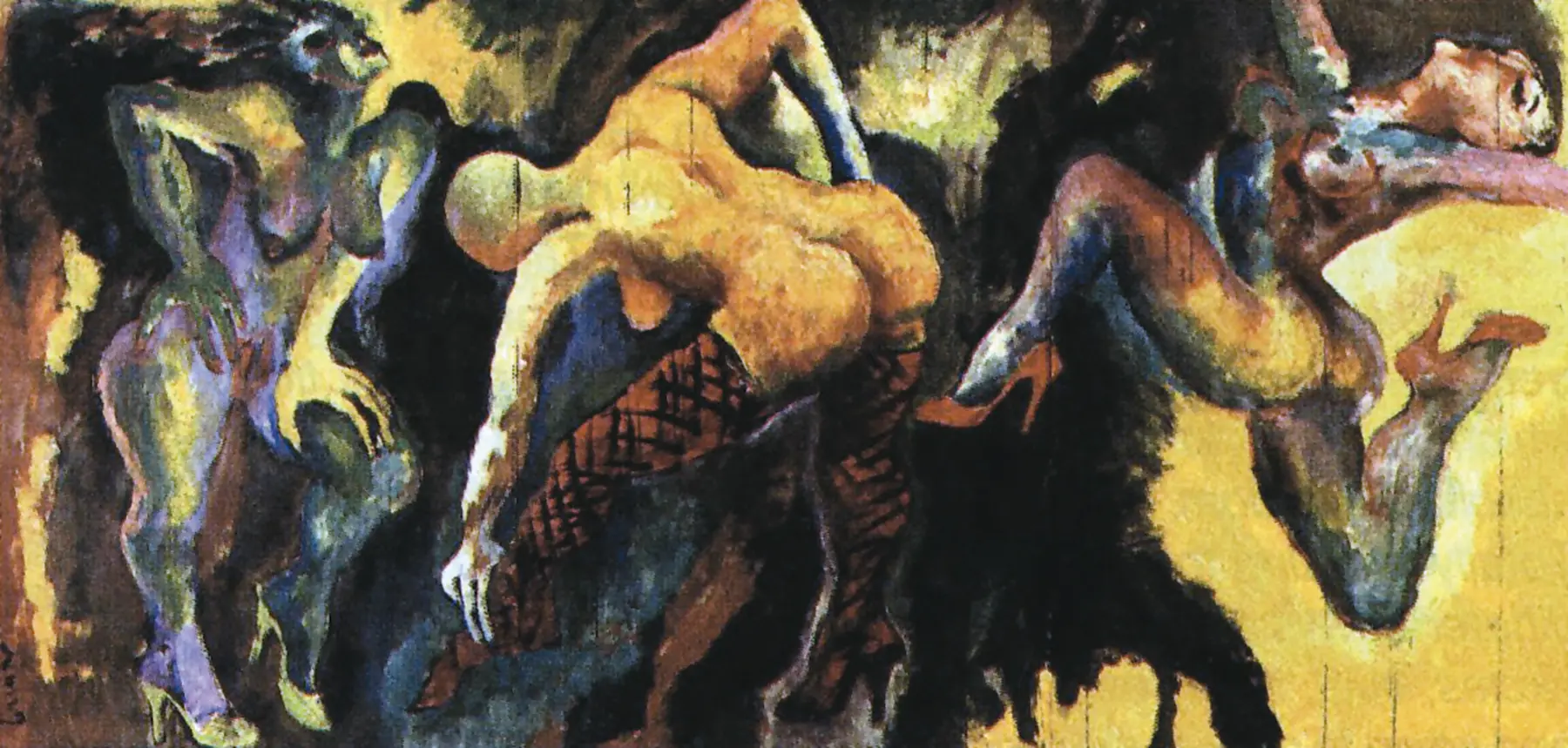
The idea of space is made up of nature and history.1 And in fact, the work of Lorenzo Jaramillo can be seen from these two points of view: in terms of the deepest motivations of human nature, which finally give an apparently terrifying image of man, but tempered by the softness of acceptance, without judgement or excessive guilt; and in terms of what is perhaps the most interesting feature in his work, its historical component. Lorenzo Jaramillo was a precocious painter who died in 1992 at the age of 36. Despite his young age, he revealed a deep knowledge of the history of art, which he digested in an almost cannibalistic fashion, and of drawing and painting with the sureness of having seen everything, like a historical being, but at the same time mixing the elements and carrying them to the extreme.
A retrospective exhibition is justified if it reviews the creative process of an artist. What was surprising in the case of Jaramillo, from the very beginning, was this handling of his graphic resources, for example, in his illustrations, where he mixed with the most absolute freedom crayons, inks, and temperas, and in his early drawings, where he gradually discovered the secrets of the medium and subsequently astonished us with his linework. An example is his Suite of the Extravagant Girls (1985), in which he reveals his knowledge about the weight of thick lines, the levitation of the thin ones, and the way a body can be constructed with squares and scribbled lines. Then there are his stains, which form a separate chapter in his work, because they are stains that show that Jaramillo had learnt everything about the color of shadows, the light of colors, and artistic spontaneity, enabling him to construct bodies with all the possible tensions, both within and without.
Ink and brush are two resources that he handled in a surprising manner in his series entitled Talking Heads, in which he invented a host of different ways of making eyes, noses, and mouths. The curator of the exhibition, German Rubiano, has said of this work: "Although Lorenzo was not really a fan of popular music, and even less of rock music, Talking Heads (the name of a English heavy rock group whose protest songs were very successful in punk circles) was the generic title which he gave to his large faces from 1981 and 1982. With absolute freedom, he attacked the figuration of the face. Totally violating the physical anatomy, he invented a host of different ways of drawing eyes, noses, and mouths. He used circles, ovals, triangles, zig-zags, jagged bars, foliage, horns, and so on to refer to the face and, above all, to give this animal, which was man, this vegetable man, all the irrationality of human conduct, just like the young people today with their own acts of rebellion."2
To return to history as one of the components of the idea of space, Jaramillo’s work contains many references to artists such as Bacon, Warhol, and the German expressionists, although they do not appear literally, but rather as a source of imagination, freed of their content and space, as fragments. Perhaps for this reason, Jaramillo was interested in texture, color, and pastel. For example, his Serial Faces (1979-1981) takes him towards a montage of stains and expressive, frank eyes. Here begins another chapter, because the images are increasingly recreated in terms of texture and presence. Sensibility and irreverence appear in the work, suggesting a kind of cheerful nomadism: "I have fallen in love with some things. The floors of the Palazzo Venezia, Bernini, the Via de la Porta San Sebastiano, which is the most beautiful 'promenade' I know; the elephant outside Santa Maria Sopra Minerva; ruins fascinate me."3
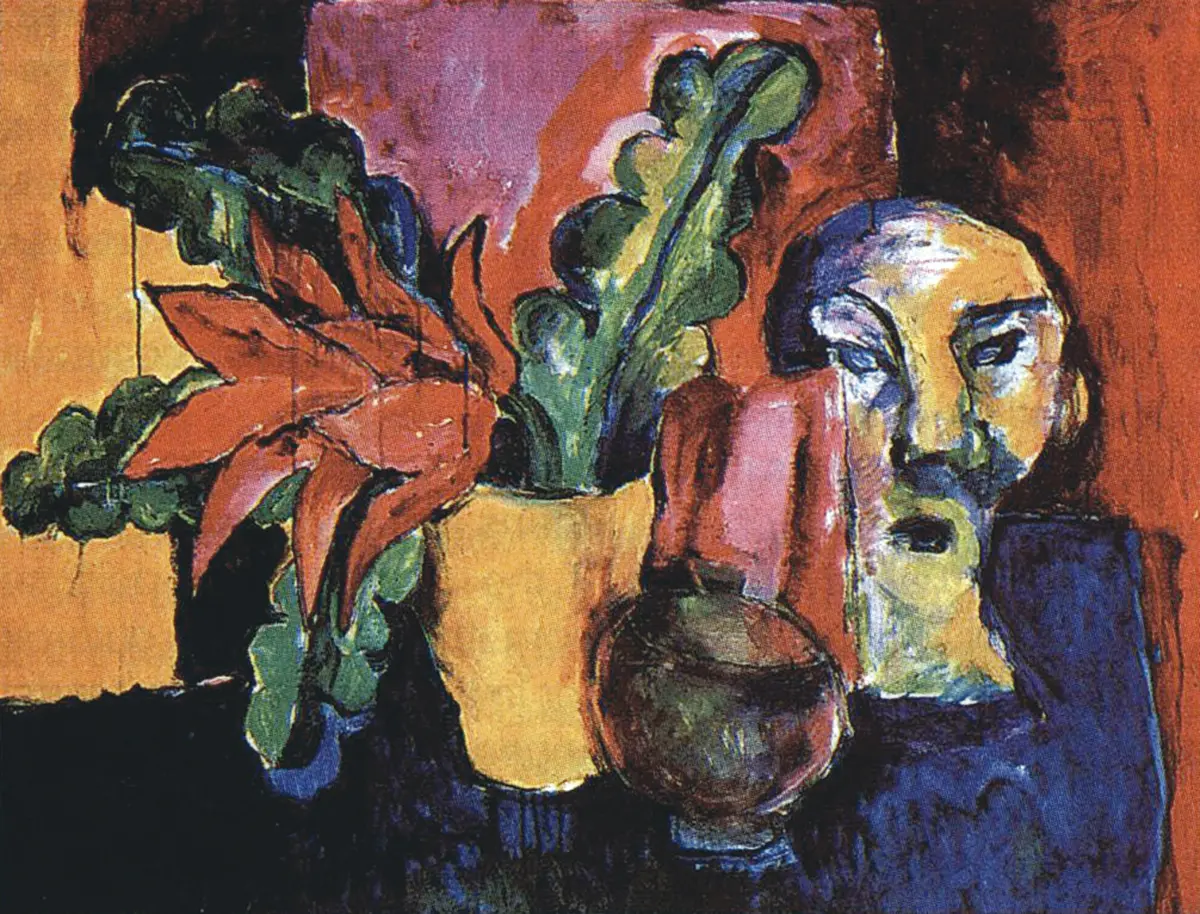
From the time of his Figures and Black Oils series (1979-1981), based on Quimbaya boards, color became an ideological adventure (we should not forget that colors come from chemical truths). In his Angels (1986-1988), this is coupled with an intuitive analysis of visual perception, centered on two basic colors, red and blue, with all their symbolic associations and contrasts between male and female, in a perfect relationship between color and form in which fantasy poetically transforms the artist’s reflection on the primitive states of human nature. "I believe that painting is color. This would be a kind of definition. If you think that drawing is essentially linework and rather simple things, then painting is color. I believe that placing a stain of one color alongside another stain in a different color is painting."4 This is certainly a very simple definition, but one which the artist managed to reflect in his final series of Still Lifes with Heads (1991), a patient and profound study of the relationship and complicity of colors.
Since the exhibition provided a complete survey of Jaramillo’s work, it also included his Dancers (1988-1990) and Fiestas (1990), perfect settings for seeing the body transformed by the most personal motivations, and for appreciating the artist’s deep knowledge of the history of the cinema: "I have not painted monsters or phenomenal creatures. I have only wanted to show our hands opening up, our legs becoming strong, our backs turning, our sex gripping us, our heads, which do not belong to us."5 There was also the series of Portraits, including the study, with pastel stains, of his father, the historian Jaime Jaramillo Uribe (1983), with his profound look, but as if engaged in some very intimate dialogue, with pastel stains, and that of Luis Caballero, one of the best, because it clearly shows how such an intense personality can only be reflected in magenta and violent ink drips.
For modern sensibility, art is mainly a matter of confession. What is intelligent and interesting about Lorenzo Jaramillo’s work is perhaps the expression of a different kind of sensibility, in which art is a joyful game of constructing, as in certain baroque moments, masks for a carnival, the commemoration and consecration of painting, and life without heed of the future, which is not ours to possess.
NOTES
1. Julio Cario Argan, El Concepto del Espacio Arquitectónico, Ed. Nueva Visión, Buenos Aires, 1979.
2. Germán Rubiano, Lorenzo Jaramillo: Retrospective Exhibition, Luis Ángel Arango Library, Bogotá, May-June 1995.
3. Observations by the artist, cited in Lorenzo Jaramillo: Retrospective Exhibition, Luis Ángel Arango Library, Bogotá, May-June 1995.
4. Ibid.
5. Ibid.
NATALIA GUTIÉRREZ
Professor of the Esthetic Investigation Institute of the Universidad Nacional
of Colombia.