
The Gallery UNO recently presented a one-man show of work by Manuel Pérez, entitled Revelations, which gathered together a large number of works done in 1994 and 1995. Continuing the investigation initiated several years ago on the symbols of Christianity, the artist proposed a series of oil works on canvas which explore aspects of the Catholic faith, such as the Holy Grail, the vessel used by Jesus at the Holy Supper, fish, the first Christian symbol, the cross, the highest symbol of Christianity, the heart of Jesus, one of the many Christian expressions, the fleur de lys, a distinctive French heraldic symbol. They were not intended to suggest any catechism or act of exorcism.
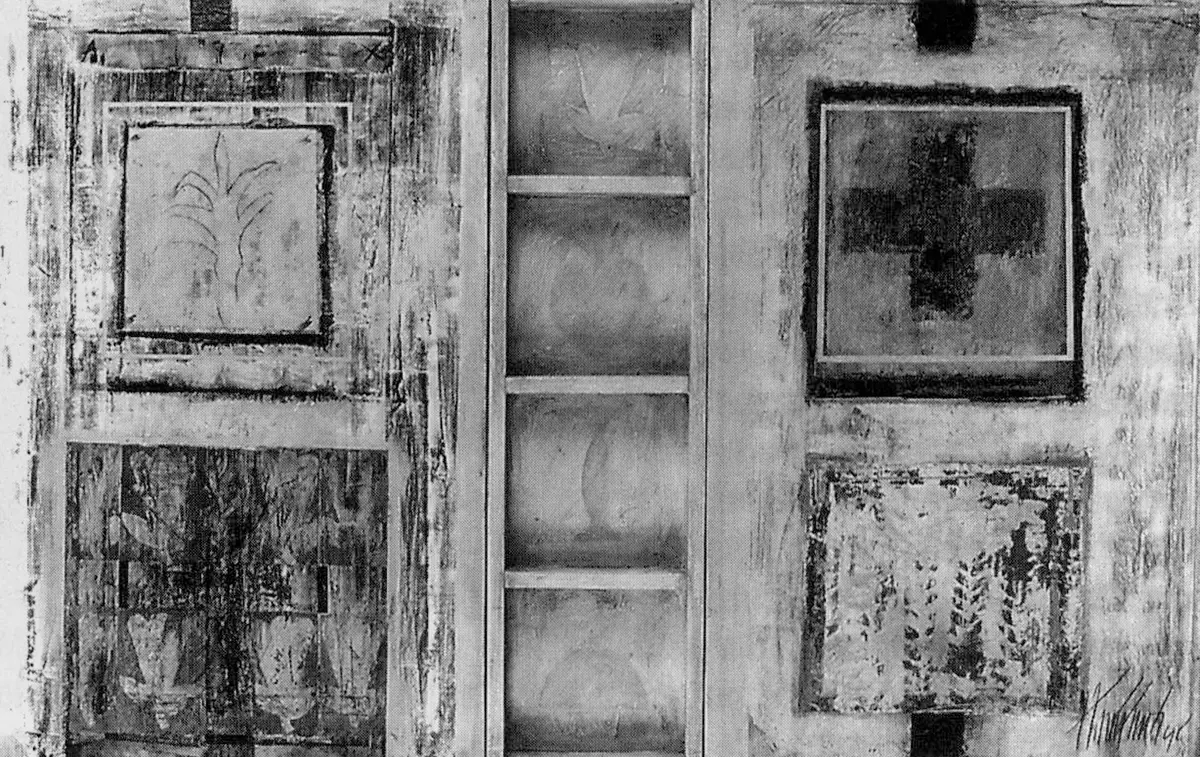
On the contrary, what the artist was examining was the decontextualization of a set of symbols that have a profound meaning in the Christian culture. Manuel Pérez appropriates these images and makes his own combinations. Thus, in the purest style of the shields and coats of arms from the medieval tradition, the works offered very personal proposals unrelated to traditional retables or any other Christian images, and even less to the coats of arms of States, cities, or families. What does Pérez take from these symbols? Their aesthetic value in itself. He also appropriates certain elements from heraldry, such as the meaning of specific colors—blue, sand, purple, orange, gold, and silver, which give the works a dominant and startling air evocative of other times, other places, without this compromising their contemporaneity. In this way, color is used in accordance with the artist’s objectives: color is within us, Newton wrote, and Osvaldo López Chuhurra has said that when man establishes a dialogue with the physical element of color, he immediately transforms it into a means of expression;1 the artist merely reaffirms the importance of color as a plastic element. The works of Manuel Pérez evoke an enveloping sensation, bringing us before objects which are timeless, worn down, useless, but which have great plastic qualities. Their composition is governed by a grid divided into rectangles and squares, with the rhythm reinforced by the placement in each box of the above-mentioned symbols (the cross, the Holy Grail, the fleur de lys, etc.). This combination of elements could extend ad infinitum, without any loss of emotional effect.
The exhibition, which closed on 15 July, was accompanied by a catalogue which included an interview with the artist by Graziana La Roca, with a number of important observations by Pérez on the role of criticism, the public, and his studio work.
NOTA
1. Osvaldo López Chuchurra, Estética de los elementos plésticos, Editorial Labor S.A., Barcelona.
ANITA TAPIAS