
At the end of May, the Valenzuela & Klenner Gallery inaugurated an exhibition of work by Pablo Van Wong, entitled Value and Identity, in which this artist from the Valle referred to the problems of violence affecting Colombia, which have undermined the country’s ethical values and the individual sense of identity. The show consisted of a series of works of delicate finish, one of the hallmarks of Van Wong’s art from the beginning.
The symbolism which the artist has used throughout his career is rooted in his oriental, Chinese origin, in the principles of I Ching, yin, and yang. The taut duality of two contradictory principles is reflected through a very refined beauty, extremely fragile, slender materials, full of linear and transparent qualities. But at the same time, the delicate structure of the objects, which are enriched and transformed by the presence of light and the passing of time, evokes a fibrous sense of sharpness, wounding, and pain. The repeated use of oxidized metal highlights both the beauty of the objects and the sensation of injury, of imminent danger, abandonment, and oblivion.
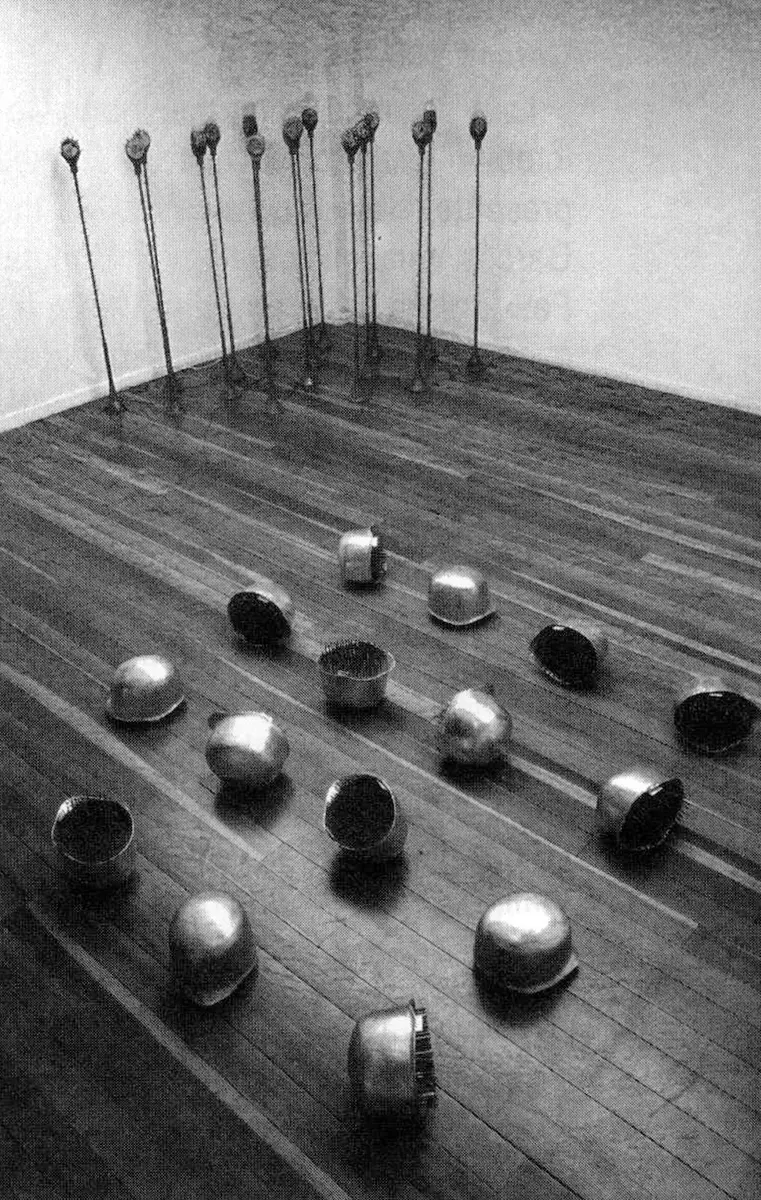
This duality was reinforced in this new show, where Van Wong enriched his use of oxidized metal with new processes and combinations with other materials, such as glass, powder, velvet, toys, and photographic material, with which he creates new objects richly symbolic of life and death.
This direct allusion to the violence affecting the country was already made explicit in the work which he presented at the last National salon: on that occasion, as with his piece entitled Night Will Come and on White Winged Horses Luminous Gods will Sally Forth, Van Wong used light, along with other elements, to reinforce the symbolism of his objects.
The piece was interesting because it revealed the features of a new stage in the artist’s work. First, there was the use of the photographic image, which encompassed the faces of some of the many anonymous victims who die each day in violent situations of unknown and dark origin. Although the figures are anonymous, the image places the pain and affection clearly within the context of our immediate reality. In his earlier works, such allusions, which were similarly effective, occurred in more unspecific zones, permitting a much more open-ended interpretation. Without this being either a virtue or defect, Van Wong’s new works reflect his intention—which he shares with many other contemporary artists— to refer directly to the horror which affects us all, although he never lapses into any obvious posturing or pamphleteering.
The photographic image is handled through a very interesting use of chance and hazard, since the photographs are done in sardine cans with the use of combustible power. As a result, the sharpness of the image varies, although there is always the outline of a face, the mark of individual identity. These photographs, delicately framed in metal can,s are placed in an urn of oxidized metal, with a glass lid, resting on velvet. On the urn, hanging like medals and decorations, there are the lids of the sardine cans, carefully covered in gold leaf.
Secondly, throughout the show there was a clear attempt at containment: on the one hand, this leads to the concept of art with a container (reinforcing what I said earlier) and on the other, the containment also refers to the object, the recipient, the container,
which appears forcefully in the above-mentioned work, where there is a clear allusion to implications which are both museological and funereal. The can acts as a piece of furniture, a showcase in which objects of value, reliquaries, photographs, or books can be presented. But it is also funereal, coffin-like, evoking the idea of posthumous memories. In both cases, the reference is to containing, keeping, and preserving. In another work, the containers are small transparent drums, made with tuna fish cans, which house small children’s games, glass marbles, plastic figures... Fibrous, rusty metal recipients... evoking the images of childhood and the sounds of war.
The delicacy with which the artist has created each object, the form in which it has been finished and placed, strengthens the implications of each component of the carefully selected objects full of intrinsic meaning and their materials, which Van Wong uses with considerable refinement, exquisite sensitivity, and spirituality. The artist has created a pure plastic language, without this implying any lack of content or meaning: indeed, in principle, that form and content are inseparable.
MARTA RODRÍGUEZ