"I have never been concerned about painting as such... In my pictures, I have not tried to resolve any given problem about nuances, but I have wanted to fix on the canvas a series of past or contemporary aspects of South American life, so that they can serve as documents for the great painter who will come later."1
In 1928, Alejo Carpentier reproduced these comments by Figari about his painting. They reflected one of the constant concerns in his philosophy: the rescue of certain characteristic values, specific to art, which were a response to the context that generated those images.
Carpentier also said that Latin America had "the rare privilege of being a contemporary of its classics. These are Diego Rivera, Héctor Villalobos, Ricardo Güiraldes, Amadeo Rodán. And Pedro Figari was one of those classics, of that new and very characterized art. For Figari, there was nothing better in the world than those vernacular things which 'cultured people' and the ridiculous 'rare birds' of our countries considered as 'defects,' deploring as they did that our tropical cities could not be made into copies of Picadilly."2
The native theme, the restoration of what is one's own, is an unavoidable link in the thought of Figari. Hence the interest in any examination of his work as a painter of looking at the environment from which that work sprang, as well as the major aesthetic principles which governed his thought.
The Context
Figari is part of a very special moment in Uruguayan history, the beginning of a period of modernity, which included political as well as social and economic developments. A cultural response was being sought to the various changes underway, with the active participation of sectors of the middle class in the intellectual life being shaped. It was a society that, by its own composition, did not suffer from the exclusive predominance of the elites. There were no excessively polarized debates, dogmatic attitudes, or nationalist excesses. The cosmopolitanism of a society open to the arrival of immigrants, and which was permeated by their influence, encouraged the growth of sectors that had a strong faith in progress, which valued the importance of education as a vehicle of change and social advancement. But without forgetting the significance of the international artistic language being imposed from Europe, some members of the new intelligentsia turned their attention towards the search for autochthonous elements, features which allowed them to recognize and restore the presence of what was theirs.
The nascent avant-garde had before it both in literature and in the plastic arts a double choice: to break with the past, to deny and reject tradition by joining the European avant-garde movement; or to recognize that the existence of that avant-garde movement did not mean separation from one's own social context and environment. On the contrary. The objective was a re-reading, from a new standpoint, of regionalism and traditional realism.
A review of the literary magazines, essays, and texts of the period repeatedly highlights these two sets of options, which were not exclusive to the Uruguayan context but characterized a good deal of the discussion that took place at the beginning of Latin American modernity.
All the variants illustrate the concern for the creation of autochthonous systems and reflect a growing interest in their achievements.
Furthermore, in Uruguay, the need was felt that the political model promoted by the liberalism of Batlle3 should be accompanied by cultural proposals in line with the new needs. And the creation of such a model could not disregard native resources, with the local surroundings providing a source of referents and establishing a distance with that modernity which took little account of the specific objectivity of the place.
Nativism gained its adherents, and it is interesting to note the reflections of one of its pioneers in Uruguayan literature, Feman Silva Valdés, concerning the meaning of the term. In 1927, in response to questions addressed by the avant-garde journal La Cruz del Sur, Silva Valdés said: "The words 'native,' 'nativist,' and 'nativism' are used by many people in many different contexts, just like the words 'creole' and its derivatives used to be. I have often noted that, with rare exceptions, what used to be called 'creole' is now called 'native.' I do not believe that they mean the same thing. For me, nativism is a movement which can be defined as follows: modern art which is inspired by the landscape, tradition, or the national (not regional) spirit and which brings with it an aesthetic triumph over and geographical broadening of the old creole movement which sought its inspiration only in the characters and customs of rural areas. The creole movement is both old and static; nativism is
'something new and evolving.'"4
If Silva Valdás was one of the main literary representatives of nativism, then Figari played a similar role in painting.
Thought and Action
A rapid glance at Figari's biography might suggest abrupt cuts and very different interests in his vast activity: a well-known criminal lawyer, a theorist of art and aesthetics, a reformer of industrial-style teaching, a poet and painter. However, in all these activities, there is an ideological nucleus that motivates both his theoretical and pictorial interests. Argul maintains that: "His thought, fixed as it was on words, forms a significant whole with his art, since his books can be read in his paintings (...) He knew how to gather together his ideas, which were fragmented into very many activities in the visual unity of the painted picture."5
Figari was born in Montevideo in 1861, the son of Genovese immigrants. He studied law and developed a parallel interest in painting, which he was forced to keep on hold to be able to meet his academic obligations. After obtaining his professional qualifications, he became defense counsel for the poor in the criminal and civil courts, an activity that allowed him to establish contact with the social world he was to depict in his paintings. A long trip through Europe after his marriage in 1886 brought him into contact with various European artistic currents, including Impressionism.
On his return to Uruguay towards the end of the century, he resumed his legal practice and at the same time participated in various artistic meetings in Montevideo. During these years, in addition to his work as a lawyer, he was also a journalist, and even entered politics when he was elected a member of Parliament. During the early years of the twentieth century, he developed his interest in teaching art, and in 1912 published his study on Art, Aesthetics, Idealism, which was translated in France in 1920. In 1915, he was appointed Director of the National School of Arts and Crafts, a key post enabling him to put into practice his ideas not only on the teaching of art but its function. He thus brought to fruition with this post a process which he had begun at the turn of the century when he campaigned for the founding of the School of Fine Arts, and tried to promote a less academic kind of art teaching in which various areas could converge towards a type of integrated training.
In an essay which analyzes the thought and work of Figari as director of the School of Arts and Crafts, Gabriel Peluffo writes: "Figari wanted to train people capable of producing objects in accordance with principles of design, finish, and the use of raw materials which were compatible with the social and economic conditions and the natural wealth of the country—which in turn would give a 'regionalist' character to production."6
The formulation of a regional art presupposed the appropriation, both for the fine arts and the creation of objects, of a repertory which included elements from the national flora and fauna, as well as the pre-Columbian cultures. It was an attempt to form a native language that would allow artists to distance themselves from the models inherited from nineteenth-century Europe. Once again in the implementation of his plan of studies for the School of Arts and Crafts, priority was given to the search for an American identity which was not restricted to the ideological field, but resulted in the creation of objects, as can be seen from the many ceramic works, pieces of furniture, and other utilitarian elements which came out of his workshops. Figari viewed the term "autochthonous" not as something closed, but as a generous and open attitude to the various expressions of universal culture.7
Figari himself said: "When people speak of autochthonous art, they know that it cannot mean, at least nowadays, a culture which is exclusively national or regional, but rather the study of one's surroundings... and the assimilation of all that is known, after a conscious selection process, i.e. looking at one's own environment with an autonomous criterion. And this, it is worth repeating, is the only sensible thing for us to do, since all the rest is pure affectation bordering on the simian. We lose our character...and that is enough for us to regionalize our minds."8
Positivism—stimulated by Darwinian evolutionary theories and the ideas of Spencer—had a marked influence on Uruguayan intellectuals of the so-called 1900 Generation, including such figures of continental importance as Enrique Rodo and Carlos Vaz Ferreira. Amid the various interpretations available, a synthesis emerged between science-oriented positivism and metaphysical spirituality, which was based on the exploration of experience from different angles of vision.9
As the product of such a context, Figari participated actively from his university days in positivism, grappling with problems which weighed heavily on his period: How to reconcile humanistic spirituality with the development of the bourgeoisie and with the new needs generated by capitalist production? How to achieve such a reconciliation within a context subordinated to already developed cultures? Through his investigations and actions, Figari sought the replies to such complex questions, in part by applying art to the creation of objects to achieve the best quality possible, and in part by using regional referents enabling him to construct his own autonomous models.
Figari's experience up to 1917 in the School of Arts and Crafts continued within the framework of the ideological proposal already put forward in Art, Aesthetics, and Idealism. On the basis that the relationship with the outside world was through action, art was here defined as "intelligence applied to achieving what is required by each vital organization."10 This statement is very significant, since it clarifies the relationship between his proposals for the reform of teaching and the plastic arts. Distancing himself from the dominant aesthetic codes that centered on the idea of beauty, he questioned and rejected the division between the greater and lesser arts, between the "fine" arts and "useful" arts.11
His perception of art as "intelligence in action" was as valid for industry as for painting, and is consistent with the concept that the function of art should be to serve man in the best possible manner, that it should satisfy his needs.
When his pedagogical experience became a source of frustration, Figari resigned his post as Director of the School and decided to settle in Buenos Aires in 1921, where he would concentrate on his activities as a painter.
All of which confirms our initial statement: he was not someone who turned to painting when he reached maturity, but an intellectual who reflected on subjects related to art and aesthetics, and their function in society. And painting was one of the ways of showing his concerns and conclusions. From the nineteenth century, there are rough sketches in oil and watercolors that reveal that he was still influenced by the academic tradition of that century. He frequented such painters as Carlos Saez, Blanes Viales, and Milo Berette, in whose houses he came into direct contact with French post-impressionist painters, especially the so-called intimist painters, such as Vuillard and Bonnard. He was also interested in the work of the Spanish artists Anglada Camarassa and Mir. The Figari who arrived in Buenos Aires had already reflected in his drawings and paintings on the evocative characteristics of the Rio Plata setting.
The Buenos Aires environment opened up new opportunities for him and his pictorial activity. Until then, his art had been carried out within a family and friends context, but now it gained public recognition. These were years of great intellectual fervor in the Argentinian capital: Borges had come back from Spain under the influence of the Ultraist movement, and the Martin Fierro Group had been established, where figures such as Ricardo Guiraldes12 exalted the value of vernacular themes, similar to those used by Figari in his paintings.
Zum Felde13 noted in 1923, in writing about Figari's painting: "Kept in his memory of his adolescence, like in some silent chest entrusted to the hazards of shipwreck, there were visions of the old times, when the nation's life, not yet standardized by modem cosmopolitanism, was full of unusual features and color, typical values which were marvelous for the artistic transubstantiation of the artist's brush, and which none of the artists of the time had ever fixed."14
Figari the Painter
This comment by Zum Felde, emphasizing Figari as a reconstructor of visions of the old times, for a long time dominated the local view of his pictorial work: he was looked upon as someone who remembered and portrayed the past.
In artistic circles, he was initially seen as a connoisseur of painting rather than as an art professional—an image which Figari himself embraced on more than one occasion. The same heterogeneity of his wide-ranging work, seen without the unifying ideology that underlay it, led to questions being asked about his painting, which was dubbed as regional and ingenuous, thus minimizing the artistic value of that work. With few exceptions, other artists were skeptical about both the way he painted and his concept of painting as something that should be representative of the national heritage.
When he was living in Paris—to where he moved in 1925 and remained until 1933—Figari sent a letter to the director of La Pluma15 in which he once again expressed his thoughts on the subject of autonomy and raised the problem of how to capture the concept of what is one's own: "Indeed, what it did not let us see clearly was that we were looking at our legend, our environment, our traditions and other native elements from an Egyptian, Greek, and Roman standpoint. I remember the resistance of our artists when attempts were made to interest them in other paths. They shrugged their shoulders as if such a suggestion were absurd. If there are no landscapes here, there are no themes: there is no character, there is nothing. Of course, what they were looking for was precisely what was foreign."
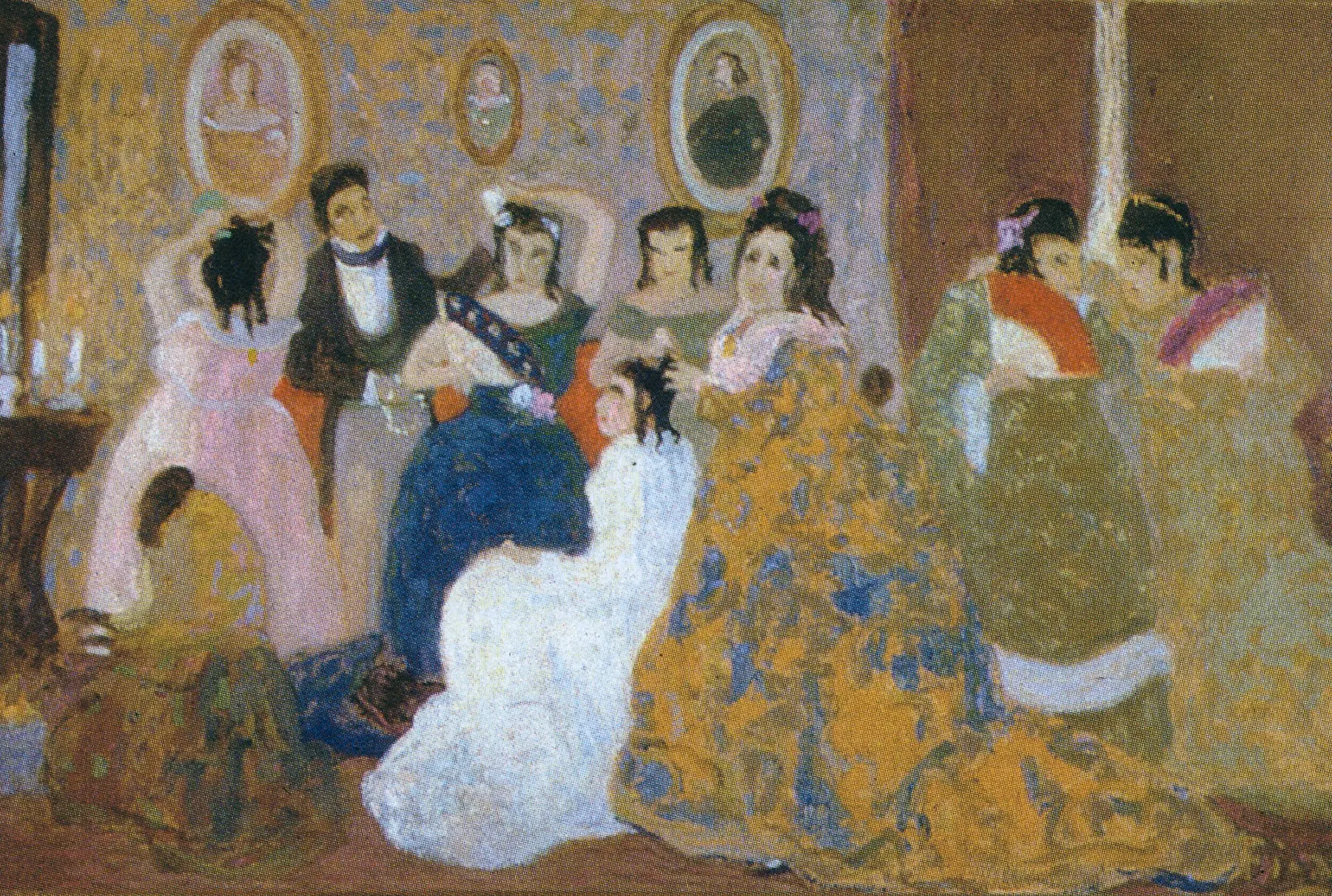
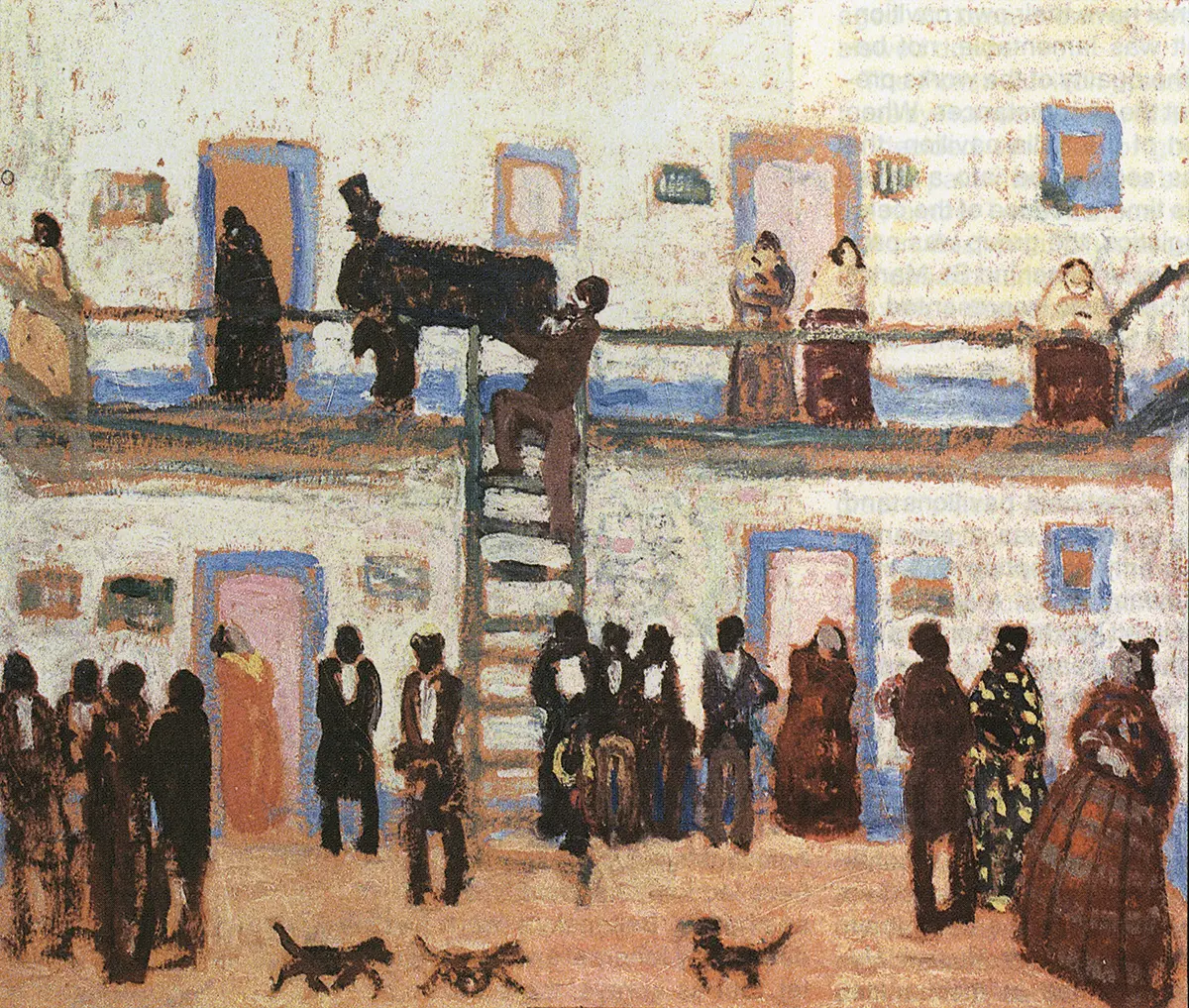
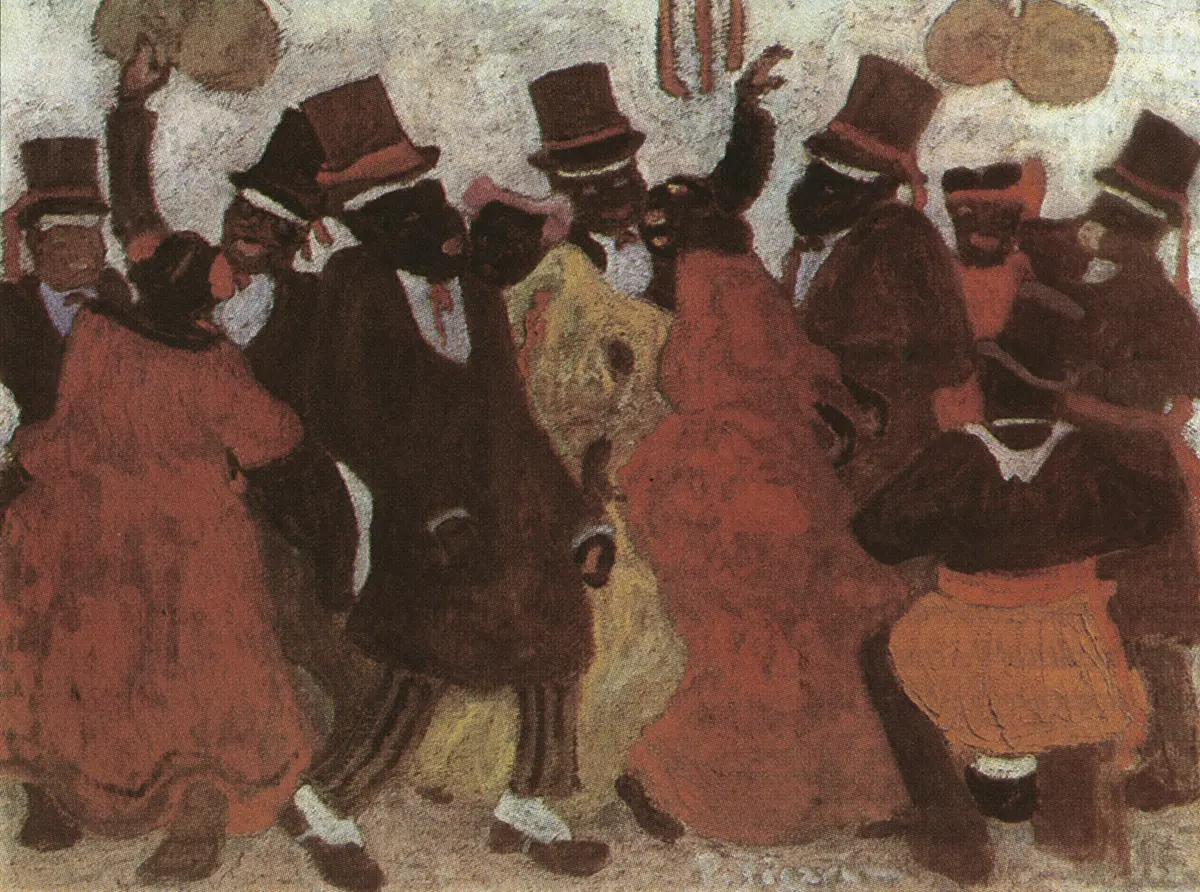
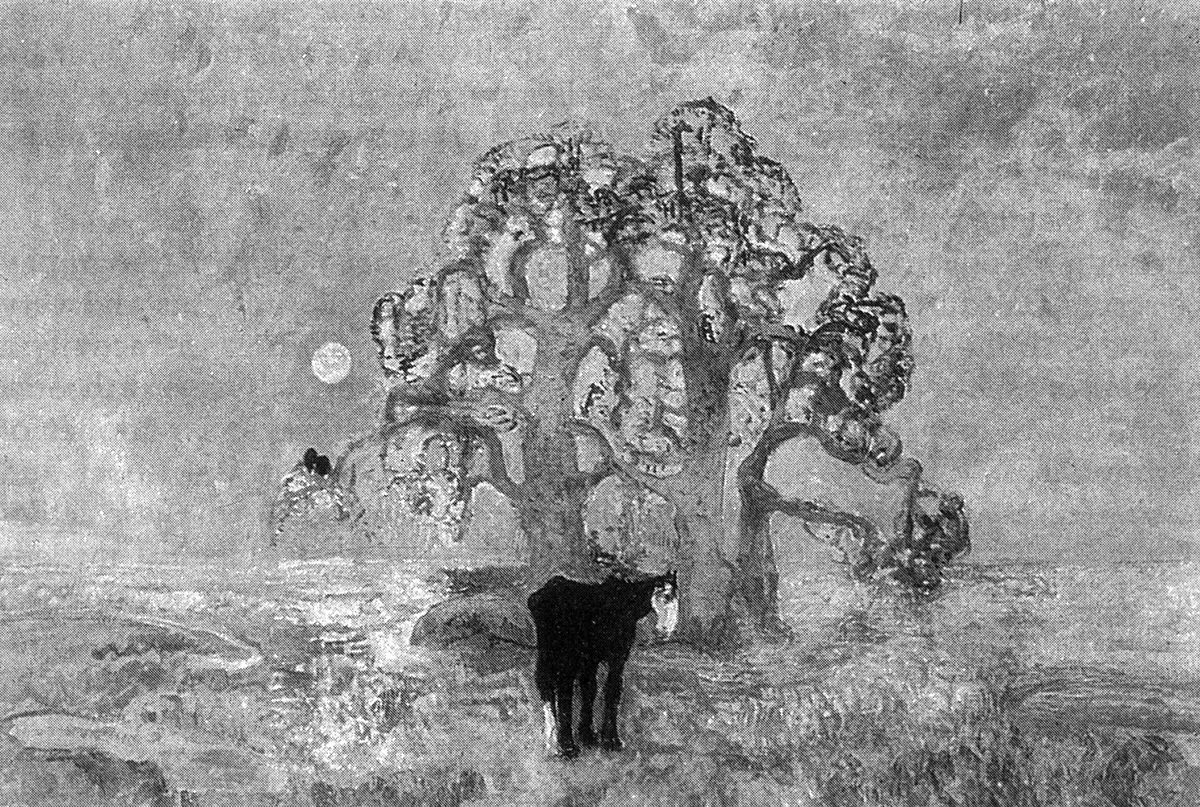
Figari's pictures show the most varied kinds of figures from the River Plata society: the everyday life of the blacks, with the conventillos16 as the social center of their lives and the candombe17 as their manner of artistic expression. The gaucho is no longer seen as a stereotype, but becomes a real person, an integral part of his own environment. In the vast spaces of the pampas, man and landscape merge to become a new kind of imagination, which has nothing to do with picturesque detail. And then there are the scenes in which he ironically shows the incipient bourgeois colonial society, which tried so much to assimilate the models in clothing and dancing imported from Europe.
Figari's presentation of these figures is not a matter of historical reconstruction. His return to the past is an attempt to evoke the correspondence which should always exist between culture and society, thus reflecting the ideological current which advocated a return to the roots in Uruguayan society during the 1920s.18
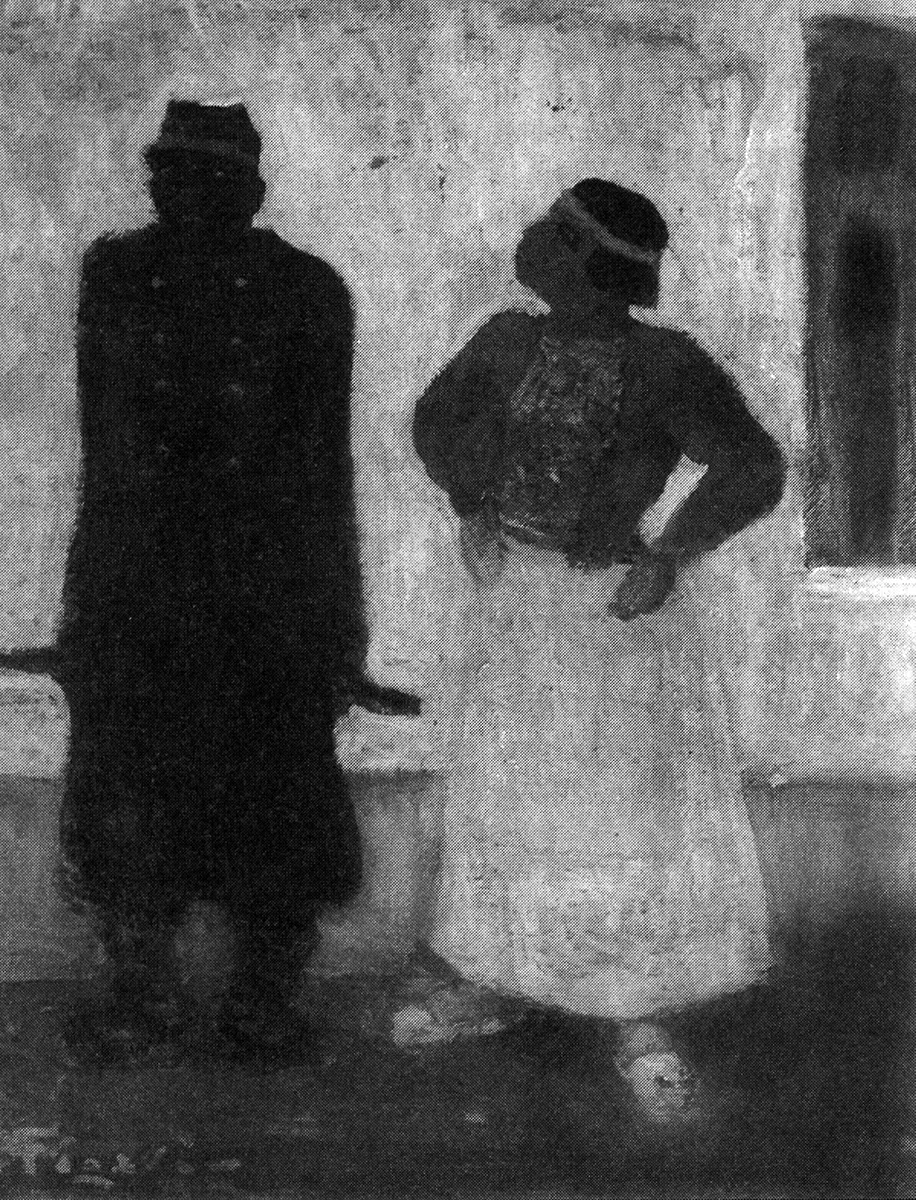
Figari's figures are different from traditional portrayals, since their intention is not to copy or to create a mimetic reconstruction. As the artist himself said, he "wanted to paint sensations rather than things." No matter how many funerals, conventillos, pampas with the solitude of the majestic ombu tree,19 he had seen or known, what he wanted was to reinvent them, to relive sensations and experiences linked to their memory. "With what pleasure I look at my paintings," he wrote from Paris in 1926. "They speak to me about all my life—about my childhood, my adolescence, my last years. There are the images, the memories, the impressions, the emotions gathered together."20
Figari longed for a sense of reciprocity between the forms of life and culture, and looking back to the past enabled him to establish links which he felt were being lost in the chaos of twentieth-century society. His Kiria History, published in Paris in 1930, was a reconstruction of a utopic world in which he implicitly criticized River Plata society. The people of Kiria did not know any racial differences; they knew nothing of wars or superstitions, they did not live in tragic circumstances, and they managed to establish a link between their way of life and their culture. And as for "art for art's sake," they would smile.21
But as Peluffo rightly points out: "Figari the painter and Figari the documentalist (one might add the word "oniric") of the River Plata past went hand in hand, even though that work may be said to belong more to the history of painting than to a history of our life and customs in the last century."22
Of course, Figari's work cannot be seen merely in terms of its thematic content: it is also a solid artistic achievement. The figures that appear in his pictures, whether inhabitants of troglodytes, gauchos, blacks, or the young ladies of society, are also the result of the interplay of color and rhythm, with form and color forming an inseparable structure in which the line work is diluted and the stains become predominant. The relationship between color and composition is thus inevitably based on chromatic contrast, where texture becomes a protagonist in his use of untreated boards.
The handling of space is frontal, almost theatrical, with the figures being portrayed in a horizontal line, which is far from the illusionist principles of the Renaissance. The rigorous composition is structured around a main axis, with the forms placed around it, so that in his synthetic compositions, the straight lines are related to architectural forms, whereas arabesques and curved lines are reserved for organic forms.23 This relationship between what is on top and what is down below allows him to structure his own conception of space: below, there are the figures who populate the story, and above, the space which contains them.
For Figari, painting was the end of a long process of speculation on aesthetics, the result of his close relationship with positivist thought and Spencer, as well as the concerns of people from his generation in seeking out explanations from spiritualism, which differed from those provided by idealism. His confidence in art led him to link painting and theoretical action in an attempt to reinvent a collective imagination that would provide models of behavior that had been lost. Beyond the descriptions of the chronicler, Figari sought to reinvent his own history, without any confrontation with the real model.
When he died in Montevideo in 1938, the artistic freedom of his work had managed to earn its place in the search for the autonomy of Latin American art, which was of such importance to him.
NOTES
1. Alejo Carpentier, "Pedro Figari y el clasicismo latinomericano" included in the catalogue text to Seis Maestros de la Pintura Uruguay a, National Museum of Fine Arts, Buenos Aires, 1987, p.72.
2. Alejo Carpentier, op.cit., p.72.
3. José Batlle y Ordoñez governed between 1903-1907 and 1911-15, and introduced a process to modernize the Uruguayan State.
4. Fernán Silva Valdes, "Contestando a la encuesta de la Cruz del Sur," La Cruz del Sur, Year 3, No. 18, Montevideo, 1927, p.4.
5. José Pedro Argüí, Las artes plásticas del Uruguay, Ed. Barreiro y Ramos, Montevideo, 1966, p.127.
6. Gabriel Peluffo, "Pedro Figari: Arte y producción nacional," Revista Nacional, No. 239, Ministry of Education and Culture, Montevideo, September 1993, pp.126-27.
7. G. Peluffo, op.cit., p.132.
8. Quoted in Peluffo, op.cit., p.133.
9. Arturo Ardao, La filosofía en el Uruguay del siglo XX, Ed. Tierra Firme, Mexico City, 1955, p.23.
10. Quoted by Rosa Brill in Pedro Figari Pensador, Grupo Editorial Latinoamericana, Buenos Aires, 1993, p.35.
11. Rosa Brill, op.cit., p.36.
12. Guiraldes published Don Segundo Sombra in 1926.
13. Alberto Zum Felde was an important literary critic born in 1890; he was the director of La Pluma and the author of several publications.
14. Quoted in Seis Maestros de la Pintura Uruguaya, op.cit.
15. Una carta de Pedro Figari, La Pluma, Year I, Vol.lll, Montevideo, 1927, p.29.
16. Conventillo is a house in which several people with low resources rent rooms.
17. Characteristic dance of the black population, traditionally held on Sundays, and which was subsequently incorporated into the Montevideo Carnival.
18. Gabriel Peluffo, De Blanes a Figari: Historia de la pintura uruguaya, Ed. Banda Oriental, Montevideo, p.106.
19. Large tree characteristic of the River Plata region.
20. Quoted in De Blanes a Figari, op cit., p.100.
21. Quoted in Seis Maestros de la Pintura Uruguaya, op.cit., p.7l.
22. Gabriel Peluffo, De Blanes a Figari, op.cit., p.102.
23. Ángel Kalenberg, Arte uruguayo y otros, Ed. Galena Latina, Montevideo, 1990, p.64.
IVONNE PINI
Professor at the National University of Colombia. Executive Editor of Arte en Colombia / ArtNexus.