
Cuban art is like a machine that has continued to function even after the engine has stopped. Sandra Ramos belongs to those artists whom I call “weeds,” because of their capacity to proliferate in the tragic situation of the country. Her work has retained the movement of new art after the widespread diaspora of the 1990s. Cuba is not producing any food to feed its people, but—whether for good or bad—it continues to produce superstructure.
Ramos and her colleagues are artists of the post-utopia and crisis. A few years ago, I saw a piece of graffiti in Caracas which read: "The dream has been castrated." Now, Sandra Ramos shows us The Island, which Dreamt it was a Continent, surrounded by famous dreamers of Cuban history and culture. In works such as this, the young artists are expressing a moment of awakening, when the images of dreams and the waking state fuse. They are reacting to the collapse of a utopic project, but they are at the same time part of it in the complexity of a simultaneously ironic and loving vision, since their home is a city of rubble and utopia. Our artists are consistently deconstructing the representations of power, reducing to smithereens the undamaged remnants of the past: representation and power. But they also incorporate other representations: the triptych entitled The New Ideology clearly reflects the interplay of superimposition and overlapping. As Derrida said, self-deconstruction is the same process as deconstruction. In The Island which Dreamt..., Ramos herself is the sleeping island.
The artists of the post-utopia have maintained art as a place of social discussion in a country in which such places do not exist, neither in the mass media nor in the assembly halls or classrooms. It is perhaps a unique case in which art has substituted the media without emerging from itself, by exercising resistance to authoritarianism and imposing civil discourse.
Sandra Ramos is a protagonist of this process within the context of the emergence of women artists among the “weeds” and the growth of social feminism. She is one of the artists who has projected their own biographies into their work, their intimate feelings, and even their bodies into their discussions of social, political, and cultural problems. One of the most frequent tropes is the artist’s self-portrait personifying the island or the flag, which establishes an emotive link between the artist’s personal situation and the suffering of the country.
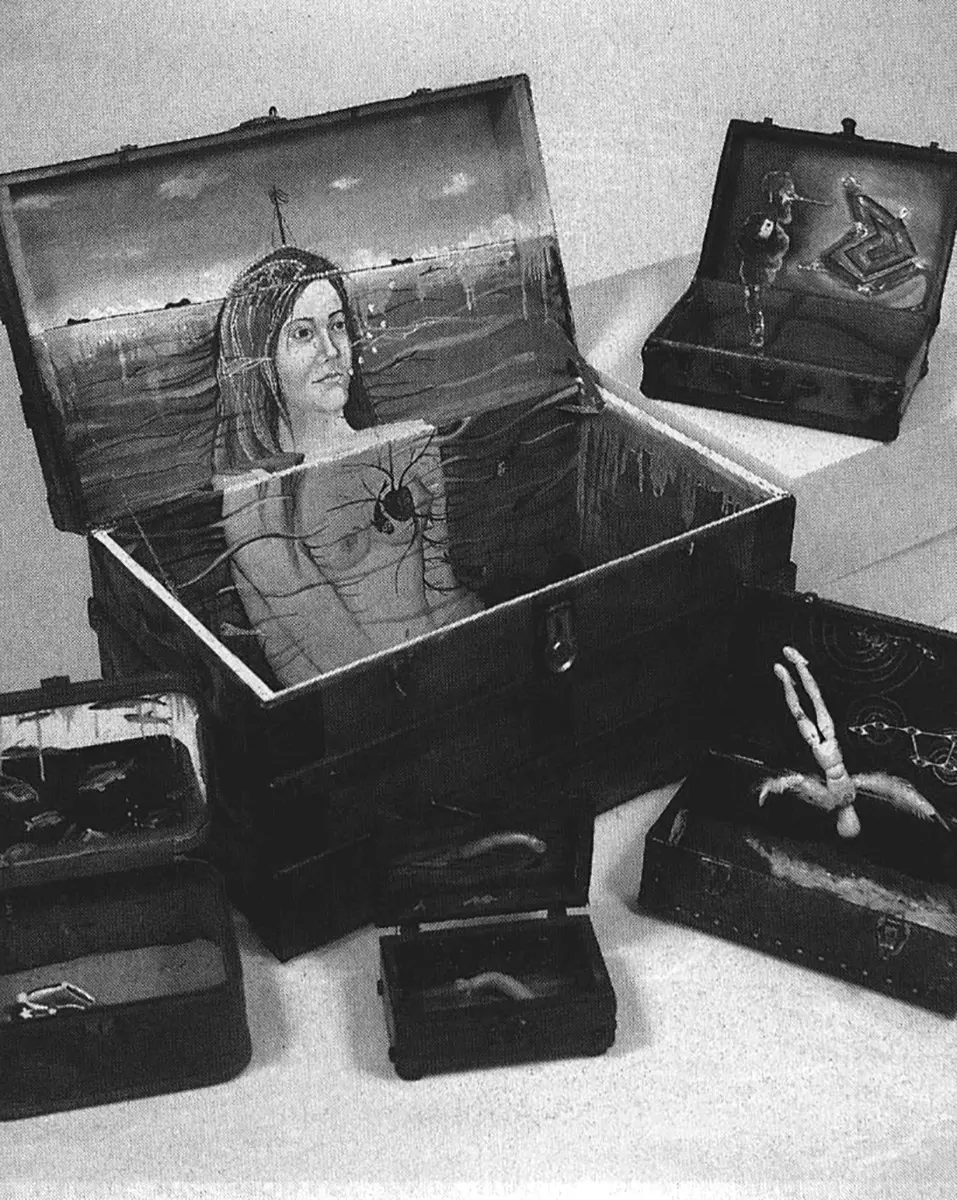
This exhibition at the Nina Menocal Gallery, entitled Island Creatures, was centered on the Cuban diaspora, one of the “revolutionary achievements” that has increased in recent years. Its predecessor was an installation of painted suitcases, which was one of the most impressive works at the last Havana Biennial. Exodus, and in particular the tragedy of the boat people, have become obsessive themes of artists. The waterfront promenade, the “Malecon,” the urban personification of the frontier as a social space for Havana inhabitants, has become a recurrent symbol, as can be seen in Ramos’s work, and is itself a symbolic synthesis of the exodus. Ramos is the only artist to examine the theme in its different facets. Not long ago, Kurt Hollander said that the boat theme could become a kind of fashion, and pointed out that "by focusing exclusively on the journey, without reference to the life before or after, such works do not offer any in-depth criticism." This exhibition, on the other hand, viewed the diaspora as a social and cultural problem and explored its various implications. It did so in terms of a personal testimony, which gave an emotive dimension to the analytical symbolization of the works. Titles such as There Might be Nothing Beyond the Water, The Fear of Being Far from Home, Solitude, or The Dream City all speak of the fears, hopes, and experiences involved in the general desire to leave, well-captured in an unusual print of the island of Cuba seen as an enormous raft in which people are rowing. Ramos also explored the drama of the Guantanamo base in a work entitled Fenced in by Water.
Her painting is based on a relatively primitive language, with comic strip elements and caricature, which are less harsh in the painting than in her prints. The works are baroque, with a proliferation of elements, details, and themes. There is a very eclectic and fragmentary inclusiveness which is characteristic of a certain post-modernist taste. Beyond the question of the exodus, these are veritable altar-pieces of Cuban contemporary life and recall, in a sense, the works of El Bosco, Leonora Carrington, and Remedios Varo. But above all, there is an emotional shudder in the Frida Kahlo style, because of the intimate, participatory subjectivity of her vision. To paraphrase Marti, these works are all fragments of what every Cuban today has hidden inside himself.
GERARDO MOSQUERA