A project, an illusion. An artistic proposal, a subject of special concern. An interest in something known to everyone, but about which nobody cares. Concrete, iron, and wood come together in the hands of this artist, who seems to be fragile, with her small body, gentle hands, and gestures, who creates works that paralyze and shake the body and soul. With a local (yet universal) theme and a few ordinary materials, Sydia Reyes, an artist from Venezuela, has created an installation that astonishes with its conceptual and thematic proposals. Is this a new kind of realism? A very novel kind of realism? The theme may be traditional, but the way in which it is expressed, both visually and materially, involves other forms of social perception.
The elements making up the work of Sydia Reyes are configurations that together evoke a special situation. They are independent of one another; that is, they are self-sufficient as three-dimensional forms, although they are part of the overall structure of the installation. The spectator is merely placed before an event: he is invited to explore, both perceptually and spiritually, the essence of these images. The material is strong, as is the theme, and a close relationship links both.
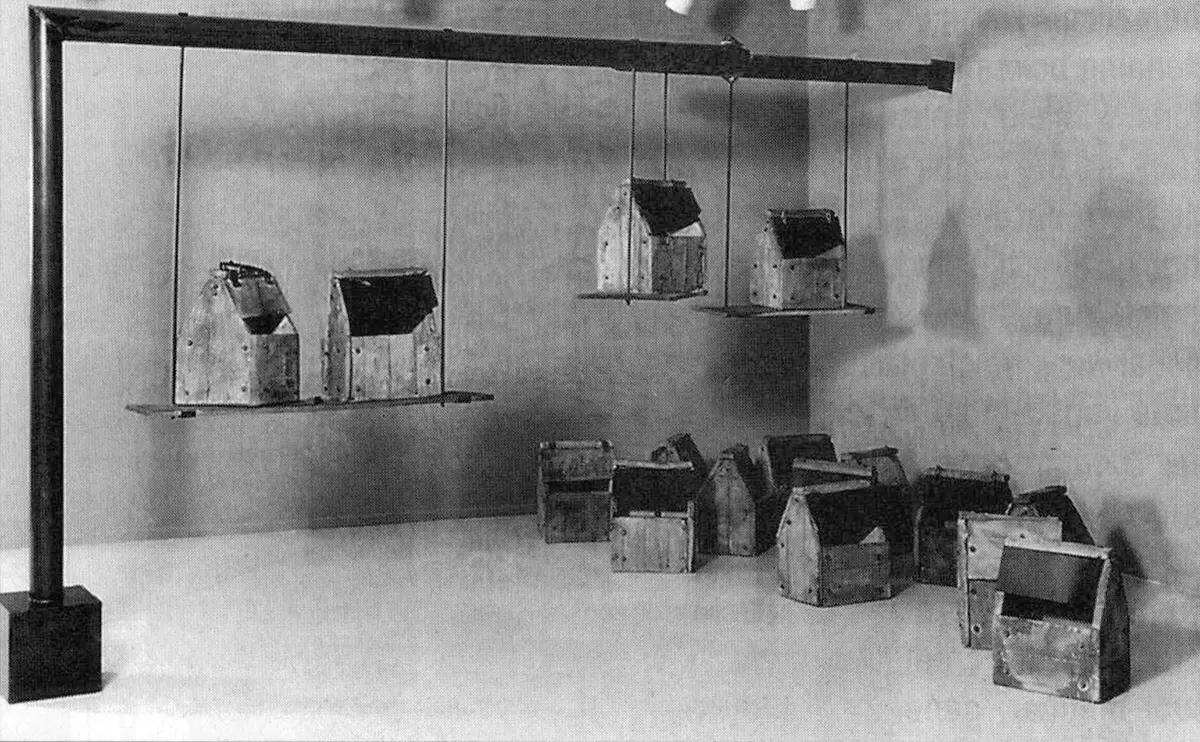
There is no pre-conceived posturing here, but an ingenuous interest in the artistic risks which a creator must face in the challenge to transform a theme into a genuinely artistic proposal. This installation can be seen as a transgression of the traditional conceptual schemas that have to date made up what we understand as an “installation.” Its central feature consists of the surprise reflexes of the relocalization of being, through the theme of street children. The artist has created large iron “boxes,” enormous constructions with grids like those over street drains. It is in this cold, almost hostile network of iron that the street children live. In principle, this is an installation, with a video in the central tube projecting images of children who work as boot cleaners, in which the relationship between time and space (viewed not only artistically, but thematically) is fundamental. The bootcleaning boxes are cement constructions, with elements of iron and wood. They are the boxes of the young boot-cleaners, but they are also their homes, their habitat, the place where they keep their things, their souls. This is a very visual work which produces an immediate impact. The space allocated to the “constructions,” which look like ducts, drains, boot boxes, and trees, without ceasing to be real representations, is an active and dynamic space, where situations are created in a vividly visual manner, generating a dynamic response from the spectator, encouraging him to see, reflect, and think. The children are in the ducts, they come out from the drains, they rest under the trees, and hide their belongings in between their roots, where nobody can find them. Their boot boxes are their working tools, but they are also their companions, their friends, and above all, their “souls,” with which they can establish an existential sense of identification.
This installation had many visual qualities and was solid, simple, precise, and efficient. The elements skilfully distributed over the exhibition space fully achieved the artist’s goal, expressing what she wanted to communicate to the spectator. In the same way, the apparent contradiction between the solidity of the materials, which are permanent and lasting, and the precarious life of the street children, their intrinsic vulnerability, highlights the coherence of Reyes’s work within urban sculpture, if we can call this “sculpture”. Reyes has developed an interest in the exploration of our “habitat” and our existential space, apprehending and expressing both with great precision, efficiency, and clarity, particularly in relation to our everyday life. The rigid execution of the elements and materials expresses at the subconscious level a very harsh reality - hence the “urban,” “human,” and “contemporary” aspects of her work. In this installation, the perception of reality was proportional to the expressive power of its constituent three-dimensional elements. Such a reality is not independent of the artist’s project and her social and artistic sensibility. In conclusion, the installation was a magnificent challenge, an excellent artistic objective that offered a fine, generous, and sensitive lesson which she shared with the spectator.
BÉLGICA RODRÍGUEZ