
Tomie Ohtake liberates form as she constructs it, making it sensual and labyrinthine, visual and tactile. Brazil is undeniably the country where abstraction and geometrical painting have been modified in the search for what Roberto Pontual has defined as “sensitive geometry.” By way of indicating briefly the differences between Tomie Ohtake’s earlier work and her most recent production, as illustrated by this exhibition, I would say that there is a kind of similar move from rigidity to fluidity, from definitive truths to transmutations, from a centuries-old country with rigid canons towards one that is young and flexible in its formation.
Man was undoubtedly the first passenger to embark on interspatial journeys, but women, too, learn about such things from uterine experience, the physical transfer involved in childbirth. Such a reflection springs to mind when we look at these twenty new works by Ohtake on show in New York, all untitled, in acrylic on canvas, measuring on average 59 x 59 in. Color and textural handling are very evident, as they always are in her work. The cellular formations, labyrinths, satellites, and planispheres exert subtle pressures on the walls of the exhibition room, confirming that although structured on stretchers, some of these paintings are capable of levitation, particularly those in red and grey. This impression is particularly clear in the horizontal diptychs, such as piece No. I, with its unparalleled subtlety of grays.
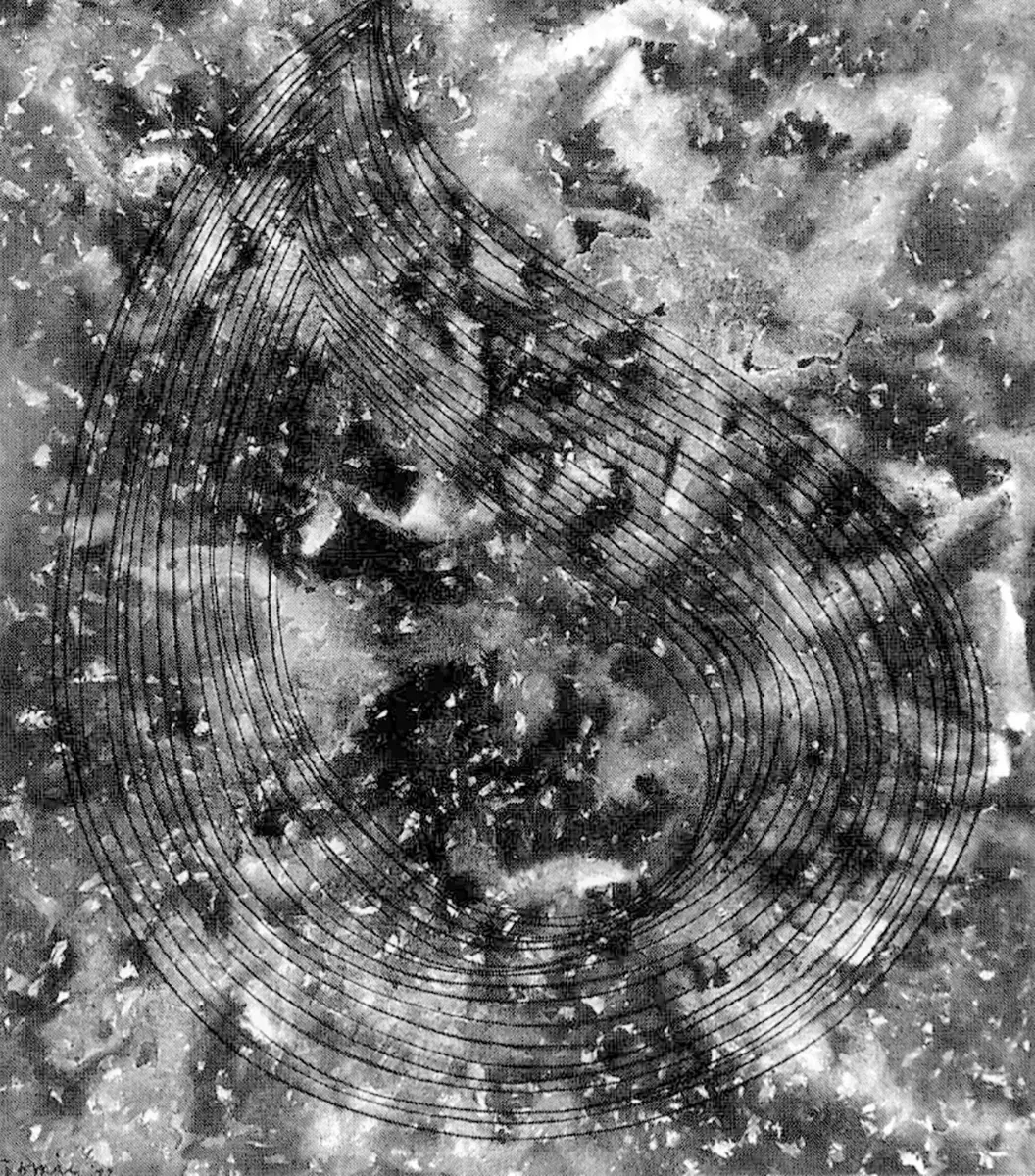
Pictures Nos. 3, 7,16, and 20 confirmed the importance of a wider knowledge of this artist’s work. However, the show could have been more effective, impressive, and sensitive if there had been between 5 and 10 less works, and certain changes to the museographical presentation in New York would perhaps have made this travelling exhibition more interesting. The show was organized by the Museum of Modern Art of Rio de Janeiro to mark the 80th anniversary of the artist’s birth. It was co-sponsored by the Ministry of Foreign Affairs of Brazil and the Grupo Ache and Transbrasil enterprises. Consisting of twenty works dated between 1992 and 1994, under the title The Creation of the World, the show had gone from Rio to the Barbican Arts Centre in London and the Bass Museum in Miami before reaching the Americas Society in New York, from where it will go on at the end of October to the Museum of the Americas in Washington, D.C., where it will close. A trilingual catalogue, with a prologue by Marcus de Londra Costa, was published to coincide with the show.
Although there are no watertight compartments in her work, where everything is interrelated, I would like to mention two other points that have some historical and social importance to the painting in this show. Tomie Ohtake was born in Japan, came to Brazil in 1936, and acquired Brazilian nationality in 1967, when she received the Itamarati Prize, the highest prize awarded by Brazil. The large Japanese colony in Brazil is only five years older than Tomie herself. Oriental immigrants have been laborious and persistent in their scientific and artistic contributions to the country, particularly the women immigrants. Tomie Ohtake has received a warm and respectful welcome in her country of adoption. Along with Tarsila and Djanira, the firstborn in the last century, and the second just one year after Ohtake, she forms a trilogy, which of course is by no means exclusive (there is also Anita Malfatti). These artists have shown singular energy in their work, which is full of subtleties and singularities in form, color, sensuality, and professional skills.
Ohtake turned to painting just after the middle of the century, and it soon became part of her already organized family life. She began with landscapes and everyday scenes, but realized that she was not really interested in the reproduction of reality and moved towards abstraction with natural ease. Henceforth, the theme or the possible differences between a figurative or abstract approach were of little interest to her. Since then, she has remained one of the key figures of Brazilian art.
GRACIELA KARTOFEL