
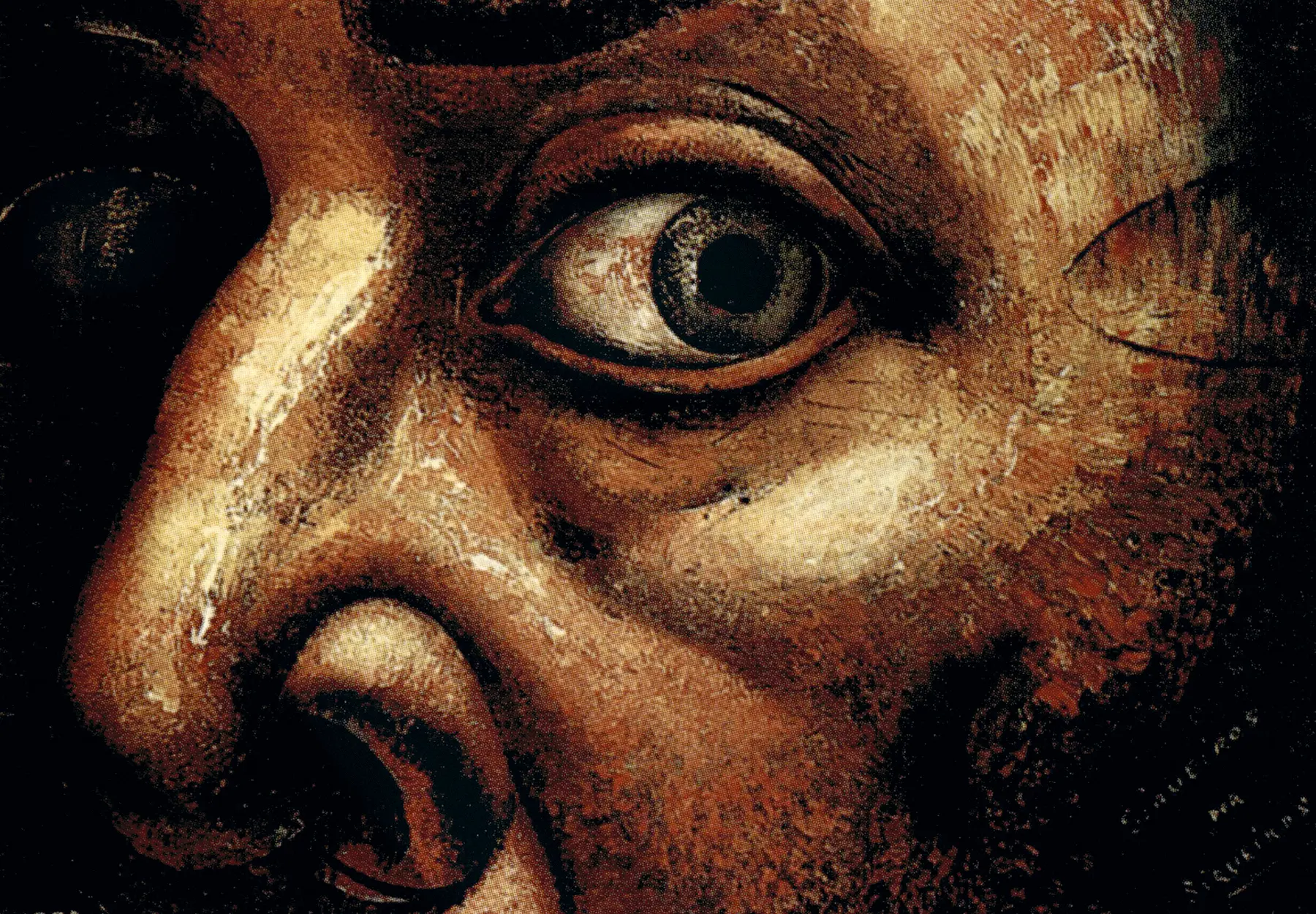
In a short but excellent study on Siqueiros’s period in the United States, the German historian Irene Herner recalls that Siqueiros and Pollock were very friendly, so much so that the Mexican used to refer to Pollock as Nice Guy.1 However, they ended up detesting and almost killing one another.2 A recent exhibition in Düsseldorf, titled Siqueiros/Pollock - Pollock/ Siqueiros, once again focused attention on this dispute and tried to show in visual terms the influence which the Mexican muralist had on the first great painter in the history of art in the United States. The above-mentioned text by Irene Herner was excluded from the general catalogue of the exhibition, perhaps because it proved beyond doubt that the subject is more complex than the arguments put forward by simplistic critics or by those who feel they have been offended.
Siqueiros vs. Pollock is not the only dispute in the history of art that concerns the North vs. South debate. I should like to refer to three others, each of which is relatively significant, and where the controversy comes from the North and is directed against the South. Here we have no problem in acknowledging what Tarsila do Amaral owed to Léger and the surrealists, or Alejandro Obregón to Klein and Rothko, or Antonio Enrique Amaral, Vicente Rojo, and Antonio Seguí to pop art at a given moment. But history abandons the need for rigor when the influences are in the opposite direction.
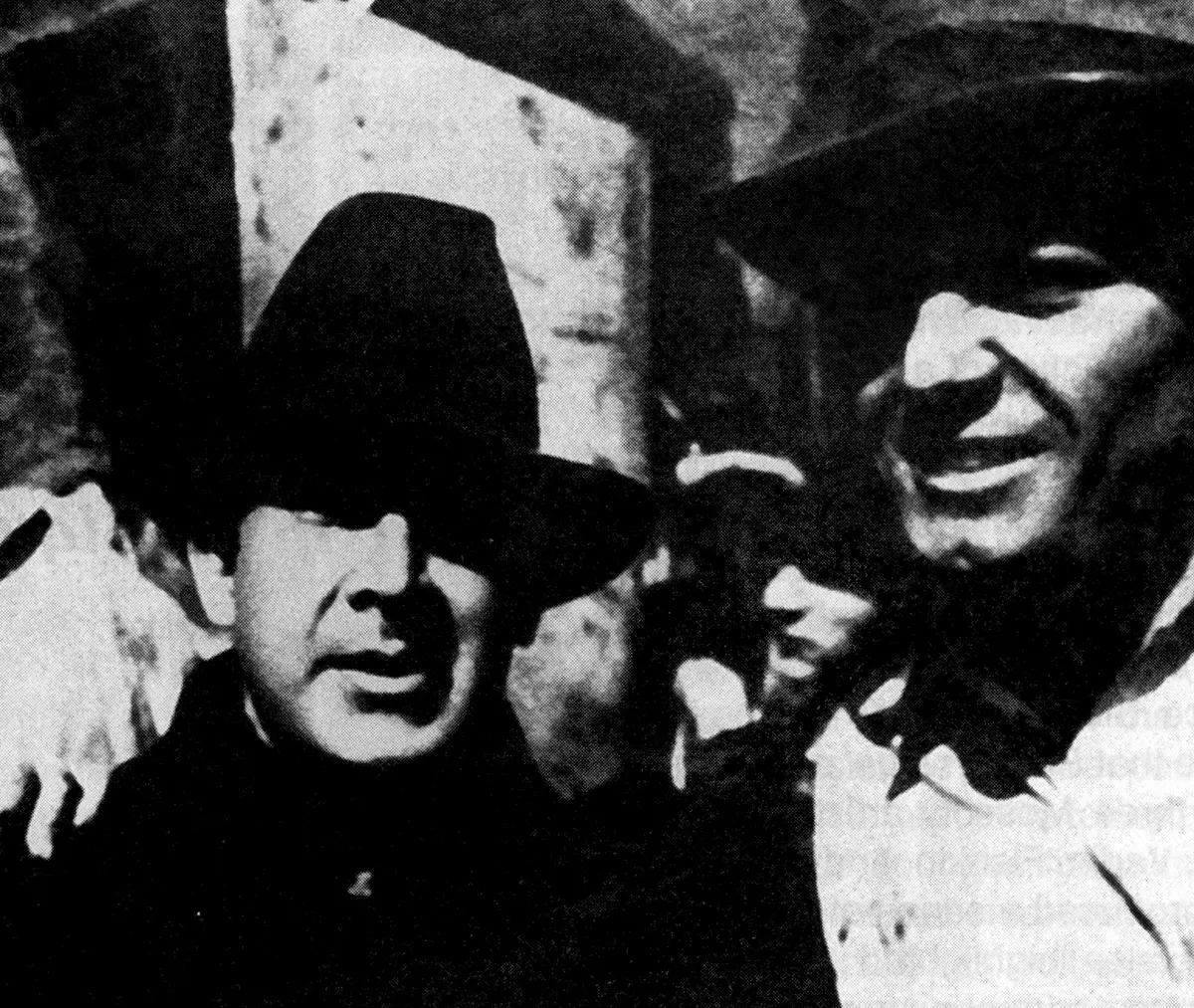
1. What relationship exists between the "classic" Stuart Davis and the Torres-García of the New York period, i.e., from July 1920 to July 1922? I ask this question because it has been said that Davis was influenced by Picasso in Paris between 1927 and 192,8 and that after he subsequently settled in the modern metropolis with its plethora of signs, billboards, and flashing advertisements, he developed with personality. This view is correct, although incomplete. Stuart Davis and Torres-García exhibited their work jointly at the Whitney Studio Club of New York in April 1921. On April 11, Davis wrote the following: "Let us rather use an alphabet of letters, numbers, canned goods labels, tobacco labels, in a word, let these well-known, purely objective things be used to make a direct impression on the spectator."3 In this way, Davis defined what in the end was to be his painting, although the truth is that his eyes did not see beyond the reduced space of the cubist table and thus could not appreciate the open space cluttered with signs of the Manhattan streets, which Torres-García did know how to see and paint, in a continuation of the experience which he had initiated in Barcelona in 1917. Torres-García painted the alphabet and number rhythms of the great city, and Stuart Davis was fortunate to appreciate this when they exhibited together. Years later, Davis also became interested in urban landscape. Torres-García had already begun his period of grid pictures, which influenced the sculptural work of the North American artist Louise Nevelson and some isolated works of the painter Adolph Gottlieb.
2. The influence of Roberto Matta on Arshile Gorky has been mentioned before, although frequently with reluctance and prejudice. This influence can be appreciated from the following brief remark by Alfred H. Barr Jr.: "Gorky had been a quite well-known figure but a rather derivative painter for fifteen years before he found himself in 1943."4 Matta arrived in New York in 1939, and he met Gorky at the end of 1941. His influence on Gorky was not in any way reduced to the technical and facile aspect of diluting oil with a lot of turpentine, but can be seen in the color, form, and iconography which characterized Gorky's work when he abandoned his Picasso-like forms cut out clearly against flat backgrouds, typical of his earlier years, and moved towards subconscious forms similar to these of the young Chilean surrealist. However, unable to recognize the fact with objectivity, Diane Waldman wrote in her study of the work of her compatriot: "While critics have noted that there is little substance in Matta's work, he was a spectacular draftsman and superb technician. Gorky was attracted to this charismatic presence and dazzling, if inherently superficial, style and gave meaning and substance to many of Matta's ideas."5 For the first time in the history of art, a derivative artist became interested in the agility of an insignificant artist and managed to become both serious and complex.
3. A short while ago, in a class on the history of Latin American art which I give at the National University in Bogota, we were studying the work of the serpentine minimalist Mathias Goeritz. I apologized to my students for being unable to also project Tony Smith's snake, since I seemed to have misplaced the slide. As I was arranging my work material at the end of the class, I was ashamed to discover that a work which I had attributed to the Mexican was in fact that of Smith, entitled Snake is Out (1962). Now, in a magnificant and well-documented study on the influence of pre-Columbian art on certain great artist, Barbara Braun devoted 28 lines to Smith and the following five lines to the Mexican: "Mathias Goeritz, a catalytic German post-modernity living in Mexico, achieved a similar fusion of Aztec architectural sculpture and minimalism in works such as The Serpent, (1953) which was installed in the experimental El Eco Museum in Mexico City and may have been known to Smith."6 The brilliant efforts made by Barbara Braun are marred in this way because, at least in the works considered, an imitator has been given more merit than the artist being imitated.
The Siqueiros-Pollock match is much more complex because it is a product of the Cold War. Originally, it was seen as a fight to the death between socialist realism and abstraction, although this dichotomy is false when we recall that the Mexican muralists never practiced what was known as socialist realism. Furthermore, according to Robert Motherwell, Pollock himself was rather left-wing.7 Thus, he was part of the privileged group of young painters who were chosen in 1936 to work with Siqueiros in his Experimental Workshop, "a propaganda art workshop of the United States Communist Party, funded and directed by the Mexican painter."8 The Workshop provided instruction on the use of thick paint and industrial lacquers, as well as dripping and pouring. Irene Herner gives a wealth of information and details on this subject.
Does this mean that Siqueiros influenced Pollock? Yes and no.
Pollock was much more interested in language and in José Clemente Orozco, although it was Siqueiros who opened up for him a technique without which he would never have been able to achieve his own work. This technique only acquired its real dimension when another Latin American, Matta, explained to him the profound meaning of surrealist automatism. Idea and technique immediately came together. And if this is the case, why then give priority to the technique, which is Siquieros’s contribution?
Commenting on the three paragraphs on his art, which Pollock published in the winter of 1947-1948, Harold Rosenberg noted that they were devoted entirely to method and not to painting. Rosenberg added: "Apparently, he assumed that the value of what he did lay in his way of doing it—an assumption common to scientists and to celebrators of sacred rites."9
A fundamental difference had arisen, which in no way changed what the North American learned from the Mexican: Pollock had become the celebrator who, through his painting, exorcized the contradictions of his own psyche, whereas Siqueiros continued to be interested in the contradictions of society. Siqueiros aspired to pure art, which he believed was possible only under a new kind of social organization, whereas Pollock did not wait for such a change before devoting himself to an art which, although not pure, at least came pretty close.
NOTES
1. Irene Herner, "Siqueiros/Pollock: Redes," in Nueve Obras Maestras de David Alfaro Siqueiros, exhibition catalogue, Arvil Gallery, Mexico City, August-September 1995.
2. Op. cit, note 17.
3. William C. Agee, Stuart Davis - The Breakthrough Years, 1922-1924, exhibition catalogue, Salander-O'Reilly Galleries, New York, 1987.
4. Alfred H. Barr Jr., Defining Modern Art - Selected Writings, Harry N. Abrams, New York, 1986, p. 234.
5. Diane Waldman, "Arshile Gorky: Poet in Paint;" in Arshile Gorky 1904-1948—A Retrospective, exhibition catalogue, Salomon R. Guggenheim Museum, Harry N. Abrams, New York, 1981, pp 51-52.
6. Barbara Braun, Pre-Columbian Art and the Post-Columbian World: Ancient American Sources of Modern Art, Harry N. Abrams, New York, 1993, p. 311.
7. "Temoignage de Robert Motherwell," in Jackson Pollock, exhibition catalogue, Centre Georges Pompidou, National Museum of Modern Art, Paris, 1982, p. 312.
8. Irene Herner, op. cit.
9. Harold Rosenberg, "The Mythic Act," in Artworks and Packages, Dell Publishing Co., New York, 1971, p. 58.
ÁLVARO MEDINA
Colombian art critic and historian. Winner of the National History Prize for his recently published El arte colombiano de los años veinte y treinta.