
An inhabitant of the center of Caracas and an artist of recomposed images, Alexander Apóstol has a child-like, half-guileless, half-mischievous face which proves surprising to those who have seen his work but not met him personally before; an impression very different from the twisted (almost perverse) puzzle made up by his photograph-images which were almost too much for many when he first emerged on the art scene in Venezuela. They are still too strong for many exhibition places, which prefer to censor his work. But Alexander Apóstol (Barquisimeto, 1969) is well beyond the scope of such moral judgements, which to his surprise have been made about his work. Discreetly, he has watched the astonishing growth of his photography like someone watching a western movie: excited and sometimes incredulous. From one day to the next, he entered into the mare magnum of exhibitions, publications, major biennials in the country, prizes, offers to participate in collective exhibitions and to present a one-man show, and the inclusion of his montages in major private and institutional collections.
At the beginning of the 1990s, Apóstol seemed to be like a precocious child, a source of promise in the equally adolescent world of art photography in Venezuela. At the age of 22, he burst onto the scene with his unusual work, creating confusion and raising a number of questions: where to place him, under what label to classify him, and so on. The replies were sought and confirmed in the international scene (mention of Witkin, the Star Twins, Gilbert & George being obligatory)—which are useful references in evaluating the impetus of a certain kind of Venezuelan photography with a marked tendency towards manipulation and plastic codes, but inadequate as a yardstick for individual works.
Today, the sterile discussion about the place that this "photographer" does or does not occupy has ceased in the wake of the sheer weight of his work. The strength of this already mature production leaves no room for idle critical pursuits or hesitant wagers, but points towards the consolidation of an artist (whose use of photography may be "more" or "less" than the conventional norm, it does not matter) whose discourse and proposals have proved to be very impressive.
Doll’s House
Apóstol began to take his first photographs when he was 18, and he opted for black and white once and for all. This was the time of the passionate workshops in the Quinta Manoa, under the protective wing of Ricardo Armas, an emblematic photographer on the contemporary Venezuelan scene and an initiatory figure for an entire generation of young artists who have now taken their place among the photographers of the decade.
Apóstol, in a process which was both a game and an apprenticeship, chose dolls as the models for his first works; porcelain figures which he dressed and undressed, making them up and combing their hair. In addition to the mischievous transgression of conventional codes (boys do not play with dolls), his interest in the mise-en-scène came from his apprentice experience in various film projects. The habits he acquired during this period of montages and work with clothing and decoration characterized this first stage. The inanimate compliance of the dolls made them perfect accomplices for these interminable games, where the artist explored ad infinitum such aspects as framing, precise lighting, exact exposure—all framed within stage-set displays.
From the dolls, Apóstol moved on to human beings, friends, and family members willing to enter into the game of dressing up and set designing. Using the same aesthetic as with the dolls, his women appear at rest, with their pale faces and loose clothing: the photo-sensitive paper was then ready for the line work, the scratches, the stains—all of which would make the final result far from a "perfect copy." Sometimes, he immersed himself in a world of nudes, more out of a voyeuristic impulse than for any intention of anatomical study. The experiments and exercises followed one another, recalling photographs from the turn of the century, reminiscent of the morbidity of Cameron or Lewis Carroll.
From his first photograph, Apóstol knew that he could never be a documentary photographer. "I would be a failure as a reporter. To be a documentary or press photographer, you have to keep your eyes open, you have to be alert at all times. I am very disoriented," he says laughingly. He never goes out in the street to take photographs; he has never been able to work more than one full day in advertising (which, at times, he regrets for financial reasons), and if he travels, he takes only a few photos in the most crassly tourist-like fashion. He is not made for this kind of agitation. He prefers the tranquillity of his studio to bury himself in old encyclopedias and magazines from the 1950s, to ruminate in silence, and to do clumsy sketches of the images emerging from his head with astonishing fecundity. To construct them, he needs more than just disguises and old clothes—and he found what he was looking for in the world of liquids. Manipulation in the laboratory allowed him to recreate the codes and aesthetics of the past. Gradually, he purified his desire to achieve impossibilities,» moments which might have been, but utopic nevertheless because of the anachronistic nature of his themes. "I would only be a documentary photographer if I had a time machine," he says. But it is not mere nostalgia that motivates him, but rather a conviction that the keys which he is seeking are not to be found in the present.
The Ferocious Chicken Coop
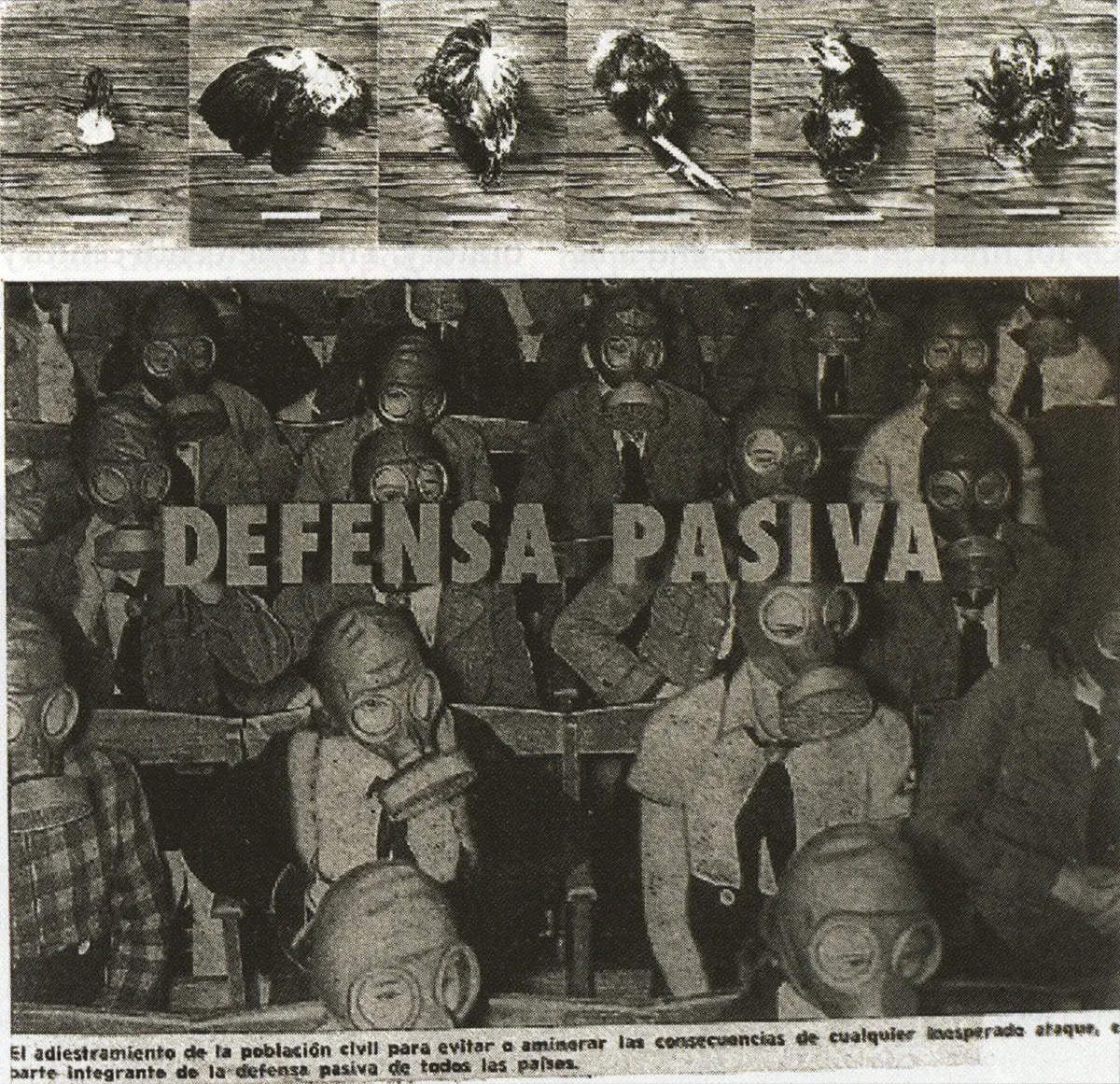
The Quinta Crespo market, just a few blocks from Apóstol's home and studio, is a frenzied uproar every morning. The artist's excursions around the many meat stands astonish the market vendors, who have never been able to understand why he scrutinizes the rotting fish and chicken heads, his requests for entire pieces, perfect pieces for subsequent dissection in the laboratory. The nineteenth-century sense of aesthetic morbidity was replaced by one bordering on necrophilia, but equally handsome in its irreality. The fetid odors of rotting flesh remained in his studio. Then, in the gallery, the chicken or fish acquired the texture of some symbolic portrait, floating almost mystically in space.
The hens entered his work when the ideas and techniques had become sufficiently mature to allow the poultry to become part of an unavoidable thematic and narrative axis: the ironically everyday discourse. The ambiguous interplay with domestic themes is full of both sarcasm and veneration. These works are far from the early exercises, although there remained the constant experimentation with the techniques of fixing, fogging, and montage, along with fragmentation, superimposition, and sewing, as required by the recently assimilated large formats.
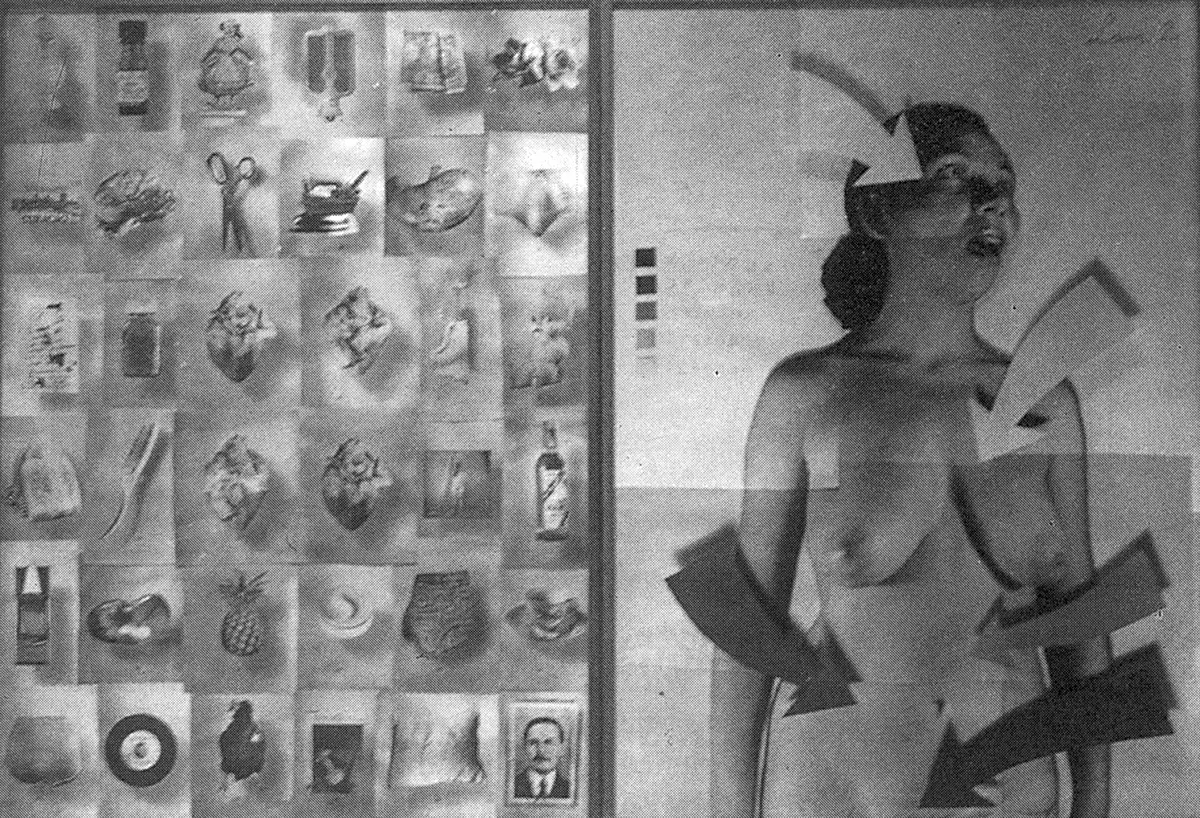
While the mise-en-scène was initially theatrical, it subsequently became of a more graphic nature. At the beginning, the game occurred before the take; now it began afterwards—in the composition and subsequent recomposition, on the various limits set by the medium and large formats. A language based on recurrent codes thus emerged through the extensive list of interests with which the artist first set out on his journey.
The year 1992 marked a turning point in his career: he was selected to represent Venezuela, along with four other photographers, at FotoFest in Houston, one of the most important photographic gatherings on the continent, which opened up the way to the international scene. Apóstol's ability to transcend mere anecdote and achieve a complex, polysemous image that is both emotionally expressive and intensely ironic caught the attention of the North American curators who visited Caracas to prepare the final Venezuelan selection. That same year, Apóstol began a long series of portraits for the art journal Estilo. Thanks to Apóstol's intuitive montages, those interviewed—a wide range of artists—appeared in these photographs recodified in their whims, gestures, surroundings, and aspirations.
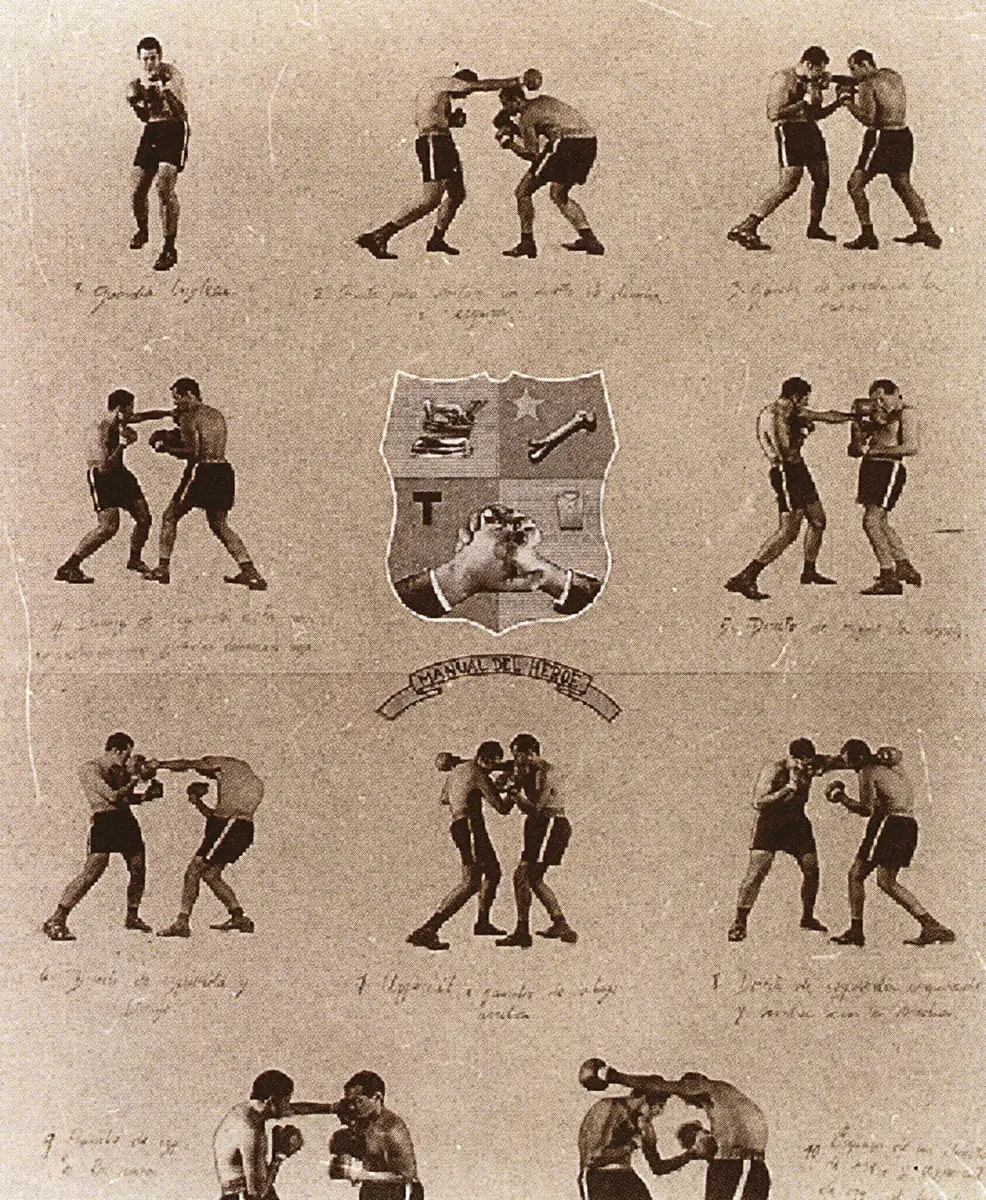
Apóstol's zoo gallery did not have any four-footed creatures, and he found them on a ranch in the state of Apure, in the form of buffalo from the Venezuelan plains. Apóstol's interest was in no sense ecological: he wanted to establish a parallel between these working animals and man himself. Both figures, dissected and labelled with the traditional meat cut names, are reminiscent of instruction manuals, another important aspect of his work. "You can learn everything in these manuals, he says. And everything can be re-interpreted."
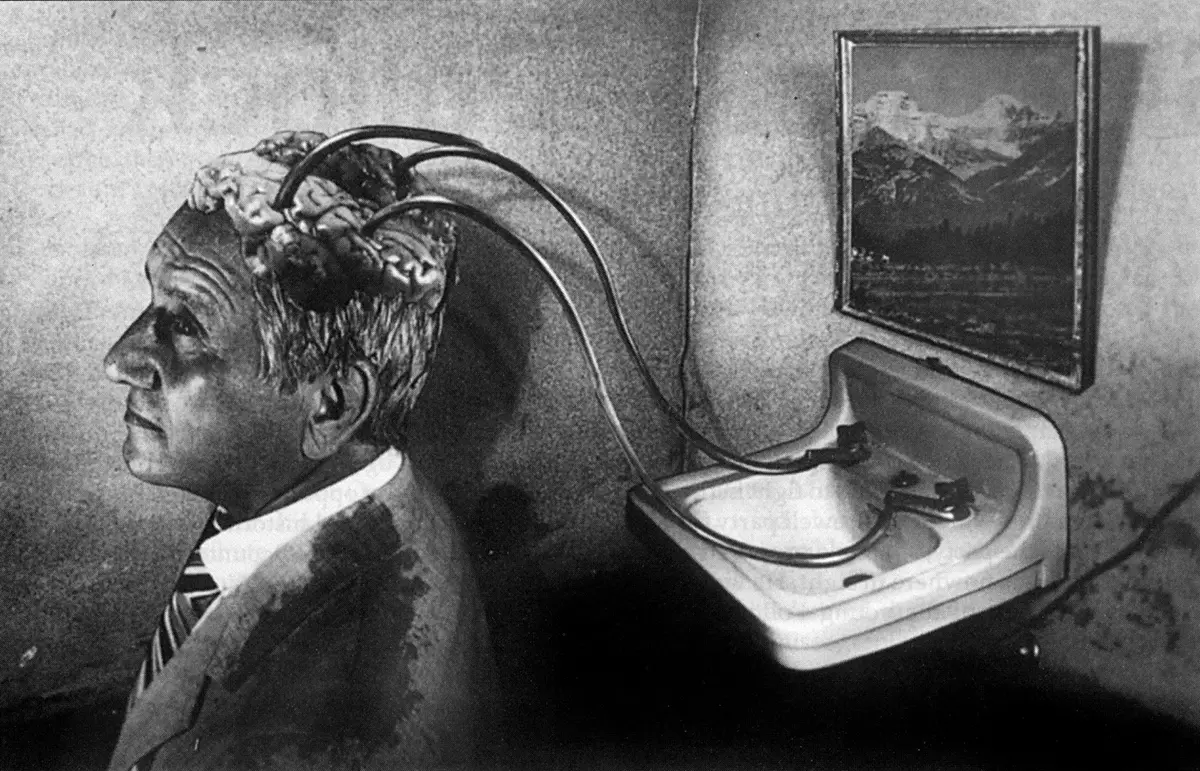
The Happy Family
All the members of his family have posed at one time or another for Apóstol, whether or not they like the results. They let Apóstol indicate which posture to adopt, when to smile. He then dissects or mutilates them in the montage, enclosing them in sepia alongside fragments inspired by encyclopedias, dictionaries, manuals, or old publications. He returns constantly to the aesthetics of the 1940s and 1960s, and above all, to the 1950s, which for Apóstol was the golden age for Latin America. There was steady prosperity, unmarked by the effects of the war, which allowed the modern cities of Latin America to flourish. All this, along with the growing influence of the United States, brought the American Dream and the panacea of comfort to the countries of the South. It is this ideal of life which Apóstol recodifies.
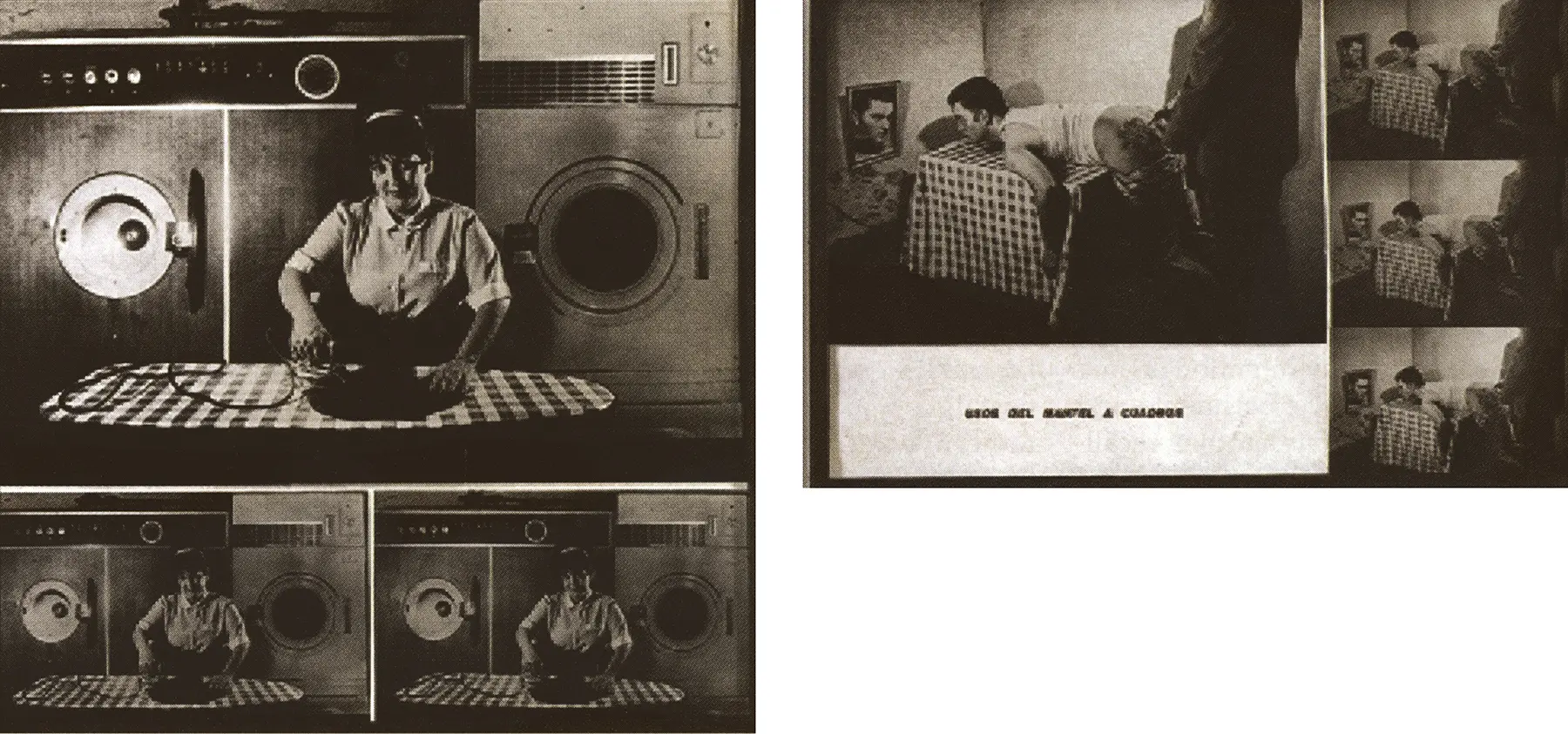
Shaped by his early amusements, Apóstol's most recent work is an attempt to discern (and unmask) the interplay of domestic and family morality: all that should and should not be, and especially all that should be shown and should be hidden. The external facade of this double and hypocritical ethics is resemanticized ironically in school writing exercises, kitchen artifacts, and utensils, a square-patterned tablecloth, and the white ironed shirt, which symbolizes correct masculinity. "I have always lived with this: being a well-behaved child, following correct values." Now the child reveals his rebellious and perverse intelligence. In works such as Uses of a Checkered Table-Cloth, Crossword or Family Washing, the strict roles—the housewife, the father, the perfect child— are reworked with sarcastic humor. The formats continue to be huge, and sometimes the work reaches down to the floor; the rustic juxtaposition has been replaced by montage and a cleaner process of rephotography; and little by little, script texts have been included.
Apóstol is no longer interested in the old dispute of whether he feels closer to being a photographer or a plastic artist. He is not afraid of ambiguity, seems at home between the two, and enjoys the disconcerting effect his work produces on people. He resists any kind of classification. "I feel I am a photographer, because that has been my support, but I don't care where they classify me, because my work remains the same." For that reason, and because he knows that he is not a technically perfect photographer, he does not exclude the imminent possibility of working with new media.
The roof, which he had reached in the Venezuelan market this year, has opened up like a skylight. His incipient incursion into the international scene in 1992 was consolidated in 1994, with exhibitions in Mexico and Guatemala bringing his work to a wider public. Next year, his work will go to New York. The apostle of unusual proposals and aesthetics, Alexander Apóstol, has forced his way into the limelight.
CLAUDIA LARRAGUÍBEL
An arts graduate, Claudia Larraguibel is editor of the journal Estilo and writes for several publications in Venezuela and abroad. Lives in Madrid.