
In her work entitled IN MEMORIAM, Ana María Mazzei strengthens and revitalizes her psychological concentration, as well as her artistic, aesthetic, and conceptual proposals. From the psychological point of view, she reveals an intuitive refinement and sharpness of sensibility that prevent any weakening or loss of focus. At the artistic level, she continues the line of experimentation which, since the 1970s, has led her to explore different technical options and alternative kinds of supports. In the same way, at the aesthetic level, emphasis is placed on the combinations which have been paramount throughout her artistic development, that is, those evoking the interplay between the symbolic and the playful, the virtual and the real, the expressive and the critical, the direct and the metaphoric, the past and the present. Finally, her conceptual rigor is also evident, with this work providing a supreme opportunity for profound analysis of the substance, devoid of any accommodating, superficial considerations.
The work consists of 90 rhomboid cylinders set in a precarious, but repeated vertical balance. They pivot and take on a sensation of softness due to their material components—inflated modules whose stability is the result of their sand and water base. The resolution is achieved through the resistant and rustic qualities of the plastic material used, which creates a challengingly rough tension on the surface. Through her use of these supports, the artist reiterates the contemporary images of the Yanomanis, as well as those of the Ewaipanomas, the celebrated headless warriors reported by Walter Raleigh and illustrated by Theodore de Bry in the sixteenth century.
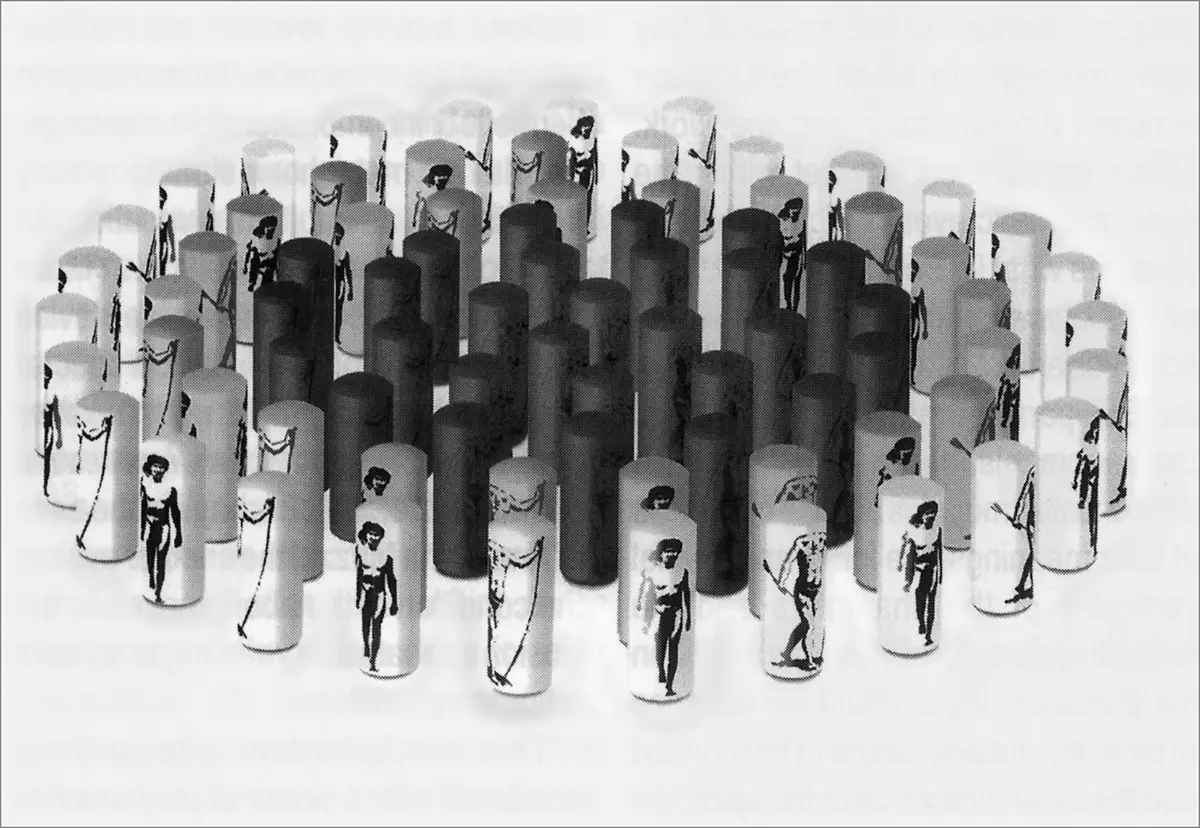
Ana María Mazzei transforms her proposal into an excellent and enigmatic installation, the direct result of contact with spaces that evoke an ambiguous and provocative sense of time and a suggestive psychological environment. The spectator is caught up in an experience full of unresolved associations, suggestions and metaphors, ramifications, and journeys which are both perplexing and astonishing. These sensations are reinforced by the permanent sense of self-regulation that results from the interactive relationship between subjects and modules. Metaphor and the sense of play are, I believe, the two poles that establish the hegemonic content of this resolution.
The symbolic space of metaphor and the recurrent use of the sense of play allow the artist to break the isolation between the spectator and the work. These two aspects are set within the same aesthetic event, which in the end validates what D. Bell called the eclipse of distance. Mazzei undoubtedly achieves an eclipse between the past of the Ewaipananomas and the present of the Yanomanis, between the presence of the inflated modules and the otherness of their meanings, the initial and inertial verticality of the characters and the reiterative swaying of the forms, between the presence of place and the distance of time, the outside nature of the context and the inner dimension of the spirit, the simulation of figures and the dissimulation of their exhortations, the ratification of an ecological-primitive vocation and the expressiveness of a psychological-contemporary vision, the aesthetic solemnity of a sense of ordering and the simultaneous alterations resulting from coincidence and simultaneous participation by the subjects. In the final analysis, the work captures the essential problems of paradox and the inhibitions characteristic of the ludic world.
Instead of finding himself merely in front of the work, the spectator begins to move around in it and becomes a protagonist within the artistic event that it encompasses. The immediacy of sensations, the curiosity of contact, the anxiety of the experience, the reiteration of the images—in short, the invaded and activated space becomes a territory which is experienced and felt through multiple prolongations that are initially discursive and referential and become associative and introspective. The artist creates a sensation of a place without any limits or center, a labyrinth where there is always some small passageway promising freedom. Such an interpretation recalls the remark by Octavio Paz that space has lost, as it were, its passiveness: it is not something which contains things but something in perpetual movement, altering events and actively participating in their transformation, it is the agent of change, a source of energy.
This takes us back to the two axes of the aesthetic foundations of this new work: metaphor and the ludic element. Metaphor becomes a system of associations moving towards abstraction, although the artist never takes refuge in hermetic or incomprehensible meanings. For Mazzei, metaphor is simultaneously a sentiment, an intuition, a vocation, an appreciation, and a position... More specifically, it is a comparative device which is based on an illusion, a specter (Schiller has said that what charms fantasy is a specter and what moves the heart is an illusion). Perhaps in the case of Ana Maria Mazzei, the specter evokes the condition of the aborigine, while the Illusion appears as a yearning to achieve a human condition.
This metaphorical approach is combined with a sense of play, which in this case takes on a "stubborn" air. Mazzei creates a floating space through the vibrant and recurrent relationship between modules, which are successively stabilized and transformed. Each element "stubbornly" returns to its original position, where it once again becomes vulnerable. But the sense of play is not merely a source of superficial humor, but has a certain satirical intention. It is not a game that makes us smile, but a means of activating an open-ended vision where nothing is hidden. In this wide-ranging context, the artist plays with real movement and virtual time in an attempt to allow the past and the present to express what has not yet been said. In the final analysis, Ana María Mazzei tries to affect our consciousness through a game that reminds us that the return to order is always accompanied by a desire for dignity. What she proposes is an interplay between different times: the past, the present, and the future. All these are moving images of the same reality, which exists only here and now. There is no other time. There is only the time which is expressed now and within—because time does not pass, only ourselves, who in the end also cease to pass.
VÍCTOR GUÉDEZ