The earlier work of Diego Toledo can be seen as an autonomous discourse in which, in a kind of monologue based on organic forms and textures, the materials express their essence in an attempt to override cultural forms. Now that such a discourse seems to be well-established, the artist has begun to test the capacity of resistance of his own proposals. In the pieces which he presented in this new show, entitled Sitio, Toledo makes less use of materials in their rough state and turns to others constructed of natural elements, which, although not conceived by man, have been subjected to the rigor of ideas and language. Thus, landscapes, fields, and constellations once again confront geometry, steel, and electric cables, but above all, words through the eyes of the spectator. One of the basic elements of the composition of these works, at both the formal and semantic levels, is the value of a typography which claims to be anonymous. Diego Toledo unsteadies the correspondences which we have assumed exist between written language and visual language, which, in this case, is made up of photographs, maps, and abstract constructions that are often similar to (or perhaps merely are) letters.
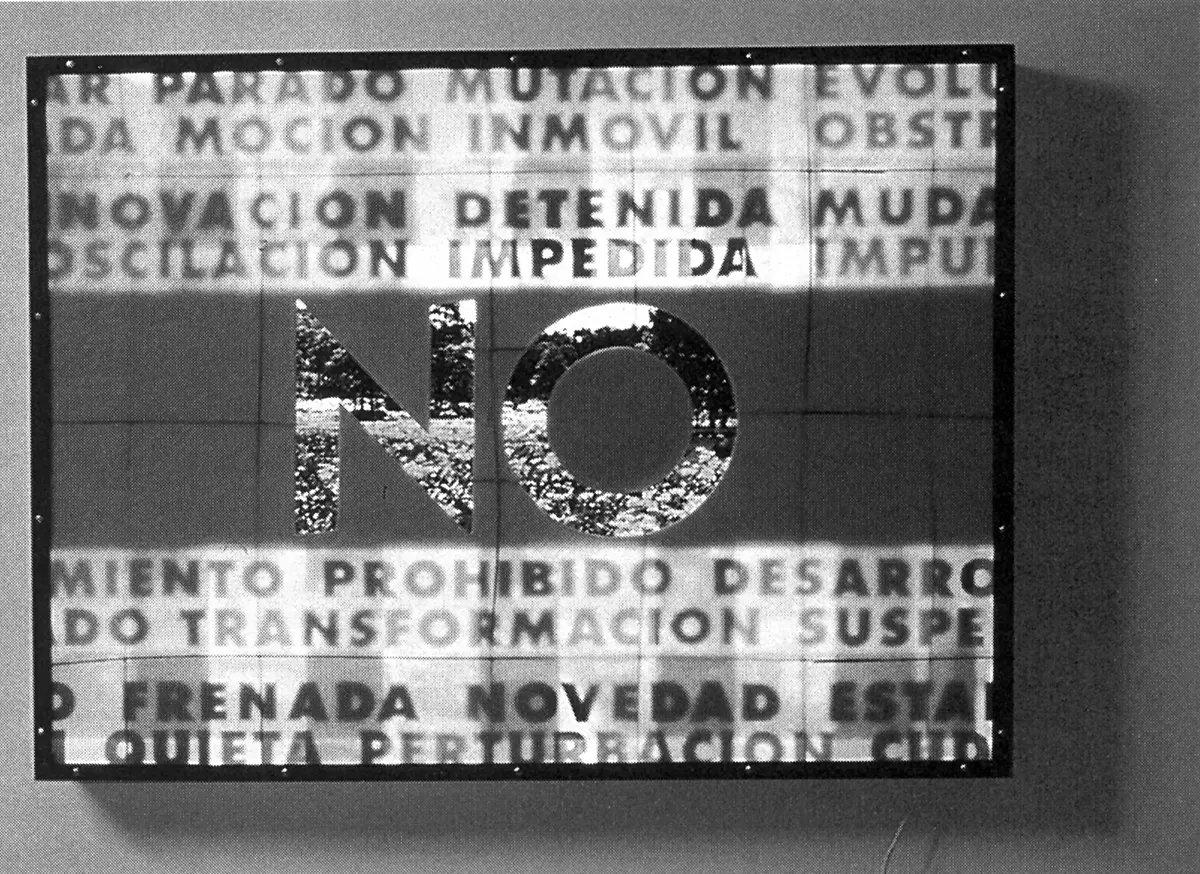
In Yes and No, the affirmation and negation stand out against a background landscape enclosing the forms of language. The compositional elements of the work cancel out one another, creating a tension which is reinforced by the juxtaposition of a series of conflicting terms ("rhythm," "restricted," "evolution," "stagnating") which try to move around but are held fast by the spectator-reader’s eye. Stars is based on the confrontation of a word ("stars"), an idea "cosmographies", and the simulation of the image to which the latter refers. Curiously enough, the first to attract our attention in this work are the side lights, followed by the concentric circles of the map into which, finally, the superimposed letters seem to be penetrating. In the same way, the concepts of time and space evoked by the word history in the work of the same name seem to dissolve as past and future—located at their extremes—lose their consistency, while the present acquires a sense of volume, casting a chaotic and illegible shadow over the wall.
In using written language, Toledo forces the spectator into becoming involved with his works, obliging them to make a value judgement. In Without More Ado and In You, whether the space is inserted into the words or the words stand out against the space, the spectator decides how to read the works and realizes, after deciphering them, that one of them only specifies "without more ado" and that the other specifies nothing at all. In this way, the words, which sometimes become letters and sometimes forms, mean only themselves and lose their deceptive character resulting from typography when they are emptied of their cultural wrappings.
MAGALÍ ARRIOLA