
The last quarter of 1995 saw the opening in Bogota of a new exhibition space, where the already traditional Diners Gallery now has its own premises in a large, old residence remodelled tastefully by the architect Andrea Amaral. To mark the occasion, the Gallery invited Eduardo Ramírez Villamizar to present a series of twenty-five sculptures executed between 1989 and 1995.
In this show, Ramírez Villamizar pays tribute to the memory of Casimiro Eiger, one of the first critics to exalt the talent and creative capacity of the artist who has now become a master. Instead of the customary essay on the works presented, the catalogue reproduced fragments of the texts prepared by Eiger for his programs broadcast on the National Radio of Colombia between 1948 and 1959. It is astonishing to see how these comments on the pictorial work that made up Ramírez Villamizar’s early period have not lost any of their topicality: many of the remarks made by the critic are perfectly applicable to the artist’s current work.
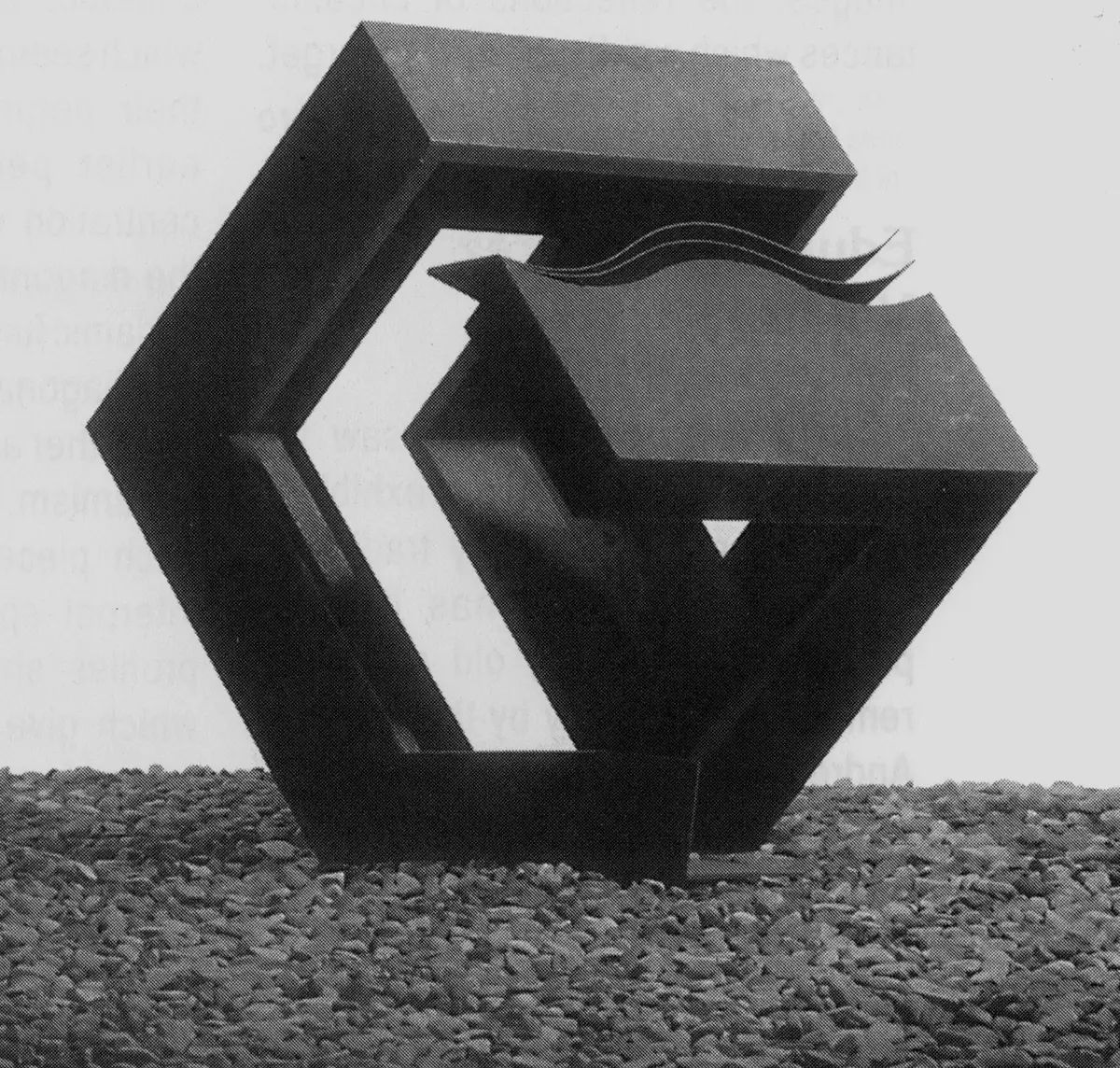
All the pieces were in sheets of oxidized iron—one of the artist’s textural constants. Another, more formal one is the use of diagonals. The forms that emerge from the sheets that are cut, folded, assembled, and transformed into potential volumetry are defined as diagonals. Line, surface, and volume are diagonals with respect to the coordinates we normally use in dealing with space. Ramírez Villamizar has been investigating the potential of diagonals as a basic source of expression for at least twenty years, and his masterful handling of the form is evident in such superb works as Telescope (1993) and Catatumbo (1995).
With the exception of Relief Door, which was done for Banco Union in Caracas in 1990, the sculptures in this exhibition shared another characteristic: they are open structures that seem to be defined inwards from their perimeter, or «envelope.» In earlier periods, the idea of concentration was less evident. That is, the diagonal had a clearly expansive dynamic function. In these new pieces, the diagonal does not suggest a flight, but rather a concentric and centripetal dynamism. The greatest tensions in each piece are to be found in the internal spaces, while the external profiles show fractures and breaks that give each volume an enormous visual solidity.
Many of the works had the shape of a regular, inclined paralleled—an illusory shape, however, since it is made up of voids and filled voids— more air than really solid elements. All of Ramírez Villamizar’s sculpture is based on the principle of virtual volumetries achieved through recourse to folds and the angular soldering of flat elements. The volumes are an illusion, the effect of the angles and the breaks. What is real are the surfaces, the thickness of which contrasts with the solidity of the virtual volumes. Only in a few sculptures, such as In Praise of the Caribbean (1991), Space Ship or Vertical Architecture (1995), do some of the flat elements retain their own character. These sheets of metal add an almost graphic touch to the works, especially when they function as lines rather than surfaces—an aspect which naturally depends on the standpoint of the spectator.
The strongest surfaces are located on the outer sides of the virtual volumetries. They seem to retain on a smaller scale elements which establish an entire discourse based on opposition, contrasts, echoes, and counterpoints. Although evident in some works, such as the Shell (1993) or Circular Ruins (1995), there is no predominant use here of the modulation on a decreasing scale, which the artist employed in earlier periods of his work. All the internal dynamics of the pieces, although perfectly enclosed in their envelope, are expressed within their own language. In several parietal reliefs from 1995, such as Galápagos, Gorgona No.1, and No.2, the interplay of small internal forms contradicts the diamond structure, which is the defining plane of the works, reducing their impact.
At all events, the oppositions established between the peripheral elements and their content are the most novel feature of the artist’s formal evolution. The precise handling of voids and volumes and the total mastery of the raw material used space made this exhibition an extremely gratifying aesthetic experience.
By giving the Bogota public an unusual opportunity to see together the recent work of one of the masters of Latin American sculpture, the Diners Gallery has successfully initiated a new stage in its own work.
MARÍA ELVIRA IRIARTE