
Contemporary painting seems to be moved by postmodernist impulses and by a nostalgic return to modernist self-referentiality from its contemporary location. More than focusing on its agony or death, exhibitions in recent years, with varied thematic and formal approaches, continue to address its possibilities. Discussions regarding appropriation, simulation, text-image relations, hybridity, and the old figuration/abstraction polemic, as well as issues of materiality, continue and reverberate in diverse centers. Upon viewing Fabio Herrera’s first one-person show at the Joan Prats Gallery, one cannot help but think how his work makes little overt references to the debate on painting and its practices, and yet how it permeates his new series as a whole.
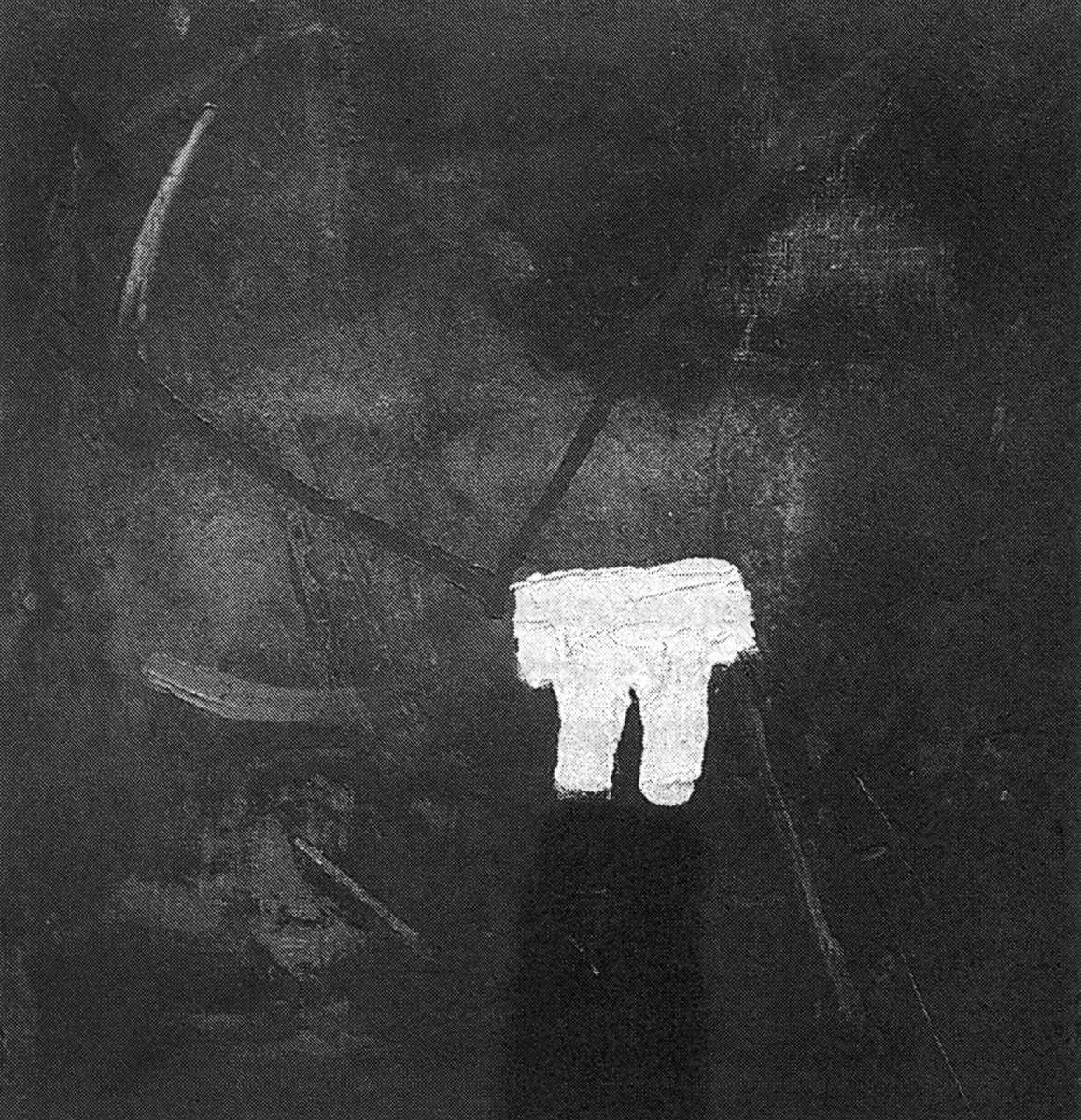
Herrera is an artist who shifts around diverse endeavors without a determining foundation or burden, depending on one’s view of conceptual undertakings. Inspired by the Informal School and Antoni Tàpies in particular, Herrera’s painting seeks to explore; it desires to free expression from self-referentiality and meta-artistic functions and process. Yet there is a critical point that makes this stance difficult to sustain, and that takes us back to Roland Barthes’s writing on Cy Twombly. Barthes, referring to Twombly’s particular abstraction, claims that it is never naive to ask what a painting represents, for even if it aspires to the absence of meaning, it still refers to nature, it sticks to man. While reference and evocation are linguistically distinct, in Herrera’s work, they merge and play around the canvas, which is understood as a zone. Layers of geometric planes, erased again and again, anchor in a Miroesque play of surfaces, of abstract figures. In Magic (1995, mixed media on canvas), an emblematic work of the exhibition, two triangular shapes divide the pictorial field: a rusty brown one that appears stained, and its counterpart, an expanse of a rich ochre marked by grayish-white large marks. A bull-like figure that resembles ancient Near Eastern bronze depictions of stags, its horns shaped like the vertices of an open triangle, is firmly anchored. The work triggers mythologies and traditions associated with the bull, and if one knows a little about Latin American tropical landscapes, it conjures up images of cebu cattle brought from India. Bullfighting; bestiaries; the tropics; petroglyphs. As soon as one initiates these plays, the process of association is interrupted, and one is back again seeing, involved in a direct present with the work.
In a statement from the artist, Herrera mentions something that might be a key to unravel or to complicate things more. Drastic changes in climate and the Earth’s surface characterize his native Costa Rica. His work has that quality in mediated ways through abrupt rhythm and dense materialities. A landscape painter at the onset of his career — Herrera was a watercolorist for years— he now seems to delight in breaking old disciplines and habits, becoming fascinated with the freedom of gesture. Gestural brushwork, painting and repainting the surface, and abrupt changes in rhythm and compositional forms are both sources and results of his references and impulses. Stroke (1995, oil on canvas) is a work within this rubric. The surface is scuffed, stained, and marked.
Herrera’s surfaces evoke action and process of everyday life: floors and walls; yet they also suggest a lived nature, one that has withstood much transformation. Cracks and a volcanic rock formation appear in subtle ways, creating dense textures of various sorts, evoking concrete and invented geographies.
The exhibition also included works on paper using diverse media. Intervened and found books, including mainstream journals translated to braille, were also shown. Herrera perceives books as yet another zone to mark on. For the most part, he does not get into the linguistic content of the book; he is more interested in its surfaces, typography, and illustrations. In the Braille series, a change is apparent given that the linguistic content, mark, and tactility coincide. Herrera claims that he paints to arouse other senses besides vision. The experimental possibilities of this vein of work, though, have just been touched upon.
Herrera paints in an abstract mode, leaning heavily on figuration. Put another way, his abstraction bursts with figurative marks. Herrera gives privilege to materiality; it makes his painting, rooted in nature, important not for its motifs but for its process. Lines charged with gesture organize the composition and paradoxically balance and disturb. While gesture calls attention to an artist’s calligraphy and subjectivity, it need not always be grandiose, full of pathos, and epic. It can, as is the case with Herrera, be hermetic and private, and in its pure present, pleasurable.
VÍCTOR ZAMUDIO-TAYLOR