As Juan Antonio Roda points out in the catalogue to this exhibition, Germán Londoño is a figurative artist since he wants to tell things and because he is fascinated by the idea of knowing that he belongs to a very long tradition of figurative painters who have used the human figure to create art. In this recent exhibition entitled Africa, at the Garcés Velásquez Gallery (October-November 1995), Londoño continues in his figurative line and in the expressionist treatment of the human figure. This time, he explores the media of painting, drawing, and three-dimensional art to narrate different experiences of a Western traveler on African soil, recounted with humor that at times becomes black, acid, or tender.
Although this subject matter and humor were persistent features of the show as a whole, the exhibition was organized into two clearly differentiated sections, each of which reflected a particular tone, intimate in the small-format works and grandiloquent in the large pieces.
The main room presented large-format sculptures and paintings. The latter were placed around the central space of the room, which contained the sculptures placed in a line: the visual impact was impressive, generating a sense of monumental order in which the humor was offset by the magnificence and hieratism of the sculptures. The large oil canvases proposed an eminently planimetric concept of space in which the horizon line sometimes appeared not as a means of dividing earth and sky, but of defining the universe of the figure and that of its shadow, figure, and its reflection. The projections of these travelers—essencially hunters—were surprising since they were silhouettes of their bodily images but often reflected those of wild animals, sharks, and beasts, as ferocious as the avid figure with knife in hand crossing the surreal landscape made up of paste-like brush strokes which formed an essentially pictorial surface dominated by the gestuality of the figures and the force of the color.
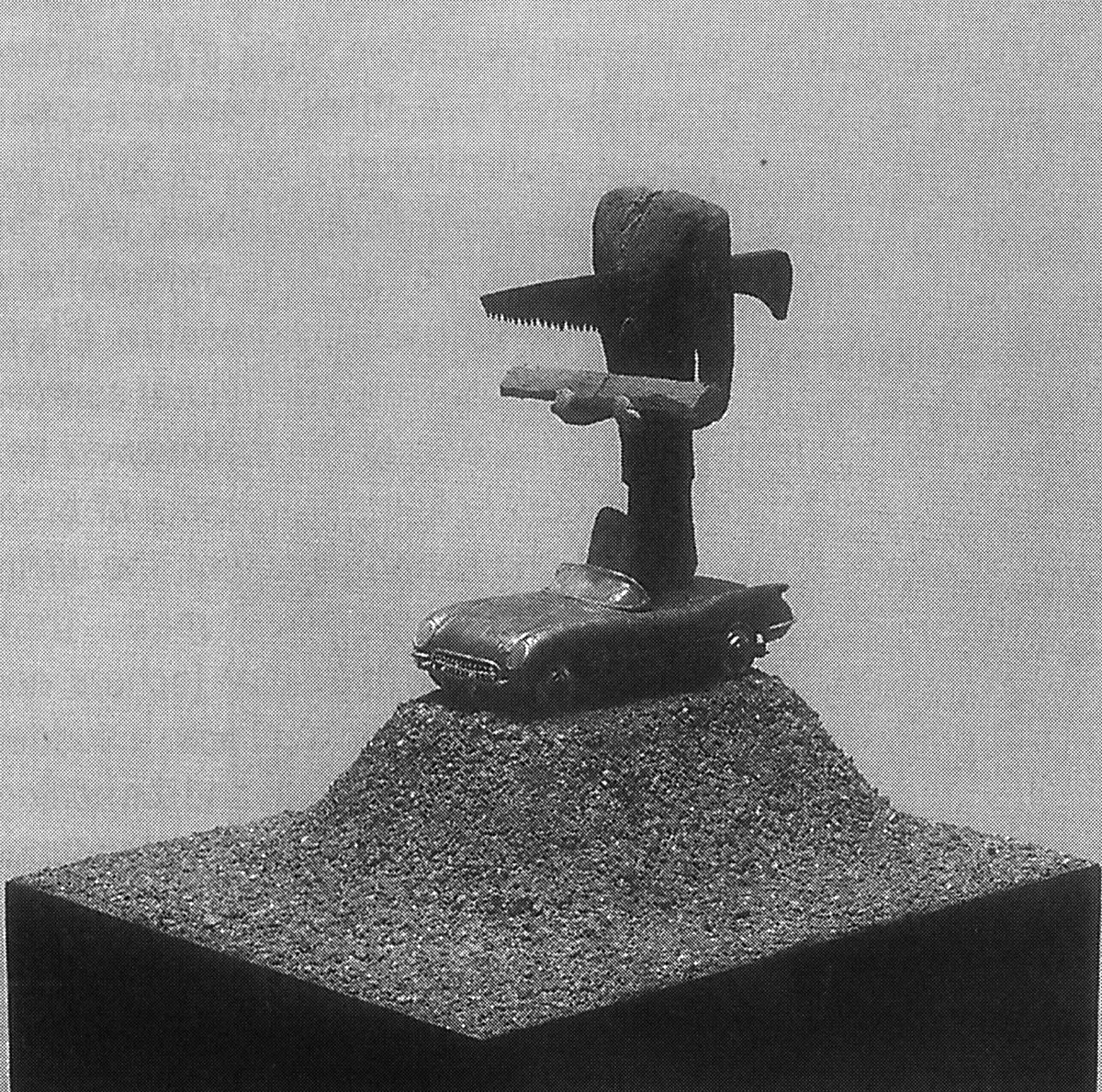
This pictorial technique was also evident in the small-format works placed in the small room of the gallery, where the space was distributed in the same way. The works here reflected various nuances of expression. The drawings, sometimes worked in the form of sketches and rapid annotations with agile linework, revealed a vision that was both syncretic and expressionistic. In other pieces, the drawing lost its note-like quality and became a box or object, as in Awakening with a Dead Traveler and Six Assassins on a Hill, in which the economy of resources highlighted an almost minimalist kind of sensibility, which in these three-dimensional drawings appeared strong and powerful in the absence of color. The small-format paintings, which remained within the same synthetic line, created a surreal atmosphere which was resolved through color zones, as in African Women Plucking Hens, a very attractive work which combined humor and a sense of pleasure in essentially pictorial qualities —color form and linework. The smaller format three-dimensional works stressed the hieratic appearance of a hunter with African features, wearing a felt hat and carrying a leather bag, standing on a pile of sand like some Egyptian figure. These small pieces, in which the artist made use of various materials, such as sand from Africa, a tin plate, and children’s toys, had a ludic quality which was accentuated by their small scale.
This show by Germán Londoño revealed a wide range of conceptual and formal approaches. On the one hand, it was an affirmation of the preeminence of "pure plastic values" which the avant-garde painters used to defend with such vehemence. Yet, at the same time, it was a confirmation of art as a vehicle for narrative, a means of capturing an anecdote, telling a story, preserving a vision that is momentary. In this way, Londoño’s work explores, through a good dose of humor and by breaking the purity of the two and three dimensions, how art can reflect on the development of Western culture, his interest in exotic, strange elements, and the art of the twentieth century. In this way, although perhaps without meaning to do so, Londoño stirred the memory of that decisive encounter between Western figuration and African expressiveness to which a good deal of the history of modern art is indebted.
MARTA RODRÍGUEZ