
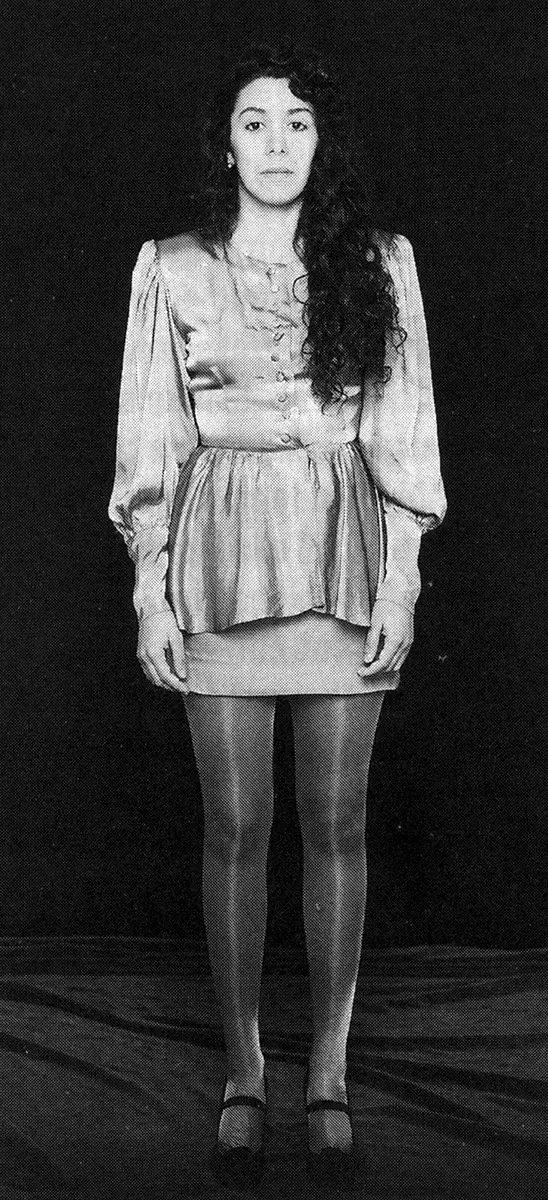
This exposition is part of La Photo (Month of the Photograph), an international photograph biennial in Montreal. This exhibition is by two artists with different techniques, but using a common theme: portraiture. Argentine-born Humberto Rivas, who now lives in Barcelona, has been staging exhibitions between his homeland and Europe. The artist uses sharp focus, black and white photographs in a small format. His iconography is diverse—from still-lifes, animals, and interiors to street scenes—but this exhibition deals with portraits and seascapes. His portraits are from the waist up and full-figured, clothed, or nude. They have the same pattern: frontal view, symmetrical, unpretentious, expressionless, and looking right at the camera. They become part of his creation, and the subjects lose part of their identity. Graciela (a dancer), with part of her hair in the front, the rest in the back, and the unnatural pose of her body, shows the manipulation of the artist.
His seascapes are poetic, with chiaroscuro tones. Some of the works give a sense of tranquility, while others convey feelings of romance and intimacy. In Cabo Nati, waves are transformed into “smoke-like” effects reaching the rocks. Even his seascapes are symmetrical. In Ampurias, the sunset is minimal, but it is at the center of the work, showing the careful planning for the shots. Like Ansel Adams, Rivas probably waited hours for the right light-dark contrast moment to take the shot. Rivas is a fine example of the Straight Photography style.
German-born Angela Grauerholz has lived in Montreal since 1976. She was included in Documenta IX, and last year, an important exhibition at the Musée d’Art Contemporain de Montreal broadened the recognition of her work. Although her iconography is diverse—from theatrical, nudes, props, interiors, and street scenes to landscapes—the subject in this show is portraits in large-format black and white. Her technique is the most important part of her work: a soft focus that gives a blurred effect, and unexpected angles, which have become her signature. She uses white backdrops, and depending on the lighting, the face casts a shadow on the backdrop, adding a new element to the portrait. The portraits are a "close-up" of the faces, cropped at the top of the heads. Her subjects are in very casual poses, some are smiling or in a 3/4 view, and none of them are looking at the camera. In the photograph of Mónica Haim, she is smoking. This photograph is so blurred that it negates the whole purpose of the portrait. Marie is drinking from a glass when the shot is taken. In Jean Blodget, the portrait is almost in profile, and the shot is taken from below. I think her challenge is to photograph the same subject matter as many artists have done, but as differently as possible. She accomplishes this using her visual language.
AUGUSTO CHIMPEN