If the sequence of works created by Luis Fernando Roldán over the last eight years were hung side by side, the organic development of his creative process would be immediately clear. And yet, if we summarize that process by placing the first work of the series next to the last, the intermediate period would be difficult to imagine. Seven years ago, Roldán was doing abstract painting with a certain degree of humor. Inflated figures, which one of his children called "submarines," were suspended over color planes. At that time, as purely pictorial exercises, the elements engaged in a direct and mutual dialogue: line, plane, color, background, and form combined without any hierarchies or sense of effect or artifice. Over time, the figure has faded and the surface has become more irregular. The only common denominator is the control of the composition by a virtual structure that "ties" the work.
In his recent works, particularly since the Independence Park scenes of 1994, both figure and drawing have totally disappeared. The compositional structure is felt, however, in the way in which the color stains are articulated. The surface, which is not so polished by the brush as in the "submarine" series, is now cracked through the use of the spatula. His current works are like geological constructions, layers of sedimentation which are superimposed to reveal, here and there, color stains which create a counterpoint of opacities and luminous effects.
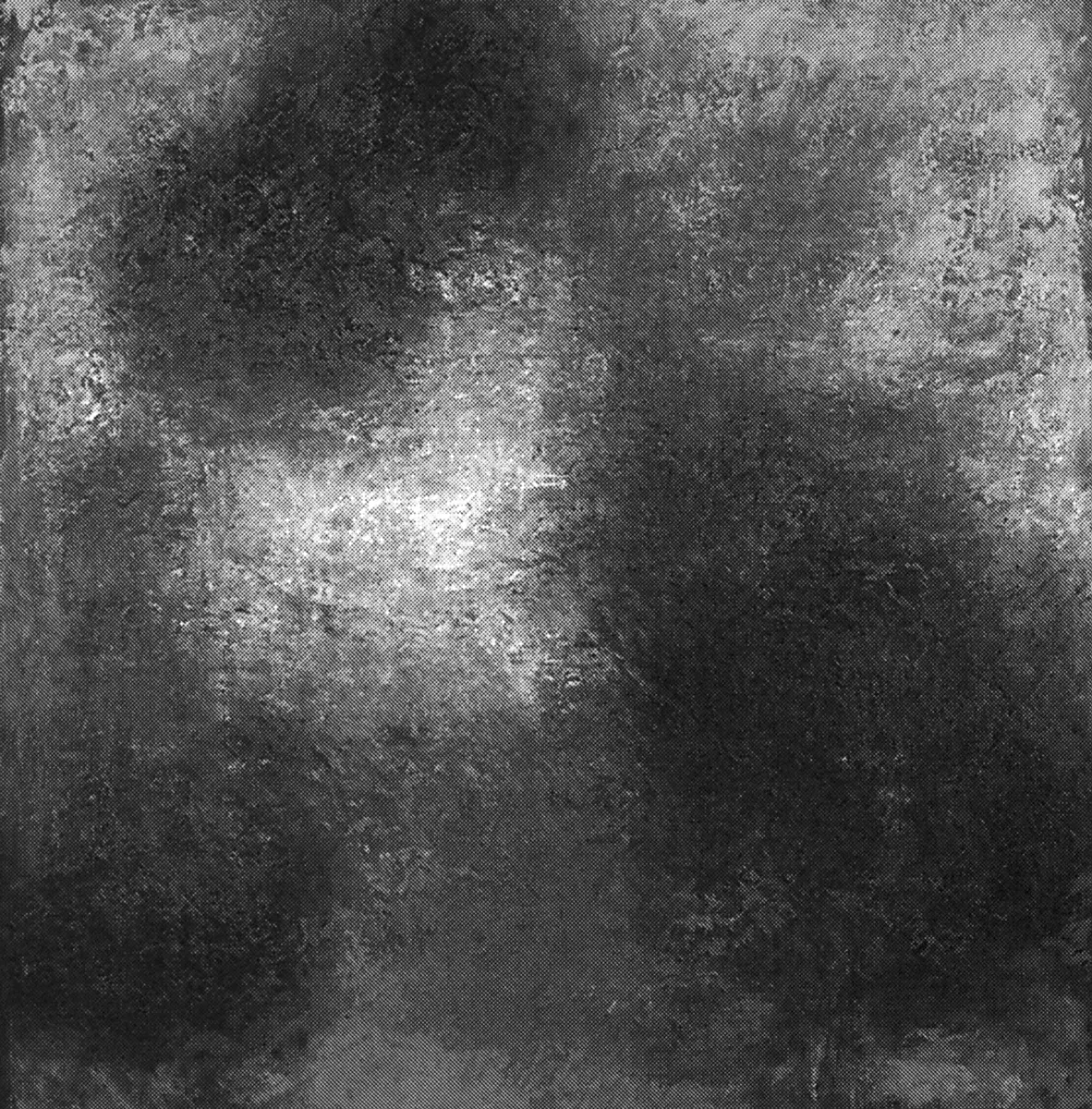
The change that has occurred in Roldán’s work is not towards a more radical form of abstraction. In his earlier paintings, the "figures" were like toys for assembling the composition, a means of creating both visual and emotional stability. Now, the figure no longer has its defined contours or drawing marking out the pictorial space into figure and background. The definition is phantasmagoric, evasive, and uncertain. The image in its totality envelops the chromatic variety in a single act of perception. The distant vision is atmospheric, and the surface at hand becomes a tempestuous landscape.
In this way, Roldán’s works resolve their own contradictions. The apparent chaos is based on a stable structure, a notion of order. The almost bucolic atmosphere reveals successive layers which, seen up close, negate the overall voluptuousness and even create a suggestion of rejection or repulsion. It is as if these works were offering evidence of some interplay of opposites, pleasure and contempt as examples of the fiction and reality which comprise the artist’s pictorial concept. The final work, seen as a whole, is a fiction, but in its details, vacillations, advances, and withdrawals, it is reality.
In this sense, Roldán’s work is clearly intuitive, with the process of painting being seen as a dialogue in which each element is added, confirmed, or negated vis-à-vis another, until fluidity is established between the different parts. Curiously enough, in this elimination of additional supports—such as drawing, figures, or a more definite treatment of color—the work reaches the extreme limits of imbalance, requiring millimetric and very subtle solutions. Whereas before, Roldán’s narrative played with the imaginary, now, in the difficult process of creating chaos, the narration is presented as a metaphor itself of the artistic process, a simile of the process of life; life as a construction, creation, and response, doubt, and impetus. His works are present without any predominant emotion, and yet in the visual journey, we come across them all.
CAROLINA PONCE DE LEÓN