The Colombian artist Maripaz Jaramillo recently celebrated her twenty-five years of professional activity with a retrospective exhibition at the Museum of Modern Art in Bogota. The encounter provided by the show was indeed very impressive. The images, with their burden of pain, reflected the different stages in the life of women, with the bursts of exuberant color and forms decisively cutting the surface of the works.
The retrospective invaded all the Museum space, with the carefully orchestrated distribution helping the visitor to create their own encounter with the female figures and the themes of love, drama, torment, festival, dancing, prostitution, happiness, and passion. It is a story made up of special and everyday moments in which the female protagonist holds on to the feelings that rule her life and which have been transformed into art. The pictures bring back memories that oscillate between pleasure, sarcasm, and the grotesque. The second floor contained works on paper from various strategically placed series—Couples, Groups, Caribbean, Galápagos, Flora and Magic, Flora and Capurganá—leaving the third floor for the most recent work, White Weddings. The basement housed multiple works, most of which have a utilitarian function and are done in mixed media.
Tired female faces, heavily marked eyes, enormous breasts emphasizing the sensuality of the bodies, innocence, bitterness, pain, torment, and passion: such have been Maripaz’s focal interests since she was a student in the 1970s. Her work has always been both original and captivating. And although her themes and inspiration were sometimes seen as frivolous during her early period of training, the solidity of her commitment to women and to love is beyond question. The best expression of her style has been in the clumsy, deformed shapes of her images.
When she was a student at the University of the Andes, she concentrated on multiple works—printmaking and lithography. As a very young artist in 1976, she had the opportunity, with Lorenzo Homar, to learn the technique of serigraphy with one of the leading figures in the medium. The theme of women began to capture her full attention from early on, in such works as in Praise of the Machine of Life (1973), I Met her in Cúcuta (1974), Possession (1974)—down to her most outstanding piece from the period, Lady Mac Bed, which won her a prize at the XXVth edition of the National Salon of Colombian Artists in 1975. The most delicious moments, the journey through different periods of life, make her hymn to women a total explosion of color and media, with the images reflecting the complicity of the dance floor, stolen kisses, caresses verging on the loss of honor. The artist clearly knows all there is to know about social relations and relationships between couples.
Feeling and loving bring happiness, pleasure, and joy, which offer captivating moments of life. The exhibition created a deeply rooted image of the artist’s mastery of sarcastic forms, giving way to sheer pleasure. In the early years, the image was seen in close-up; there followed an emphasis on the environment, with bursts of color, music, dancing, and dialogue. The female figure kept the seduction alive in the midst of salsa music, the fiesta atmosphere of the cabaret, where men and women are mere objects to be used: the woman writhes, comes and goes, creating a whole new aesthetics with her body. In Maripaz’s work, the exaltation of woman is the glory that underlies the rejection of any traditional canon. Everything has changed in the relationship between couples. The sense of waste and abuse reveals the modern, permissive world for what it is, with its prostitution of the traditional housewife or mother, the prostitution of society in general. The denunciation goes beyond any relationship and takes us to the heart of emotions themselves.
It is not only the titles of the series that are revealing in this respect: the individual titles also have much to say. Most of the works evoke a sense of something hidden, a commitment, a complaint revealing love or betrayal: Your Love Doesn't Suit Me (1978), I Want to Die of Pain (1979), Secret Rendez-vous (1980), A New Love Every Night (1980), Because I Met You (1981), Take me into your arms on to the stage (1981) are some of the compromising examples of the act of surrender and sensuality in love. In Show with Rhythm and Swing (1981), a series which deserves special mention, a woman’s torso appears in three-dimensional form, in which variety is achieved by the artist through her mastery of color. Each piece is identical in form, but different in color, and each one makes us want to touch it, with the power of seduction (based on different types of women: black or white) being modulated through the contrasts in color.
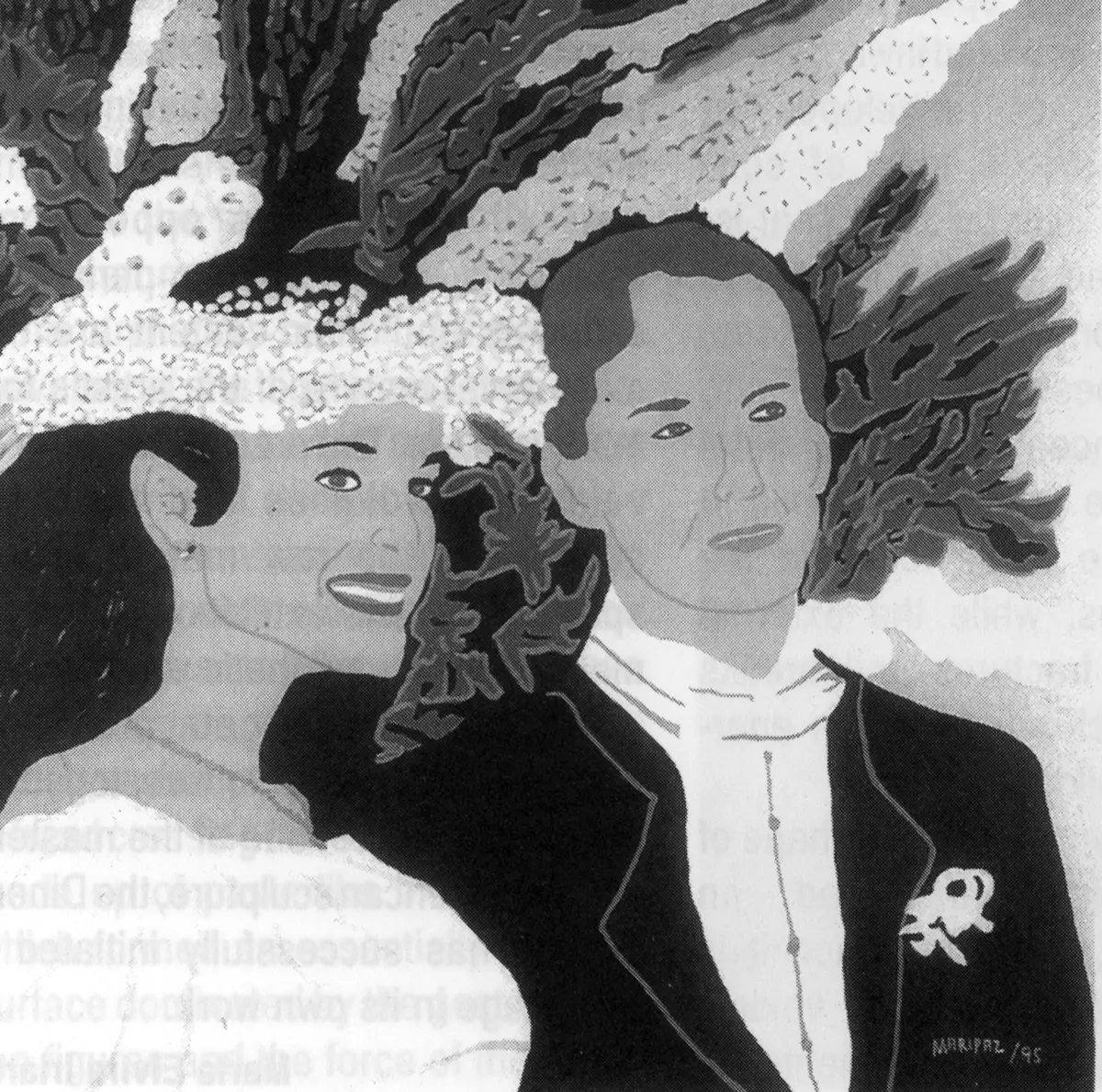
Maripaz chose the series White Weddings (1995) to celebrate her silver anniversary as an artist. She turned to this subject after exploring the themes of seduction, prostitution, the permissive society, and changes in morality, to find, in the promise of eternal union and real love, the sweetness and purity which had been absent from the tortured images of the early years. The theme is presented through various races, ethnic groups, and rites. There is also a change of color in these works, with the emphasis now being on white. Textures and broad expanses of color take hold of the surface where the couple poses for posterity. Each moment of the ceremony and union is carefully selected, and each of these moments captures unforgettable memories.
With her increasing maturity, Maripaz Jaramillo has changed her approach to the subject of seduction and the way women have been conditioned by their sex. The image of the widow of the early years gave way to that of the prostitute, followed by group scenes on the beach in the Caribbean scenes, where there is even one lady with a purity such as that cherished by the brides in the new series.
Maripaz’s work always produces a sense of enthusiasm. Her production also includes multiple works of a utilitarian kind—eiderdowns, beach bags, place settings for the table, etc. She has also illustrated books on the subject of women and love, for example, Los estragos del amor (Florence Thomas), Amores y Amantes, and some of the poetry publications of the Cama/leon company; as well as the book published by Seguros Bolívar, the fullest publication to date on her work.
The opening night of the exhibition also saw the launch of a CD-ROM of her work, a multi-media publication comprising all her production (more than 1,000 works), with various critical texts and some of the music that has inspired her pictures. Life and social context are essential features of her images, the reflections of circumstances which we do not want to forget.
MARÍA TERESA GUERRERO