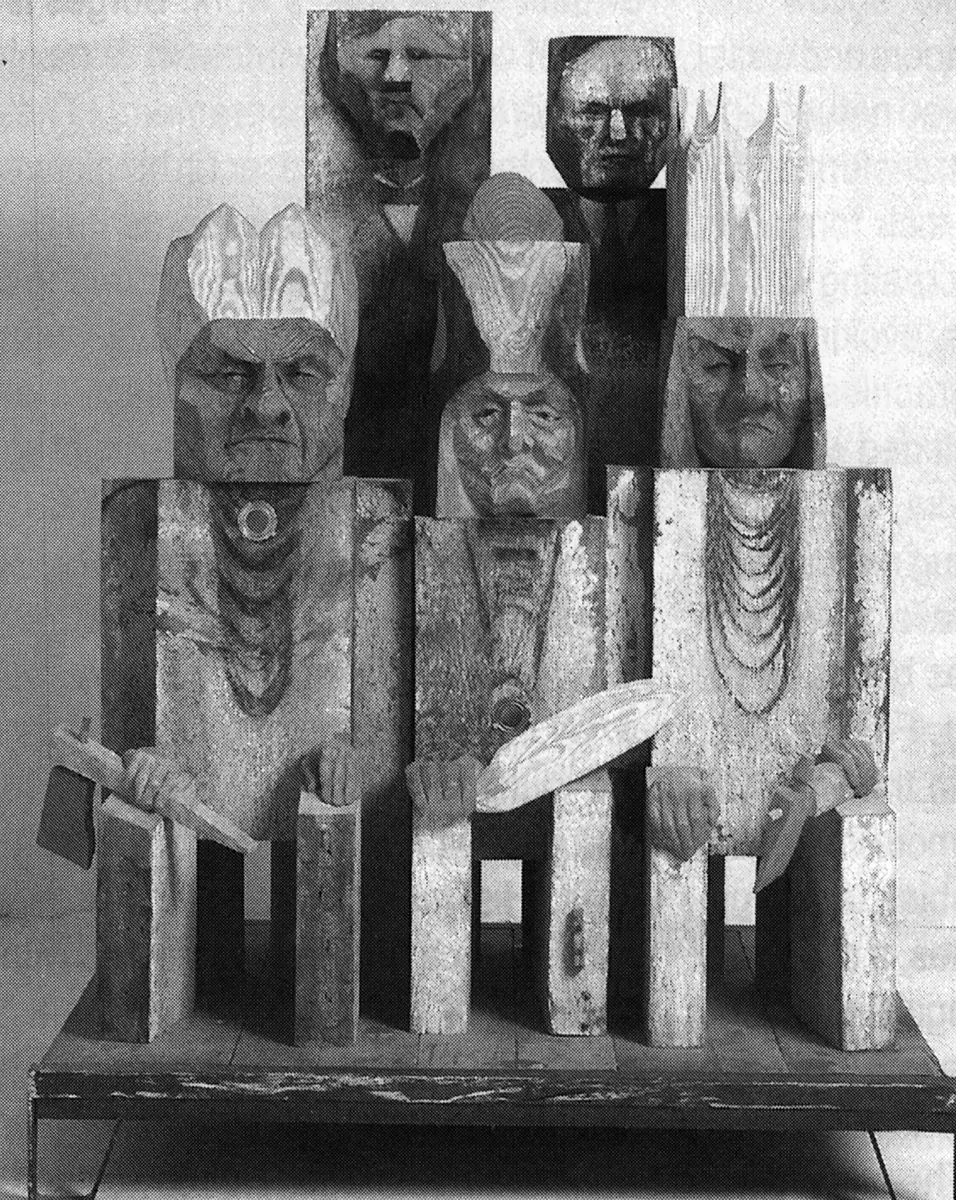
This fall, Marisol made her debut as a member of Marlborough Gallery’s stable with a collection of new drawings and sculptures. This was her first solo exhibition in New York since 1989. The sculptures, executed within the past three years, are not quite revelations, unless one considers witnessing an artist reaching a level of supreme confidence and facility in her art to be revelatory. Marisol is not marking any new territory with these works, and yet, her art has never seemed so fresh.
There is no thematic title under which this group of works is presented. Nevertheless, there is a recurrence of themes that seems to unite this particular grouping. Approximately half of the sculptures are of Native Americans, many of which reference historical—and in some cases famous—photographs. The other works, even if they do not share a similar subject matter, are all portraits. Furthermore, they all look like they were made from photographs of their sitters. Her groupings of children look as if they could have come from a Helen Levitt composition, and her anonymous General Plywood bears a striking resemblance to a young Josef Stalin posing for an equestrian portrait. The gallery, thus, became a collection of antique photographs that happen to be three-dimensional and hand-drawn.
Of course, this sophisticated level of cross-referencing is nothing new for Marisol. In fact, we have to wonder if she would not be continuously described as working in some sort of "updated folk tradition" were it not for her Venezuelan heritage. Marisol’s family is from Latin America, but the Paris-born artist has always seemed to consciously position herself as a citizen of the world.
From appropriating Leonardo’s Last Supper to the current photographs of the United States’ involvement with Native Americans (it is interesting that she offers no such engagement with Venezuela’s pre-colonial population), she has always moved within a different set of concerns. Indeed, her art does not invoke folk traditions nearly as much as it does Surrealism’s use of found and discarded objects, Pop’s trafficking in commercial culture, and multi-media appropriations practiced by such artists as Larry Rivers and Robert Rauschenberg. In fact, it becomes tempting to wonder what might result if she did turn her gaze a bit more southward and her points of departure were on a different level.
Whether or not it is fair to speculate on what would happen if the artist were to shift her point of reference, it seems that deeper explorations or a more cogent group of works could only enhance her oeuvre at this point. In the meantime, however, we still have the opportunity to see the results of an artist who is obviously in full command of her proficiency and who has managed to continue making her art, so similar to so many of us, seem new and young. Her awareness of materials is a pleasure to observe, and her formal choices and little details are always clever. But it is not asking too much for an artist of her intelligence and talents to do more than be merely clever or pleasing.
JOHN ANGELINE