
The Ruta Correa Gallery in Freiburg, Germany, is the only gallery in the country specializing in contemporary Latin American art. As part of its fifteenth anniversary celebrations, it recently presented an exhibition of new mixed media works on paper by Ofelia Rodriguez (the artist’s filth individual show at this gallery), which, as the venerable Frankfurter Allgemeine newspaper commented, offered a very unsentimental vision of her native land.
In Ofelia’s case, her titles are almost as important as her colors, and in these twenty-seven medium and small format pieces, there was a clear shift of interest evident in this respect. Although some pieces, with their characteristic palette of pinks, greens, and apricot colors, bore titles reminiscent of her earlier work (Listening to the Odious Roar of a Past, Perverse Dreams, The Breeze of Reconciliation), with collage references to such typical iconographic leitmotifs as electric fans, babies’ dummies, and safety pins, other titles indicated a continuing exploration of at least two more recent interests. First, there was the emphasis placed on parts of the body, in particular the artist’s own body, in the multiple visual and linguistic references to ears, eyes, finger nails, and tongues—a tendency which had first emerged in the works that Rodríguez sent to the last Havana Biennial. In many cases, the anatomical elements are based on photocopying techniques, as in the stunning piece entitled Stop, a richly textured composition of thick black brushstrokes, with a photocopied hand held up against the spectator in the center of the picture, and inverted white hoods at the top in an ominous allusion to the Ku Klux Klan. Although Rodríguez does not explicitly say so, this dismemberment is bound up with the question of identity and the way we (and others) see ourselves.
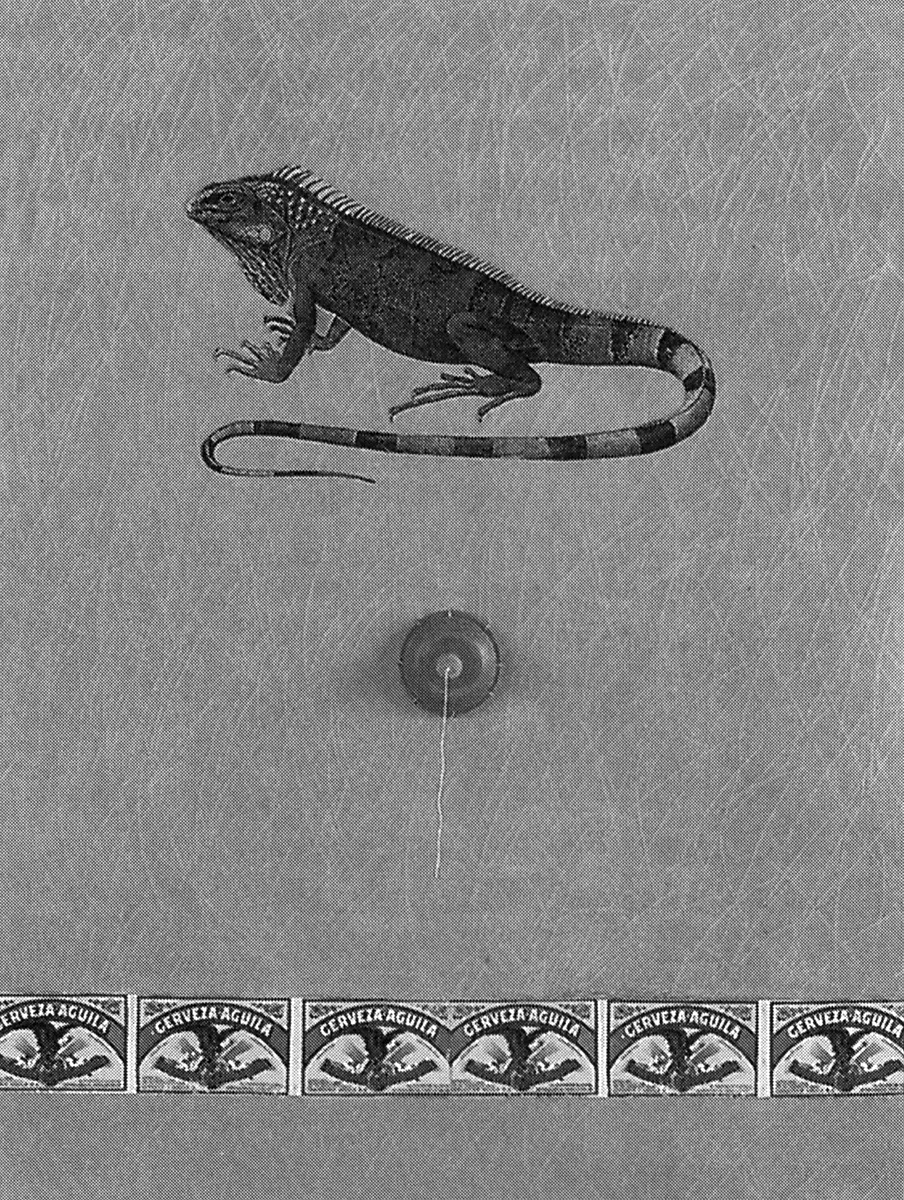
Iguanas are one of Rodríguez’s emblematic creatures, but this show confirmed her growing interest in other animals, coupled with an increasing emphasis on food, eating, and drinking, as in Cut the Big-Mouth’s Tongue, Shark’s Dinner, Hunger for Everything, Eating the Paper Tiger, and Little Pig on Stilts, among other examples. Knives and forks abound in these pictures, as do wide open mouths and tongues, which sometimes seem to fester like some wound from the past, bubbling with all the effervescence of some tropical swamp, (Cut the Big-Mouth’s Tongue) and other times seem more reminiscent of shields and escutcheons, suspended in an expanse of bright color (Drinking with a Thirst for my Past), multifarious symbols of what we are and what we have done to one another. In Rodríguez’s work, things are and are not what they seem: gesticulating fingers become the fringes of some kind of flying carpet (Ode to a Past or Jorge Negret’s Finger Nail), and a plate of brightly varnished ears could plausibly pass for a freshly served dish of devilled oysters. Other very small format pieces (for example, Taking the Alligator from the Corner for a Walk, with small plastic doll’s arm attached) are set within a series of superimposed "mini-frames," with the outer heavy black main frame enclosing others of red velvet, gold, and once again black, the sensuality of which provides an admirable foil to the conceptual sharpness of the work.
Ofelia is clearly at a transitional point in her development, and seems to be moving towards a more visceral, viscous vision of her long-standing obsessions. Only time will tell whether that transitional point might also become a turning point. For the moment, as this show clearly demonstrated, the sum of the parts is more impressive than the individual parts themselves. The ideas are interesting and the juxtapositions arresting, but with three or four exceptions, the pictures themselves take us back to those ideas rather than taking off in their own right.
BRIAN MALLET