For two months in the summer of 1995, a storefront at 33 Broadway in Newark was home to an installation by Pepón Osorio. Entitled Badge of Honors, produced in collaboration with Aljira, a Center of Contemporary Art, the project has since moved to the Newark Museum, where it will be installed through next March.
This recent work by Osorio is a continuation of his concern, explicitly manifest in the last few years, to address the needs and issues of the Latino community by undertaking projects that are created with community involvement and placed within a public context. The specific issues that the artist has enunciated for Badge of Honor include questions of imprisonment and freedom, and the importance of the family to maintain its identity and survive. The installation consists of two rooms side by side. On the left is a jail cell, viewed through a set of bars. The cell is nearly empty, spartan, with a cot and commode. On the bed are some neatly folded clothes, and a few family snapshots are taped to the wall behind it.
On the right is a boy’s bedroom, whose baroque trappings are in dramatic contrast to the stark cell. The bedroom is a lushly ornate aggregate of materials, surfaces, and objects of the sort that Osorio has become known for: the walls are completely covered with Bruce Lee posters and baseball cards, the furniture is lined with gold clenched fists, and the shelves are full of electronic equipment just as the closet is full of clothes and the floor is lined with many pairs of shoes and sneakers. Both interiors share two things; one is a family snapshot of father, mother, and son, the other is a large video projection on the facing walls of the two rooms, which is the true heart of this work.
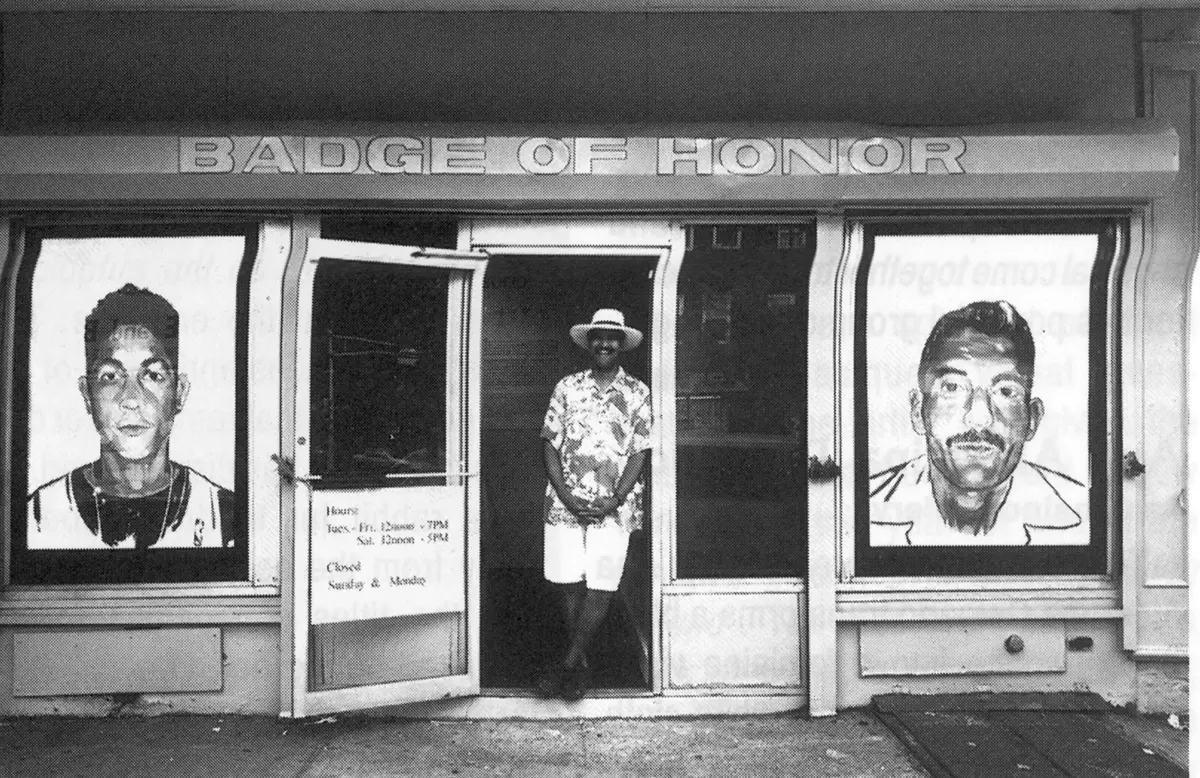
In the jail cell, we see the projected face of Nelson González, Sr., who has been incarcerated for an undisclosed reason and is scheduled for release sometime early next year. González "speaking" to a video projection of his son Nelson on the wall in the bedroom. The two engage in an often highly emotional dialogue, the frankness and honesty of which was perhaps aided by the fact that they were not facing each other in real time when it was taking place. They ask each other about the love and respect they have for each other, of how they esteem the boy’s mother (who is missing from this male setup but is evoked through the dialogue and in the photographs), and sometimes question each other’s behavior —the son wonders about the situation that led to his father’s incarceration and the father questions why his son associates with potencial trouble- makers.
While Osorio has erected a situation in which the viewer is more of a voyeur, both scrutinizing the personal interiors of two strangers and eavesdropping on their conversation, he also attempts to undermine this situation. The González’s make explicit references to the fact that they are being taped and that other people are listening in. Furthermore, both men acknowledge the tableaux that Osorio has constructed to frame their images. Nelson Sr., rather than denying the relative impoverishment of his surroundings, states at one point that he’d rather be in here than on the streets like I was. Conversely, his son at one point itemizes all his worldly possessions, including a television, VCR, stereo equipment, and computer (one can’t help but wonder, given the juxtaposition of the jail cell, if it was all legally obtained), given to him by his father but says, "I’d be willing to give up anything to have you home with us." All the surrogates of parental love cannot equal the presence of his father, while his father finds the confines of prison to be somehow more manageable than the harsher prison of his prior environment. Indeed, while the bedroom Osorio has fashioned may be some boy’s dream home, there is somehow a far more enclosing sensibility in this room than in the more open cell.
As effective and powerful—both visually and emotionally—as this piece is, one can’t help but wonder about some of its fuller implications. Most obviously, there is first the idea of community to be considered. Does Osorio’s piece effectively translate into a larger community-wide concern, and if so, who exactly comprises this community? Is it explicitly addressing the Latino community; indeed, is there any "Latino community" that can be addressed? In terms of political culture, does the suggestion that an incarcerated father is a widespread Latino concern truly reflect the society that Osorio wishes to be a spokesperson for? And if family is a necessary concept for Latino survival, how do we reconcile the seemingly conflicting messages that this work presents: a loving family, with a strong female presence, that has not managed to rise above the pitfalls of the inner city. Moreover, the notion that families can be yet another form of imprisonment, or another potentially destructive environment, never seems to have occurred to Osorio. From the viewpoint of visual culture, Osorio presents the boy’s room, which is much more easily seen as an imaginary construct than the cell, as a palimpsest of materials, objects, and images that is reminiscent of similar installations by Amalia Mesa- Bains, although her assemblages tend to indicate a spiritual dimension that does not seem as present in Osorio’s work. Yet does this now mean that we should see installations of accumulated objects, or pieces that evoke a specific history/ancestry (one is tempted to say pedigree) through such devices as old photographs, as being essential components to a "Latino aesthetic"? In this work, as in Osorio’s arresting installation in the 1993 Whitney Biennial, the abundance of materialism and consumerist devices is unnervingly ambiguous in its function as both celebration and critique.
These questions about community and identity become further complicated when we consider the relocation of this work. Can a project that was inspired by a local community, installed in part by members of that local community, and part of the everyday landscape of that community, possibly function in the same way once reinstalled in a museum setting? At 33 Broadway, passers-by could watch the dialogue from the outside through open windows, but if they were really going to engage the piece, they had to enter it, to literally step inside the storefront.
In the museum, this element of entering has been removed, thereby adding to the voyeuristic dimension that Osorio has tried to minimize, and as a consequence, placing the González’s further into the realm of the "other." Moreover, there seems to have been little thought given to the significance of granting this work a firmer niche in the art world by placing it in a museum, even one as non-intimidating and public-oriented as the Newark Museum. After all, Osorio has created a work about barriers and imprisonment within different institutions and environments, but now it can only be addressed within the confines of yet another institutional environment, the highly problematized one of the art museum.
Of course, Osorio has justly earned a reputation as an educator as much as that of being an artist (another trait he shares with Mesa-Bains), and this installation is occurring within the larger framework of related workshops, lectures, and special events, many of which are targeted towards children and families. The work, of course, should not be seen as a final answer or ultimate declaration, but rather as an invitation to communicate and a reminder that dialogue is a necessary component to co-existence. Still, at times it seems that some of the broader implications raised in this work have not been addressed, and as long as the ill-defined tension between the piece’s attempt to both universalize and localize remains untreated, then what is most effective in this project remains muted by what is problematic with it.
JOHN ANGELINE