The isolation from the "international" circuits, which resulted from the Cuban Revolution, meant that well-established artists who continued to work on the island are now little known outside. There is an astonishing lack of exhibitions, books, and courses on the art of figures of such importance as Antonia Eiriz, Amelia Peláez, and Raúl Martínez. This is also the case with René Portocarrero (Havana, 1912-1985), an extremely interesting painter who has been seen as a paradigm of the search for Cuban (and Latin American) visual identity based on the concept of the baroque. Along with Mariano Rodríguez, Portocarrero was the major representative of the visual poetics of the Orígenes Group, which determined the course of Cuban culture in the 1940s. The group was centered around José Lezama Lima, the island's most famous writer, who wrote a long essay on the artist. I believe that a review of the life and work of Portocarrero would throw considerable light on the nature of his personality.
Although he followed some art classes in 1924 and 1926, his training was essentially self-taught, which is surprising in the case of such an "intellectual" artist. He began by doing drawings of angels and circus figures, some of them surrealist, which he presented in his first individual show in 1934 in the Lyceum, the non-profit gallery of the enlightened and "avant-garde" bourgeoisie of Havana. He continued to work on them up to 1937, when he took them to the famous Modern Art Exhibition, which marked the affirmation of this kind of art in Cuba, ten years after its first emergence.
In 1937, he participated as a teacher in the ephemeral Free Studio for Painters and Sculptors project, a Cuban version of the free workshops of Mexico. From then up to 1940, he was, along with Mariano, the main source of influence of Mexican muralism—combined with classic Picasso—which briefly characterized Cuban painting. These pictures of rural and semi-urban women were characterized by their palette of earth-tones, monumental figures, and a sense of hieratism. In a similar style, he created a mural for the Teachers' Training College in Santa Clara in 1937, as well as his first major oilworks: Casablanca (1939) and Peasant Woman (1939).
Portocarrero collaborated in all the literary journals directed by Lezama up to the 1950s, frequently providing illustrations and vignettes. The relationship between his artistic work and poetry is reflected in his own literary activity. In 1937, he published a long poem in Verbum, and in 1939 wrote and illustrated a poem entitled The Dream, which was not published until 1960. These illustrations reflect an evolution towards a Picasso-like element and a certain kind of surrealistic note, characteristic of his 1940 painting.
In the following year, in drawings of women with butterflies and once again angels (it has been said that Lezama's exclamation about "another angel!" summarizes the baroque nature of Cuban culture of the time), he established his own poetics. He became interested in ornament, and his horror vacui led to the multiplication of the elements of composition. The painting revealed a simultaneous—and paradoxical—influence of Cézanne and Matisse, as in The Dinner (1942). Portocarrero concentrated on the inner and almost mystical search for an essential "Cubanness," in the line of Lezama, Elíseo Diego, Fina García Marruz, and other poets of the Origines Group. It was not by chance that he illustrated Lezama's book entitled Enemigo Rumor of 1941. Ramón Vásquez has even said that his work seemed to be a visual transposition of that kind of poetic sensibility.1 Thus, Portocarrero was the typical representative of the so-called second generation of avant-garde tendencies in Cuba, which was more introspective and less "social" than the first. The Augustinian Catholicism of those writers was also reflected in the painter, who in 1944 exhibited a series of religious paintings, and who in the previous year had done a mural in the chapel of the Havana prison, where he gave drawing classes. Throughout his career, he occasionally painted catholic virgins and crucifixes, in a language which was more natural and peaceful than usual, as if he wanted to show as much respect for the original catholic iconography. However, the religious ingredient was, above all, an internalized element in his painting.
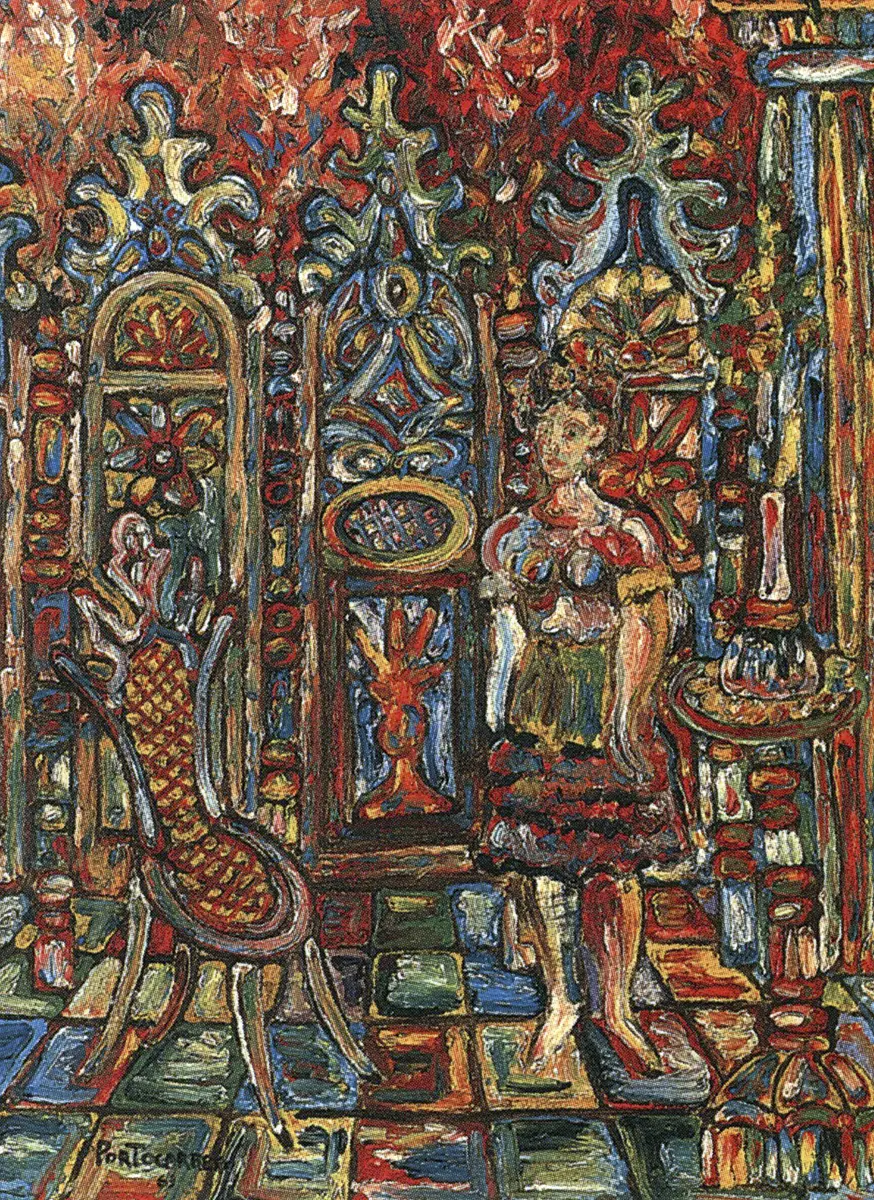
With his series entitled Feasts and, above all, Interiors of El Cerro in 1943, there emerged a plastic world that was to identify Portocarrero's work. El Cerro is a neoclassical and eclectic district of Havana, typical of the nineteenth century, in which he spent his childhood. He transformed his memories of the Creole environment of his early years into a kind of inner landscape. The images are a motley of dynamic juxtapositions of color fragments, in which the figures, according to Lezama, seem to be a prolongation of the house,2 within a setting which is both ornamental and gently expressionist, a result of the tendency to caricature in the figures.
In these pictures, ornamentation becomes the main agent, reflecting an interest similar to that of Amelia Peláez during the same period, but more expressive and less constructive or abstract. There emerged from the fragmented, nervous lines and intense, personal color a sense of the baroque which was to characterize all his later work, a pictorial amplification of the Havana experiences which were his inspiration. Like Peláez, his modern language and spirit fused with the creole tradition at the same level, within an inclusive discourse.
Another important series was Figures in an Imaginary Mythology, which he began in 1943 under the influence of Wifredo Lam (who, the same year, had finished The Jungle, his most famous picture), but within the artist's own ornamentalist taste. It was structured with decorative motifs from "primitive" cultures, within the same prolific and chromatic framework as Feasts and Interiors of El Cerro. The series was extended in 1945 with the Sorcerers, works centered on Afro-Cuban mythology, in which Lam's figuration seems to be disguised for some carnival in El Cerro. Lam's startling bodies become sweeter, and their mystery becomes a visual spectacle. The African religiosity was transmuted into a white creole vision, characteristic of the area of Cuban culture in which the artist developed, despite his interest in Afro-Cuban elements, which from that date began to appear in his work. However, perhaps the African element was nuanced from within his stylistic language—as in the case of other artists, although not evidently so at first sight—with certain accents of rhythm, color, atmosphere, etc.3 These pieces were shown in New York in 1943, where Portocarrero remained for about a year, and then in Washington. Almost all are now in North American collections.
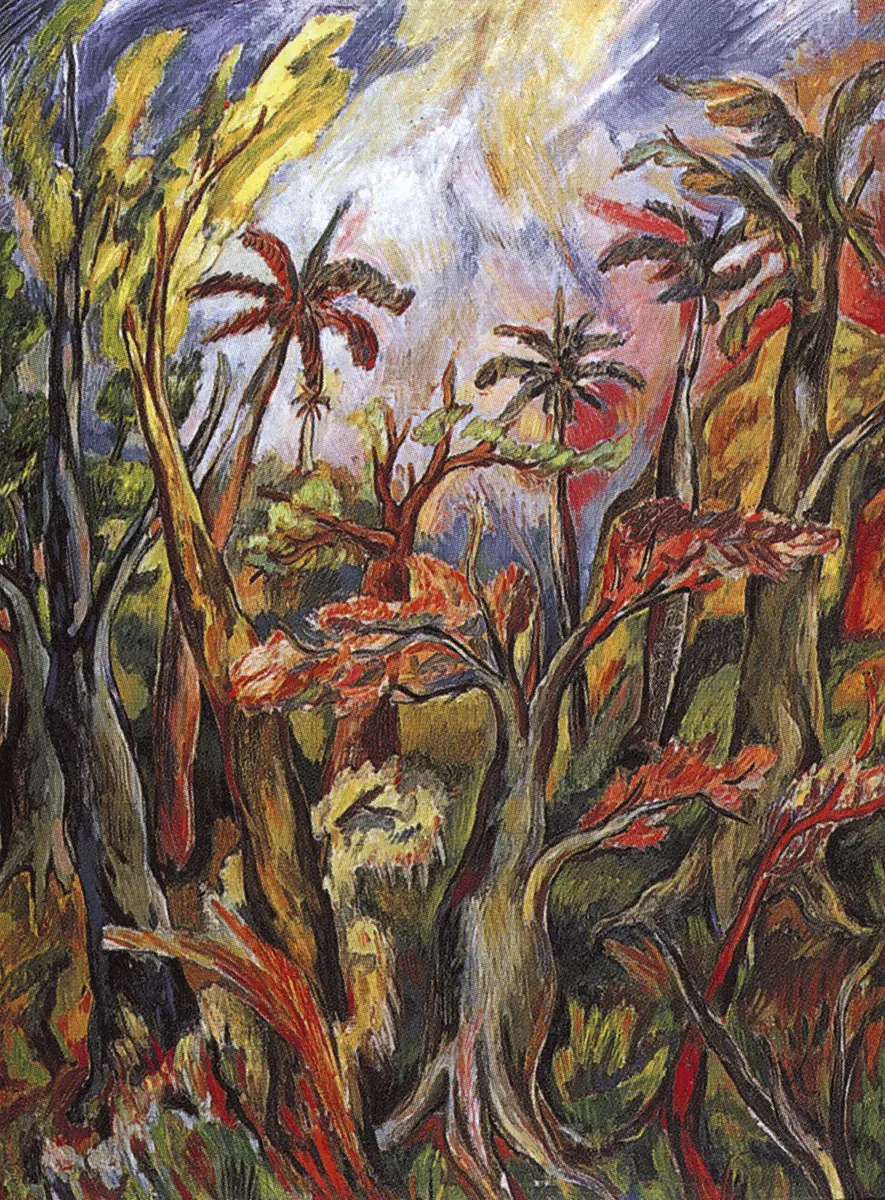
Following a visit to Valle de Vinales, in the west of the island, Portocarrero, who was to become the great urban landscape artist of Cuban painting, became obsessed with rural landscape. This happened only once, in 1944. Curiously enough, he painted a series of works which are very unusual in Cuban rural landscape art, in which the habitual serene or "tropical" vision gives way to expressionism, as in Landscape (1944),4 coupled with a spontaneous (although wisely ingenuous) closeness, which was more marked in Landscape No. 5 (1944) and other related works. There is little of the picturesque peacefulness of Vinales, one of the tourist postcard places in Cuba, in these pictures. Portocarrero offers us rather an interior vision, perhaps inspired by the Einfühlung theory, which was very influential among Cuban intellectuals at the time.
In addition to Sorcerers, he also produced for the first and only time in 1945 several still-lifes, similar to those works done in ornate colored language. These still-lifes, which tend towards baroque ornamentalism or expressionism, have little to do with those done by Amelia Peláez, the painter who was closest to Portocarrero. The works clearly reveal a significant difference between the two main exponents of Cuban baroque pictorial art. Both shared a sweetly ornamental and baroque kind of mystical creole vision, but Peláez's hedonism was more abstract-oriented, contrasting with the more "primitive" and expressionist mode of Portocarrero.
Portocarrero went to Haiti in 1946, like other Cuban painters of the time, such as Lam and Carlos Enríquez (who even showed their works there), thanks to the effort of Centre d'Art and Pierre Mabille, the then cultural attache at the French Embassy in Port-au-Prince. This was the only instance of cultural exchange between two countries that were so close, yet so far apart. It is from that year that we can date the artist's first incursion into a more abstract, geometrical kind of language, in a series of oilworks and drawings significantly titled Gestáltica. This interest was interrupted for three years, during a series of pastel works on which Portocarrero concentrated in 1947 and which continued up to 1949. These pieces were close to the Interiors of El Cerro and the Feasts, and were full of heavy, ornate interiors, processions, buffoons, and Afro-Cuban celebrations, highly colored and with a taught sense of drawing. The most well-known of these include Bembé (1947) and Chinese Procession in Havana (1947). They show the artist's emerging interest in popular elements, which, years later, was to result in his famous Color of Cuba.
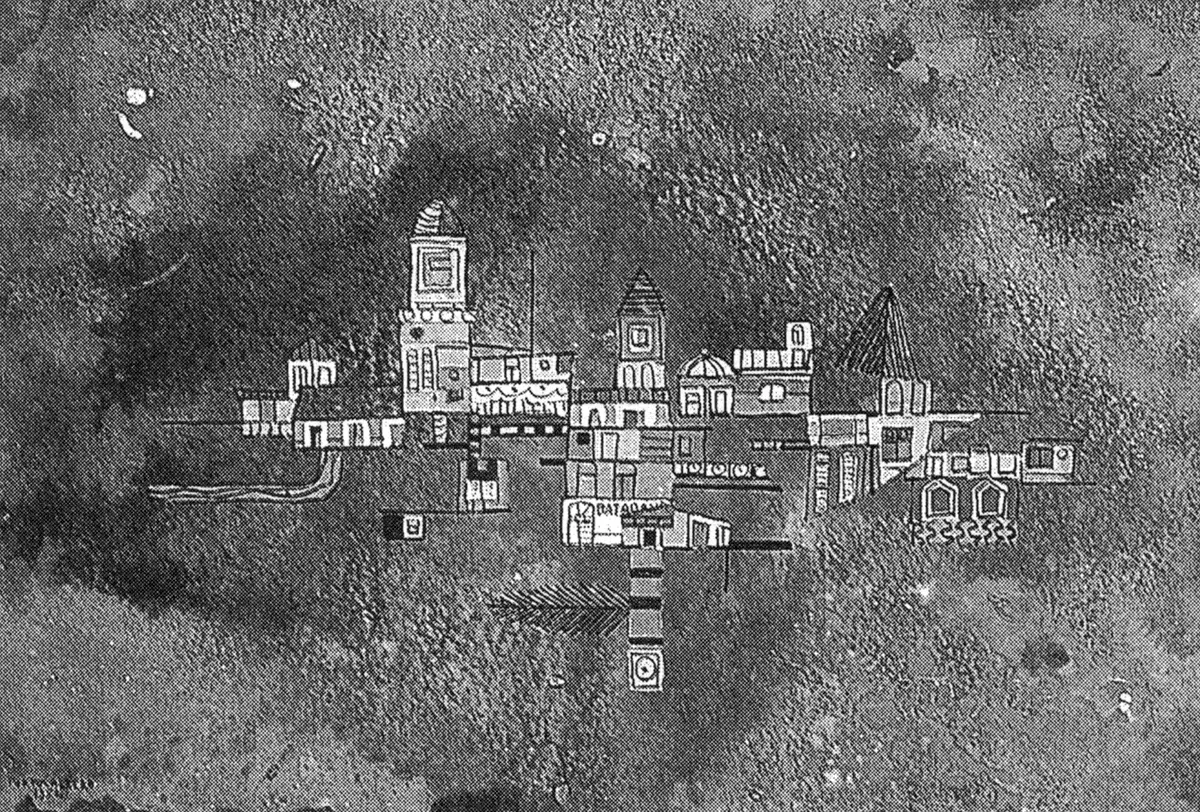
But from 1949 to 1953, Portocarrero's work reflected a geometrical tendency, no doubt in line with the abstract orientation of Cuban art in the 1950s.5 Portocarrero was markedly influenced by Paul Klee, and his work never became truly abstract. The most radical examples, which appear to be geometrical compositions, are in fact Target Practice, a series undertaken between 1951 and 1952: once again, there was a recreation of "ornamental" elements from popular media. He also did some geometrical figures, such as The Idol (1949) and Woman with Arrows (1953), although the most promising element was the emergence of the theme of the city in 1952, which was to lead to some of his most famous works. His early cities seem to be suspended in space: they are very geometrical and are very indebted to Klee. The previous year, he had painted Homage to Trinidad, another forerunner of the Cities, where he abandoned abstraction in favor of expressionism, and where there is, as Vásquez has said, a summa of his previous work.6
His work became more diversified as a result of the increasing demand for Cuban modernists from the 1950s, who mainly participated in architectural environments. In 1950, he did a tempera mural for the Esso building in Havana, and began to decorate ceramics in a small workshop in Santiago de las Vegas, near the capital, along with other painters, including Amelia Peláez. Portocarrero also did small mural works in stone slabs. A further development of his artistic-literary interests came with the publication of Masks in 1955, a set of twelve inkworks with an introductory text, with female figures embodying a profusion of decorative elements which were to become one of his most well-known themes.
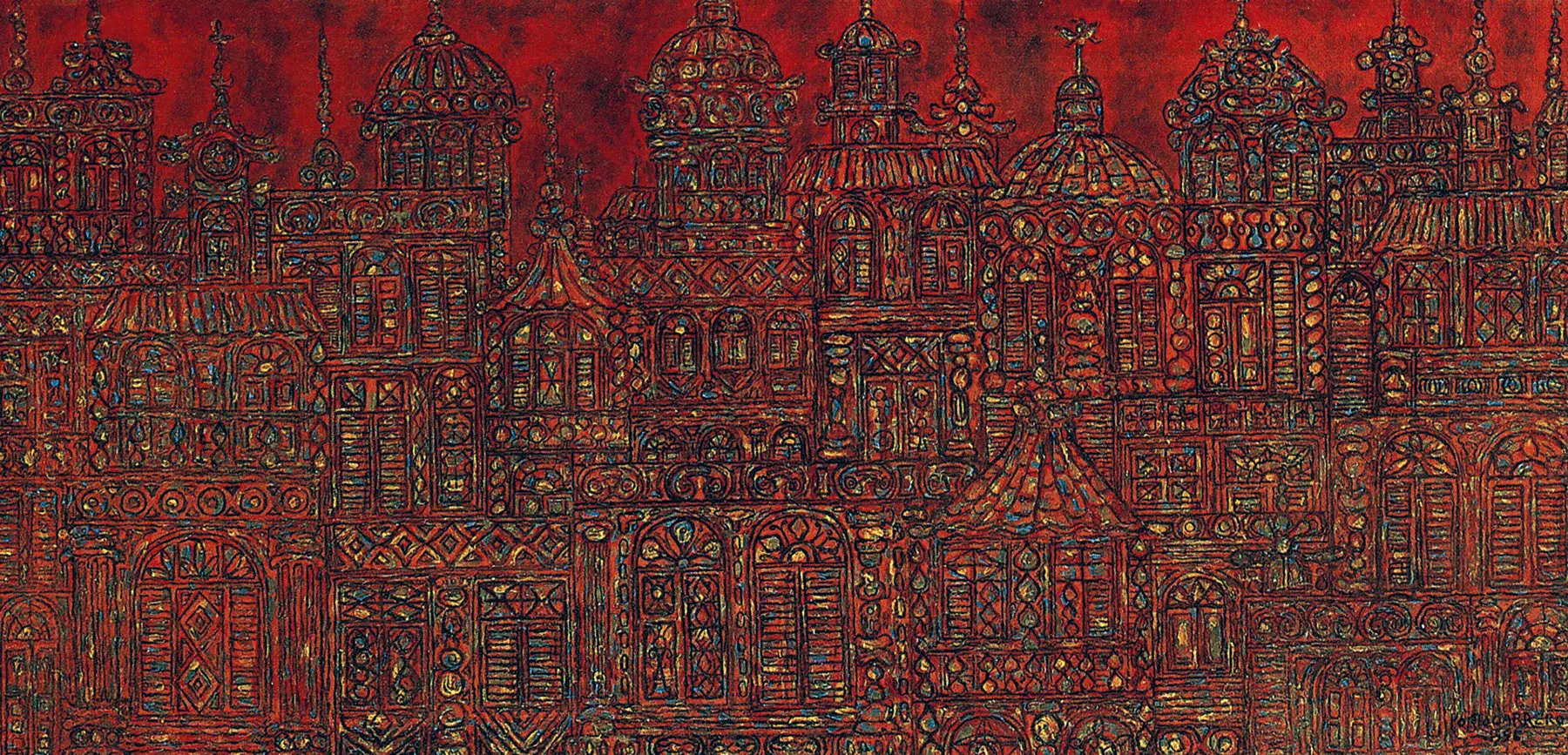
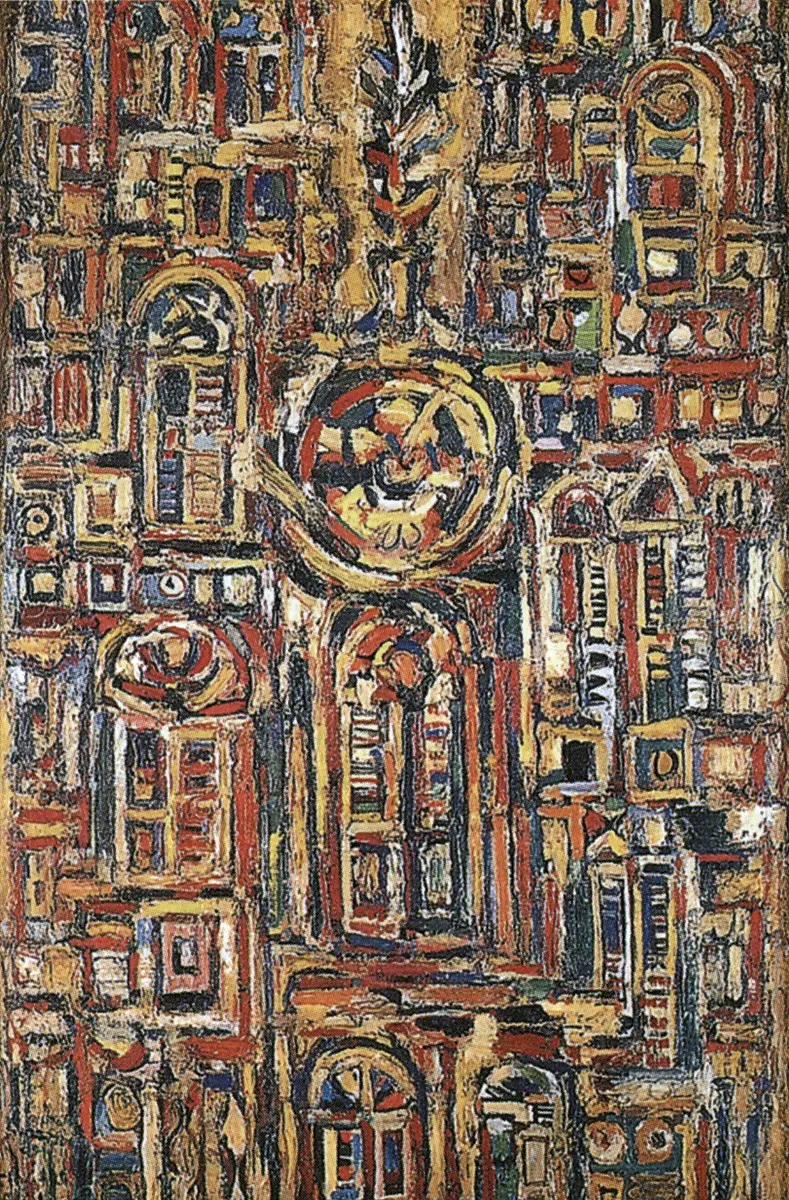
The same year, in a large oilwork with the same name, the Cities appeared in its final form, one of the most important themes on which Portocarrero would continue to work. They are urban landscapes constructed in the form of coral banks, with an infinite proliferation of minute ornamental details, full of color, light, and texture, set within a paradoxically geometrical and structural drawing. These oils reflect the non-figurative trend of the period, and only the framework of the drawing prevents them from being seen as textural abstractions. With Cathedral (1956), the old theme of the cathedral—which he had tackled from the early 1940s in an expressionist and more drawing-oriented manner—joins the new language of the cities, as reflected in the Landscapes of Havana painted from 1961 on.
In all these works, the artist captured the images which have best caught the character of Havana, an eclectic city exuberant in its details, a city whose style, as Alejo Carpentier said, consists of a lack of style.7 For the writer, these pictures were a transcendental interpretation, unique of their kind, of the Cuban baroque.8 They are cities which are a synthesis of Havana as a whole, rather than a description of its fragments, typical architectures with some precise place barely suggested, abstract visions of the city which express its unique flavor in an overall, infinite manner. In the words of Lezama, who was paraphrasing Manley Hopkins, they are inscapes rather than landscapes.9 In addition to the works already mentioned, the most notable pictures include the two Landscapes of Havana of 1961 and 1962-1963 (the latter considered as the main example), Cathedral in Yellow (1961), and Havana Landscape in Red (1972).
Portocarrero's style was well suited to mural painting. In 1957, he did a ceramic work entitled History of the Antilles for the Havana Hilton Hotel, with emblematic female figures recalling the drawings of Masks. For the church in Baracoa, a town near Havana, he did a Virgen de la Caridad del Cobre in Venetian mosaic, and painted the twelve pictures of a Via Crucis, continuing his practice of religious art. The parish priest was Angel Gaztelú, one of the poets of the Orígenes Group and the first person to publish a text on Lezama, who subsequently became the Cuban writer most discussed by international critics. The church became a meeting place for those writers and artists. In 1960, Portocarrero completed his Theater Figures, also with female figures, done in thick paint on concrete, for the National Theater. A year later, he painted another mural for the National Hospital. Between 1967 and 1968, he completed his masterwork in this genre: a ceramic mural measuring more than 200 square meters for the Palace of the Revolution, with plants, flowers, and women's faces. Commissions of this kind led to a change in the economic situation of several Cuban artists. Portocarrero took advantage of his improved finances to travel to France, Italy, England, and Holland in 1958, as did Amelia Peláez, the woman who shut herself up in her house around the same time.
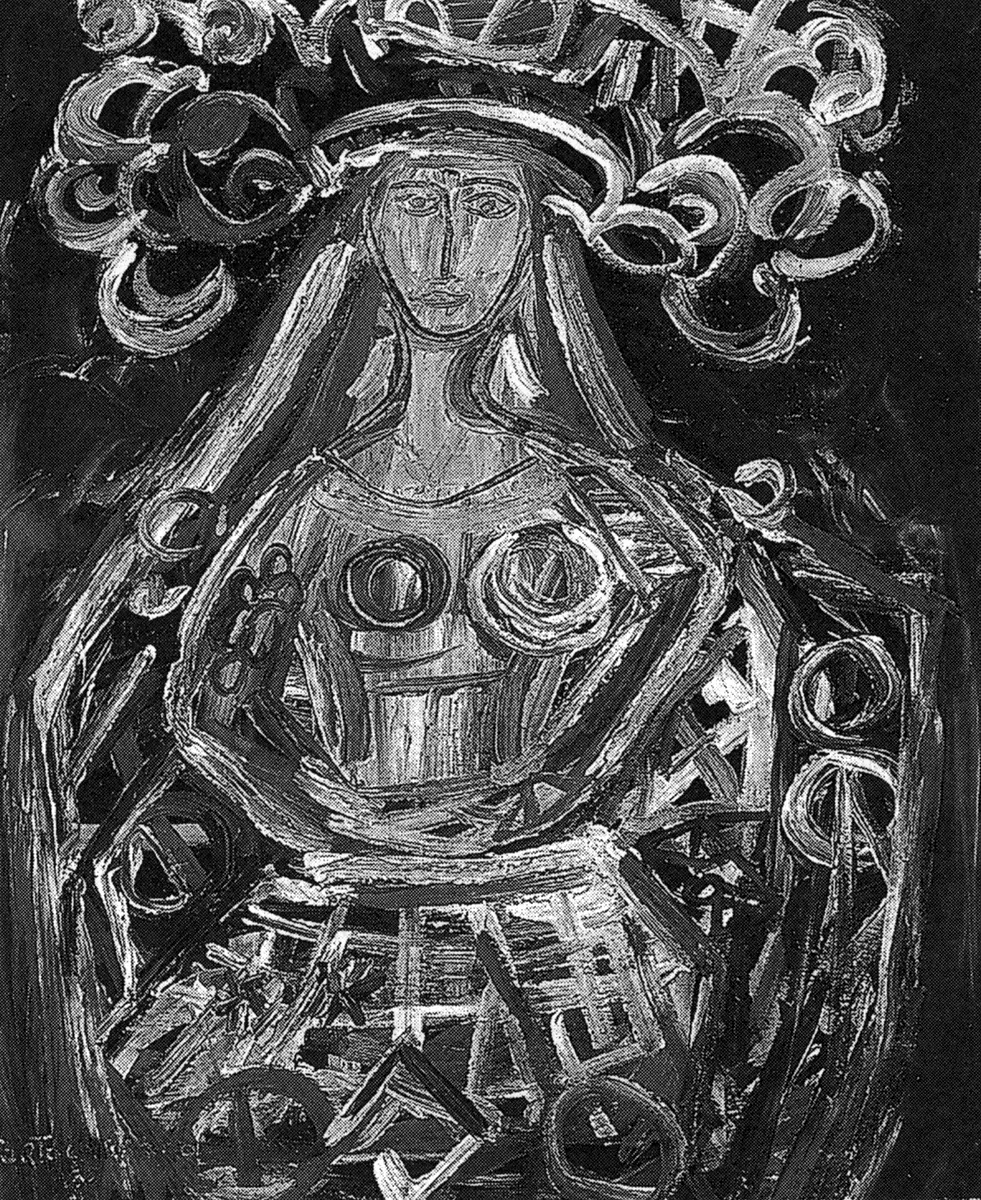
Although the late 1950s saw the emergence of a textural splendor in Portocarrero's urban landscapes, which was to remain until the end of his life, it was complemented by the presence of the human figure, mostly women, conveyed through a language that was indebted to gestual abstraction. It was as if the Interiors of El Cerro had bifurcated: on the one side, atmospheres, on the other, the women who inhabited them. The female figure, a permanent motif in his painting, became the protagonist of some of his most famous series. From 1962, there appeared the Ornamented Figures, ink drawings which were, significantly enough, first called Interiors of El Cerro. In all these works, there was a proliferation of headdress and adornment, with the figure itself sometimes appearing to be yet one more ornament, as the contrast with the background faded and everything became a sort of overworked pattern. In the process, the female figures were transformed into a web in the very important series entitled City, where ornamentation, the basic interest of his poetics, achieved—as Vásquez pointed out—total autonomy through the creation of a very characteristic and particular morphology of abstract motifs.10
In the oilworks entitled Carnival Figures (1962), on the other hand, gestual and textural elements predominated over the web, giving vitality to dancing figures with sumptuous headdresses, like those seen on the floats of the Havana Carnival, which reached its high point of popularity in the early 1960s. Between 1962 and 1963, there also appeared the so-called "popular saints," oilworks of virgins and catholic female saints fused with Afro-Cuban gods, in which Portocarrero's religious art turns towards the vernacular. But he did not paint Yoruba deities, but the Christian icons associated with them. Examples include Yemayá (1962) and Santa Barbara for Paris (1963). There was also the Little Devils, inspired by the íremes, masked figures of the Abakuá Secret Society, a male-only society of African origin active in western Cuba.
With these four series and several Havana landscapes, Portocarrero assembled his famous exhibition entitled Color of Cuba, at the La Habana Gallery in 1963, which was presented by Alejo Carpentier. The period was one of nationalist enthusiasm, and the show was seen as a paradigm of a typically Cuban visuality. A year earlier, Lezama had written the most important text he was ever to write on any artist, a text which is still the longest study of Portocarrero.11 Color of Cuba reflected a sharpening of the painter's interest in popular themes, which was undoubtedly due to the heat of the Cuban Revolution. He was part of a movement among intellectuals towards popular and Afro-Cuban elements and a kind of inner exoticism. The utopian mood of the time extracted the cultural component cleanly from the vernacular context to construct a "higher" paradigm of popular expression as the symbol of a Cuban and Latin American specificity, which could be used to counter cultural imperialism. The same year, Portocarrero won the Sambra Prize for the best group of works at the VIIIth edition of the São Paulo Biennial.
At the Xlllth Venice Biennial, Portocarrero presented his Imaginary Portraits of Flora (1966), a noteworthy set of oilworks based on pieces from 1961, such as Woman in Gray No. I, which showed female busts reflecting an abstract taste for the pictorial material. The same images were once again full of headgear and adornments, like the Ornamented Figures, and formed a series on which the artist continued to work for the rest of his life, entitled Flora, and which explored one of his most typical themes. In 1967, the National Museum of Fine Arts of Havana organized a large retrospective that finally established his reputation. Even in the periods of greatest repression, and despite being a homosexual, Portocarrero was a survivor, and his reputation continued more or less intact, even to the point of almost becoming "official." In 1967, he illustrated the Mexican edition of Paradise, the most famous novel by Lezama, and maintained his close image-word relationship with the writer.
In 1970 and 1971, Portocarrero carried out his most extensive series and final work of importance: Carnivals. It consists of some 200 casein pieces which are an iconographic synthesis of all his work, a parody of humanity through, as Veleri Zemskov says, its "garments," or styles, and the grotesque itself.12 Here, Portocarrero's various characters appear in gestual outlines, participating in a carnival that envelops life as a whole.13 He subsequently continued to work on his classic themes, designed stained-glass windows for a restaurant, Las Ruinas, on the outskirts of Havana, and completed four series of lesser importance: Seated Figures (1975-1977), Eternal Mothers (1981-1983), Transfiguration and Flight (1982), and Transfigurations (1981-1983).
The work of Portocarrero was based on the exploitation of ornament as a source of expression, leading to a paradoxical expressionism created by decorative elements, and a prolific, sumptuous, and color-oriented sense of the baroque. It was this which must have inspired a good part of Carpentier's discourse on the baroque as a key component of Latin American culture14 and one which was very popular in the 1960s. It also contributed in a decisive way to the stereotype of a Cuban visual identity seen as something luminous, sensual, and colorful, and as suggested by the title given by Portocarrero to one of his major collections, Color of Cuba. These tendencies, which were paradigmatic of Cuban art in the 1940s, led Alfred H. Barr to define the "Havana School" in terms of its gaiety, candor, and exuberance, in opposition to the socially-oriented Mexican School. 15
For all these reasons, and because of its dynamic fusion of traditional and modern elements, Portocarrero's work is close to that of Amelia Peláez, despite the fact that there was practically no intertextuality between the two artists and that téey each had their own individual styles. Peláez was more constructive in her processing of cubism and developed a white, creole-bourgeois tradition. Portocarrero was closer to Matisse, more gently expressionist, basing himself on textural and gestual elements, and his development of the same tradition encompassed both popular features and cultural elements of African origin. His world was more open and closer to the street than that of Peláez, whose work Lezama once described as reflecting the hostility between the flesh and structure,16 whereas that of Portocarrero reminded him of the oscillation between an angel and a butterfly, between archetypes and metamorphosis.17
NOTES
1. Graziella Pogolotti y Ramón Vásquez Díaz, René Portocarrero, Ed. Henschel, Berlin, 1978. My analysis is indebted to the excellent research carried out by Vásquez in this study.
2. José Lezama Lima, "Homenaje a René Portocarrero," in his La cantidad hechizada, Ed. Union, Havana, 1970, p.367.
3. On the different forms of African cultural expression in Caribbean art, see Gerardo Mosquera: "África dentro de la plastica caribeña" I and II, Arte en Colombia, Bogota, No. 45 and 46, October 1990 and January 1991, Pg. 42-49 and 72-77.
4. This picture was auctioned at Sotheby’s for US$130,000 in 1992, which set a record for the artist.
5. Gerardo Mosquera, "Cuba 1950-1994," in Edward Sullivan (editor), Latin American Art in the Twentieth Century, Phaidon Press, London (in press).
6. Vásquez, op.cit.
7. Alejo Carpentier, "La ciudad de las columnas," in Tientos y Diferencias, Ed. Union, Havana, 1966, pp.52-53.
8. Alejo Carpentier, "René Portocarrero," Color de Cuba, Havana Gallery, 1963.
9. Lezama Lima, op.cit., pp.365-366.
10. Vásquez, op.cit.
11. Lezama Lima, op.cit.
12. Valeri Zemskov, "Con René Portocarrero. Meditaciones después de la charla," América Latina, Moscow, 1979, No. 1(21), p.184.
13. René Portocarrero, Exposición Carnavales de René Portocarrero, National Museum of Cuba, 1979.
14. Alejo Carpentier, "Lo barroco y lo real maravilloso," in Razón de Ser, Ed. Letras Cubanas, Havana, 1980, pp.38-65.
15. Alfred H. Barr, "Modern Cuban painters," MoMA Bulletin, April 1944, Vol.XI, No. 5, pp.2-14.
16. Quoted by Ramón Vásquez Díaz, Amelia Peláez, Exposición retrospectiva 1924-1967, Museum of Fine Arts, Caracas, 1991, p.20.
17. Lezama Lima, op.cit., p.377.
GERARDO MOSQUERA
Cuban critic and writer. Guggenheim Foundation Fellow.