A few months ago, on the first anniversary of the death of Elias Canetti (1905, Ruststchuk, Bulgaria, 1994, Zurich, Switzerland), the Museum of Modern Art of Mexico City presented an interesting exhibition inspired by the writer’s ideas on the phenomenon of power, that relationship between men which, he one said, we have "look at straight in the eyes, without fear, to defuse it." The show consisted of work by nine artists who offered their individual interpretation of Canetti’s philosophy, converting it into visual art and concept through installation. Through their reading or re-reading of Canetti’s work, these artists forged concepts, images, messages, questions, signs, and symbols that seemed singularly relevant in the tragic context of Mexico today. No other writer has been more pertinent than Canetti, a deep thinker who argued in one of his most erudite studies, Mass and Power, that the collective existence of human beings in itself always and inevitably leads to domination by some over others.
Inaugurated in June at the Fernando Gamboa Gallery of the Museum of Modern Art, the show, entitled Fire, Mass and Power: Around Elias Canetti included eight installations by nine artists (two of them married and working together): Carlos Aguirre, Maris Bustamante, Felipe Ehrenberg, Isle Gradwohl, Victor Lerma, Manuel Marin, Monica Mayer, Humberto del Olmo, and Eloy Tarcisio. The title of the show referred to three of the recurrent themes of Canetti’s work, which were examined from different angles by the invited artists, who freely executed their work in the eight spaces allocated.
Carlos Aguirre (1948) explored the dialectic between intelligence and power. In this installation entitled Dialectics, Intelligence vs. Power (1995), he strategically hung ninety extinguishers (belonging to the Franz Mayer collection) on the ceiling at different heights. In the middle, and hanging low, there was a set of scales, with a human brain on one side and on the other, a bronze bust of the former late President Díaz Ordaz. Under the bust, on the floor, there was a circle of human ashes. On these scales the artist had placed intelligence and power, reason and brutality, the dialectics which ravage man; fire which burns and goes out, memory which remains, and with it the demands of any self-respecting people: food, culture, democracy, education, independence, information, justice, freedom, peace, health, land, work, and housing.
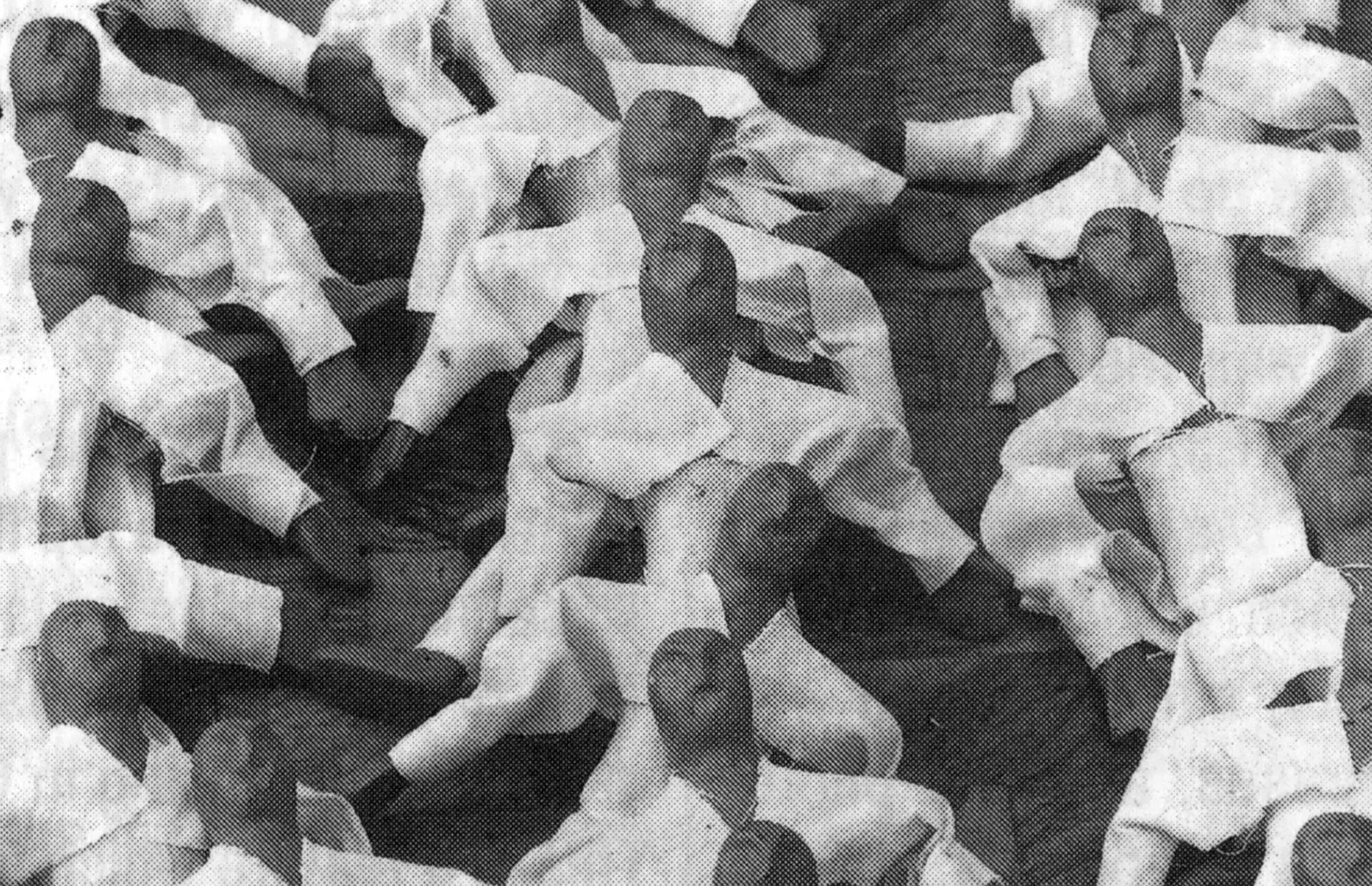
Maris Bustamante (1949) was not so dialectical, but caustic and corrosive. Her acid humor was reflected in her installation entitled Roll Out the Carpet for Me (1995), where she portrayed the madness of power. Using polychrome foam oilcloth, she constructed a "car-pet" of corpses and objects, at the top of which there was a dais and a microphone installed for a political address. On one side, there was the leader, a demagogue with a mirror for a face and holding up the mortal remains of one of his subjects. Felipe Ehrenberg (1943) also examined the theme of the masses, alienated human beings repressed by power. In Individuus II (1995) was the title of his work, made up of almost three hundred little figures of men (pegged to clothes-lines), a rag doll, two broken mirrors on the floor, and a series of words painted chaotically on the screen to describe the human being: fury, rage, fear, terror.
Ise Gradwohl (1943), a Viennese painter who has lived in Mexico since 1973, is concerned by intolerance, the brutality of power which stifles freedom of thought. In Yeca (1995), she presented a box with burnt books (in memory of those burnt by the Nazis), two long strips of stained paper, and two megaphones from which fragments of Canetti’s works could be heard. Víctor Lerma (1949) and Mónica Mayer (1954) said they were not interested in the masses or power, which was a lie. Their installation, In the End We Don’t Care About the Masses or Power (1995), offered a reflection on the political situation in contemporary Mexico. The screens contained the words Justice and Democracy, painted in enormous letters. Further down, in smaller letters, an invitation for the public to reflect: "Today, when Mexico is being ripped open by crisis and skepticism, what action will you take to achieve this utopia?" The visitor could put his or her reply in a little notebook placed on a table, next to which there were other books with texts by Canetti altered by Lerma, fragments of Mayer’s diary, documents on the disputes in our cultural bureaucracy, and other items arranged by this couple who are used to fighting.
For Manuel Marin (1951), justice and democracy also seem to be utopian. Hence, the pessimism of his installation, Mass of Shadows (1995), made up of fifty-five little polychrome metal statues. Equally pessimistic was the rough-edged installation by Eloy Tarcisio (1955) entitled The Disinterested World (1995), which combined broken cooking pots, strips of wood with various phrases, and four photomurals with a self-portrait, stained with pig’s blood. Finally, contrasting with this mood of pessimism and the generally critical tone of the show, Humberto del Olmo (1961), the youngest participant, preferred to play. He presented a video installation entitled The Metamorphosis of Elias Canetti (1995), with three screens showing butterflies, signs, and the face of Canetti, forming a game of "noughts and crosses" (two pairs of parallel and interwoven lines). The works also included a kind of micro-greenhouse, with cocoons and butterflies, indifferent to the electronic game of the metamorphosis of Canetti, indifferent to the world of men outside.
ANTONIO ESPINOSA