
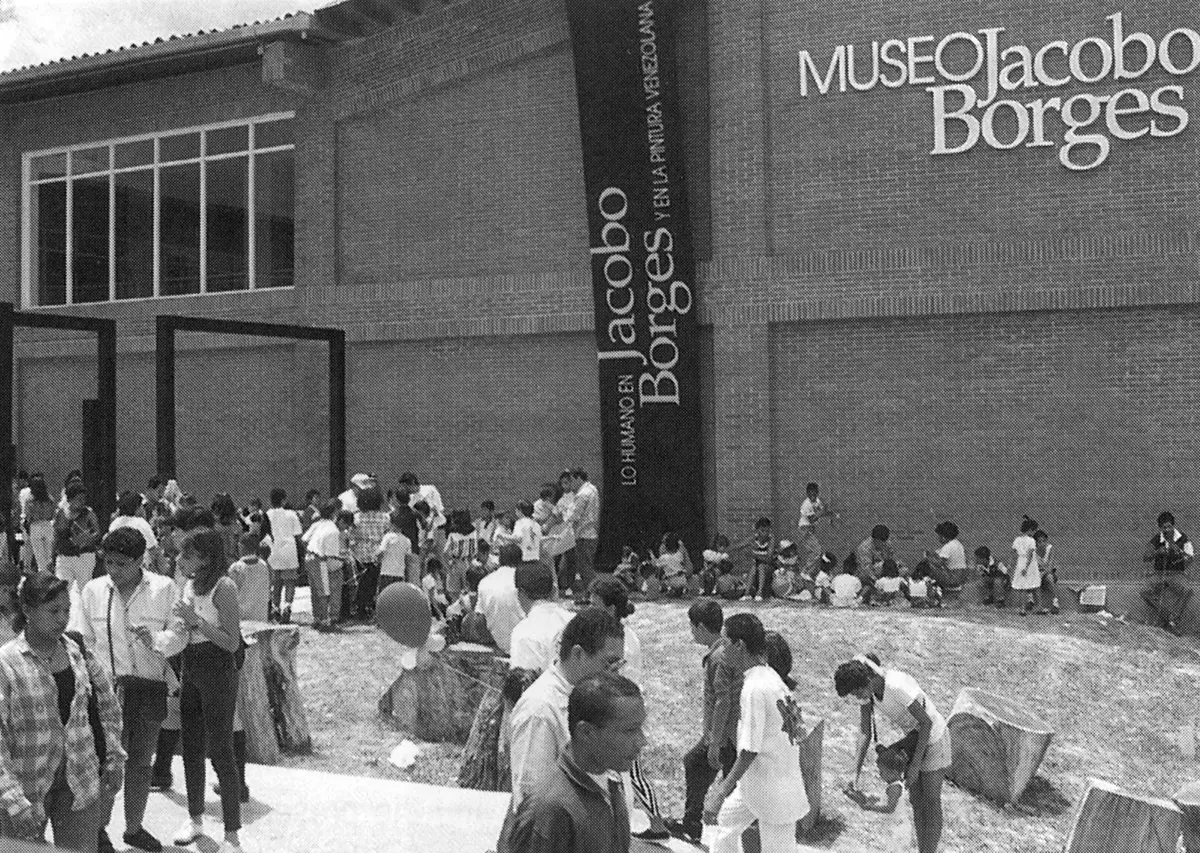
The recent inauguration of the Museo del Oeste Jacobo Borges was not only a major event on the Venezuelan cultural scene but also provided an opportunity for renewing contact with the work of the artist and the vitality and strength of his vision.
This anthological show confirmed both the consolidation and the perseverance evident in the artist’s work. Borges is a man of considerable intensity, a painter of overflowing temperament. These characteristics are present in his pictures, each of which betokens some intimate origin that lies deep in his own experiences. Every detail of his works reflects the sensitivity of recollection and the fantasy of a memory. We might say, along with Reik, "that the function of memory is to protect impressions. Our recollection tends to dissolve them. Memory is essentially conservative, while recollection disintegrates." It is in the midst of this existential space that Borges’s work bursts forth and affirms itself. His memory brings back references, which his recollection sets within a series of psychological and artistic problems. But what is masterly in his case is the fact that this confrontation with his autobiography does not lead to a mere list of anecdotal references. His painting, instead of remaining just a picture, goes beyond the paint to achieve a kind of transcendence. Just as Adorno said that it was possible to go beyond the concept by going through it, in the same way, Borges goes beyond painting by going through it. He knows that its intellectual meaning, over and above being acts of conviction, as well as its emotive energy, over and above being sources of drama, are always means of expansion that help generate the resonances conjured up by each image.
The show also confirmed that Borges’s work has retained a high degree of ferocity. However, the pitiless sense of objection, the explosion and lacerations of his earlier periods have now given way to a more tranquil kind of interrogation, although without any loss of strength or force. His discursive capacity has now acquired a sensibility more concerned with the depths of the spirit than circumstantial outbursts of rage. He has not stopped being a committed artist, but rather his analyses are based on new strategies which do not compromise his intrinsic temperament nor the framework of his convictions. His emotional strength remains intact: Borges’s development is far from being over, and the potential for challenge remains ever present.
From an aesthetic standpoint, Borges heightens the structural effectiveness of his images by means of strong self-referential content. His pictures are based on some autobiographical past, although they are contextualized in the experiences of today and projected towards some paradoxical future. Borges captures a sense of time/space in which he alternates nostalgia with a sense of anxiety. The result of such experiments forms part of what Harold Rosenberg described as an "attempt at prophecy," i.e., to rise up above what has been and beyond what does not exist. This is where the energy leading to renewal and resurgence is to be found.
Following the same argument, we can say that communication and expression are not antithetical in Borges. He communicates without lapsing into anodine descriptions and expresses his vision without the fury of the undecipherable. Increasingly, these two complement one another in their resolution, but without any loss of eloquence or impact in communication, and without expression ever forfeiting any of its resonance and repercussion. Borges manages to harmonize artistic, conceptual, and aesthetic space within the singular nature of each picture. His oft-expressed intentions are now extended into a new context, but the axis remains the same: time and space. Time is now more disruptive and turbulent than ever, and space has become more simultaneous and diffuse. Borges accepts the challenge and tries to capture what Lipovetsky called "the seduction of the ephemeral." In the same way, he meets the challenge of interrelated and global space. The result is admirable: he captures the tangible in order to retrieve what is intangible, to go beyond what is apparent to reclaim what is substantive. Borges also captures what is overwhelming and reduces it to an instant, visualizing what is global within the unity of multiple spatial dimensions. In this context, the vertiginous and abrupt nature of time, as well as the confusion and turmoil of space, are condensed within an instinctive artistic plane and, at the same time, evaporate into a spiritual atmosphere. Time and space are thus harmonized and expanded to the maximum. Space may be immediate, projected, unobstructed, suspended, acclimatized, enclosed, contaminated, or rarefied, and time, for its part, may be juxtaposed, halted, made volatile, sequential, sublimated, transmuted, or nebulous. In the final analysis, illusion, alterity, and identity emerge as the organizational nuclei of his wide-ranging repertory, when we are finally convinced of the legitimacy of Hermann Hesse’s aphorism that "art is the communion of instinct and the purely spiritual."
VÍCTOR GUÉDEZ