
Gabriela Morawetz recently presented an exhibition at the Diners Gallery in Bogota. The artist, born in Poland, lived for many years in Caracas, although she is currently residing in Paris. Her work seems to reflect these different moves, with multinationality leading towards universality, perhaps because the comparison between differences has enabled her to discover the essence, the humanity of the various contexts.
However, in her case, the interest does not lie in the human and historic—category where the current globalization reveals its circumstantial character—but in what is archetypal, non-historical, and original in the human condition. For this reason, her figuration is frequently described as oniric, perhaps because in this way it can express what Jung called the collective unconscious. From her palette to her iconography, her symbols and their treatment, everything points towards the substantiality of the original.
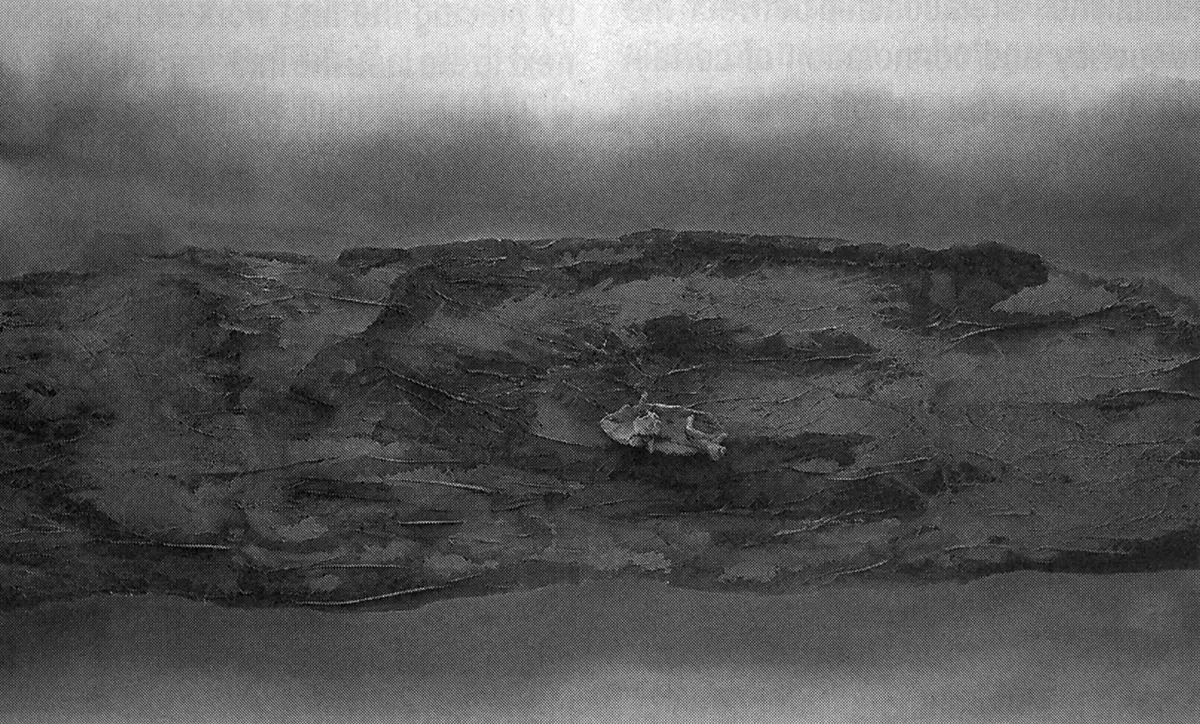
It is impossible not to feel the atmosphere of a certain Central European archaism, the same for which Beuys, for example, was so criticized, and the same of which Kiefer has been accused. And yet, it is a sensation which is only motivated by the cultural vision of someone who establishes a relationship between the frequency and connotation of certain symbols (the tree as the center of the world, intricate ornamentation, spirals) with specific moments of civilization. The human silhouette in levitation (or rather submerged) has an appearance which is very close to the practice of various Latin American artists, especially interested in primitive representation and the atemporal semiotics of the body. This is emphasized in the artist’s animal men.
Archetypes, yes, without any doubt. But the real meaning of the paintings only becomes clear when set against the sculptures on show at the Diners Gallery. Here, there appears a space of a non-religious, sacred kind, the interior of which is isolated, with the content being raised to the level of a relic, an inaccessible treasure. It is to this category that the natural sources of cosmic energy, which Morawetz has selected, belong: the bundle of branches, the mineral element, and the earth. Everything has been made transcendental by the color (ochers and greys, sometimes shot with a sudden flash of cobalt or green) and the setting, texture, and temperatures reproduced or evoked: indeed, the alchemistic residue becomes gold because of the simple fact of its organic appearance. Infinity and everyday reality appear fundamental in the pointless interplay of what is superficial or eccentric. Telluric, like the point binding body and soul.
Another lesson to be drawn from sculpture is the understanding it can give us of intimacy. This is less obvious in painting, where it is weakened by the large format of things. The little windows become a kind of aleph through which, like a navel (omphalos), we see the secrets of the universe in the details of the world.
KLAUS STEINMETZ