
Gerzso’s retrospective is a small and successful exhibition that shows some of the artist’s most representative paintings, as well as his incursion into other media such as prints, drawings, works in mixed media, and sculpture. Gerzso has attained his own style, which should not be confused with repetition. Each work opens up to a different system of forms and emotions. As Gerzso has stated: "A painting must be brought to a point where it communicates the emotion that informed it. Then it detaches itself from that emotion and acquires its own life. That is when spirit inhabits matter."1
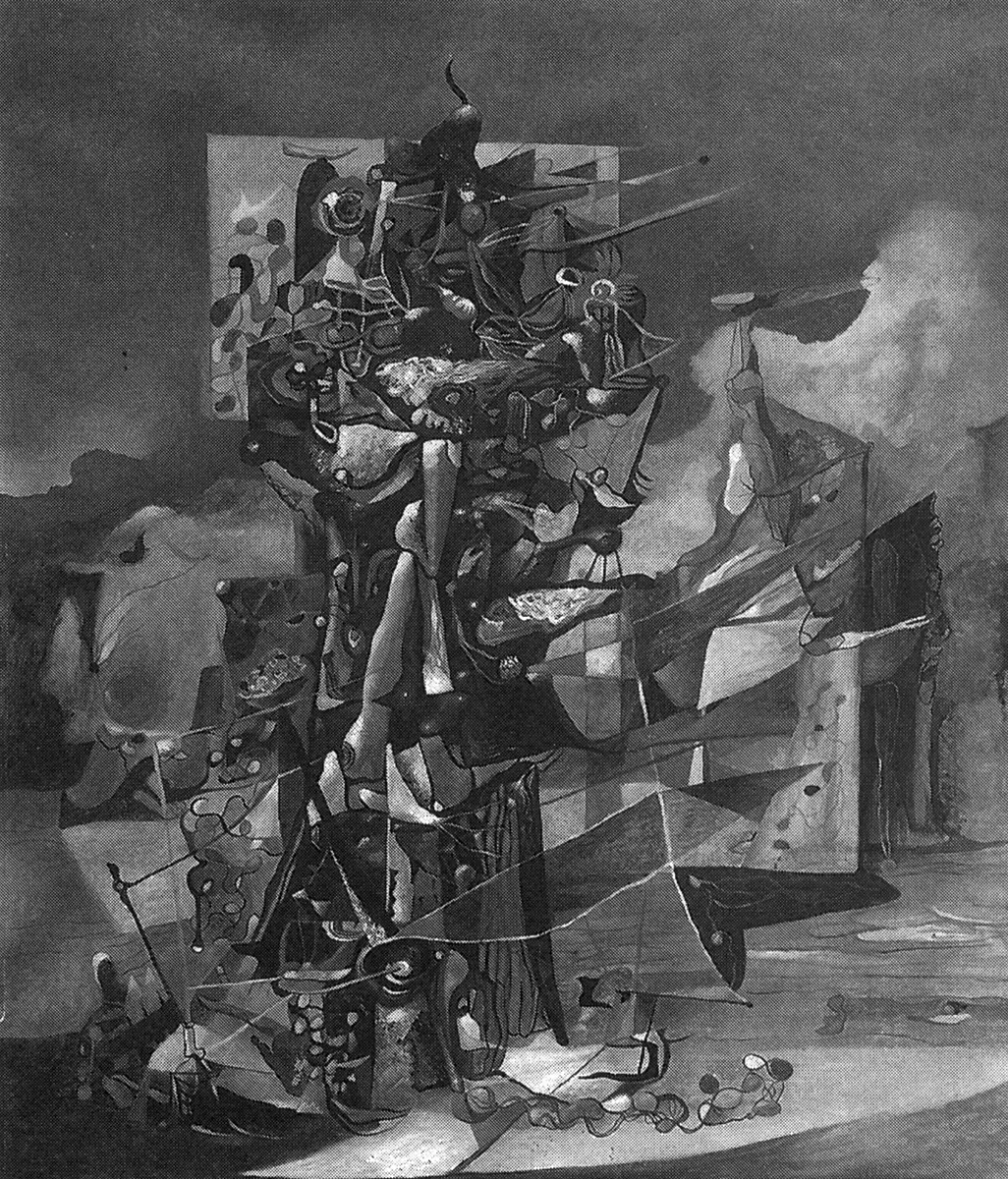
Gerzso first started painting in the early 1940s while working as a set designer for the Cleveland Playhouse (1935-1940). When he returned to Mexico in 1941, he befriended a group of European exiled artists, which included Remedios Varo and Esteban Francés. Leonora Carrington, Kati and José Horna, Wolfgang Paalen, and Benjamin Péret. Gerzso recalls frequenting their house on the street of Gabino Barreda: "I was very impressed there. Hanging on pins from the walls were drawings by Picasso and Tanguy."2 As a result of his contact with this group of refugee artists, Gerzso began to produce a number of paintings and drawings in a Surrealist vein. In the exhibition, there is only one work representing this early phase of Gerzso’s career, Personaje of 1942. This painting, a curious amalgam of biomorphic forms and vibrant colors that recalls works by Salvador Dalí, Joan Miró, and Yves Tanguy, stands as a visual testament of Gerzso’s interest in international artistic trends at a time when the Muralist Movement dominated the art scene in Mexico.
By the late 1940s, Gerzso’s early interest in Surrealism shifted to a desire to create imagery related to Mexico. Although Gerzso was a contemporary of the Muralists, he never espoused the dogmatic content of their work nor resorted to their often facile and stereotypical images, developing instead his own style with which to express his vision of the "Mexican." This interest developed mainly through his discovery of pre-Columbian art while working as a set designer for over 150 films during the golden age of Mexican cinematography.3 Extensive travel in Mexico during the filming awakened his interest in the Mexican landscape, especially the Mayan ruins. "In 1946, I became very enthusiastic about pre-Columbian art through Miguel Covarrubias; I had met him three times then. One day I said to myself, 'I’m going to make a painting that has to do with our country' because before everything was very influenced by Surrealism. So one day I made this painting [Tihuanacu]; everything that came afterwards is already contained in that one work."
In the late 1940s, Gerzso developed a style based on planar compositions and solid colors. Constructed as intricate architectures, many of his works speak undoubtedly of the Mexican landscape through a complex system of signs and colors. A remarkable work in the exhibition is Paisaje of 1957, where the use of abstract forms clearly evokes pre-Columbian architecture. Many of the artist’s compositions include sharp-edge structures that account for a certain uneasiness and anxiety. Plano Rojo of 1963 is a menacing composition that depicts two tusk-like forms next to an intensely red plane. The tusks function as signs of a jaw, which brings to mind the jaguar, an animal of extreme importance in Mayan mythology. In many of Gertzso’s compositions, the body is inscribed through its absence, or as Octavio Paz has lucidly stated, "Gerzso’s painting is a system of allusions rather than a system of forms."4
If Gerzso’s early period is rather underrepresented in the exhibition, a number of paintings from the 1950s and 1960s illustrate some of the artist’s best work. With its vibrant colors and less rigid forms, Personaje of 1956 recalls works by Paul Klee, whom Gerzso actually met as a child growing up in Switzerland. Also worth noting is Greek Landscape 1959, a painting made upon the artist’s return from a trip to Greece that same year. The use of a sand-like texture confers on the work a telluric quality that is also present in some of the artist’s more polished works.
In addition to paintings, the exhibition presents some interesting recent mixographs on handmade paper, Meridional and Recinto of 1995. By making use of the paper’s own venous texture, the artist gives the works a biological quality that subverts the rigidity of his precise shapes.
Among his more recent works are also a number of bronze sculptures, some of which directly relate to his paintings. In Constelación of 1989, Gerzso superimposes different planes, creating a three-dimensional work that is an intricate and enigmatic play of space.
Gerzso’s works are neither narrative nor explicit in their content. They suggest, rather than describe. It is true that many of his works speak of the Mexican landscape, but part of the exhibition’s success lies in its ability to make us realize that Gerzso’s work transcends the narrow categorization of place.
NOTES
1. Marie-Pierre Colie. interview with Gunther Gerzso, Gunther Gerzso/80th Birthday (exhib. cat.). New York: Mary-Anne Martin/Fine Art, 1995, p. 14.
2. This and all other quotations are taken from a personal interview with the artist (New York, September 1995).
3. See Rita Eder. Gunther Gerzso. El esplendor de la muralla. Mexico: Era, 1994. pp. 10-11.
4. Octavio Paz. "Gerzso: The Icy Spark," Gerzso. Switzerland: Editions du Griffon, 1983, pp.9.
ILONA KATZEW