
Venezuelan sculptor Joel Casique questions the philosophical division between the natural and the man-made through subtle explorations of the action of time on traditional sculptural media. His materials, whether quarried stone or polished wood, are often worn smooth by repeated use before being incorporated into a sculpture. This patina of age lends an ageless quality to Casique’s essentially abstract compositions, while emphasizing the fact that nothing, not even nature itself, can resist time. Conversely, Casiques’s choice of stone celebrates the endless processes of sedimentation and metamorphosis that created his materials.
A significant spiritual element underlies Casique’s visual investigations. The artist was given the Amster Prescott Fund Award in New York earlier this year for one of the exhibit’s strongest works, Walking Around. The piece, composed of a block of wood, a rusted iron sheet, nails, and a polished green stone, was inspired by a vivid memory of New York City’s disintegrating subway system. But his reworking of a crumbling tile wall held in place by massive wooden beams also suggests the weight of Catholic imagery. The block of wood that supports the sculpture itself recalls the cross of Calvary, while the green stone, pierced by three rusted nails, evokes the sacred heart of Jesus. This impression is amplified by the fact that, for many indigenous American peoples, the vitality of a human heart could be represented metaphorically by green stone.
In Crevice, the texture and coloring of the sculpture’s rock matrix bear striking similarities to the oxidized iron railroad spikes that split the stone down its center. Ara takes this same concept and expands it to the environment unique to aging industrial cities. The construction, which resembles the neoclassical building from which its elements derive, rests on a foundation of worn building stone. The sculpture’s pediment, a. piece of marble that perhaps served as the banister for a long-vanished building, rests on two simply worked but highly polished columns. It, in turn, is crowned by a rusted piece of iron, scraped by steel brushes and intensified by streaks of graphite to emphasize the fact that the elements linking the individual objects in the sculpture are both formal and architectural. Casique produces similar results in Window Series # 7 by juxtaposing the interstices of an oxidized iron grate with the fine grains of the stone on which it has been set.
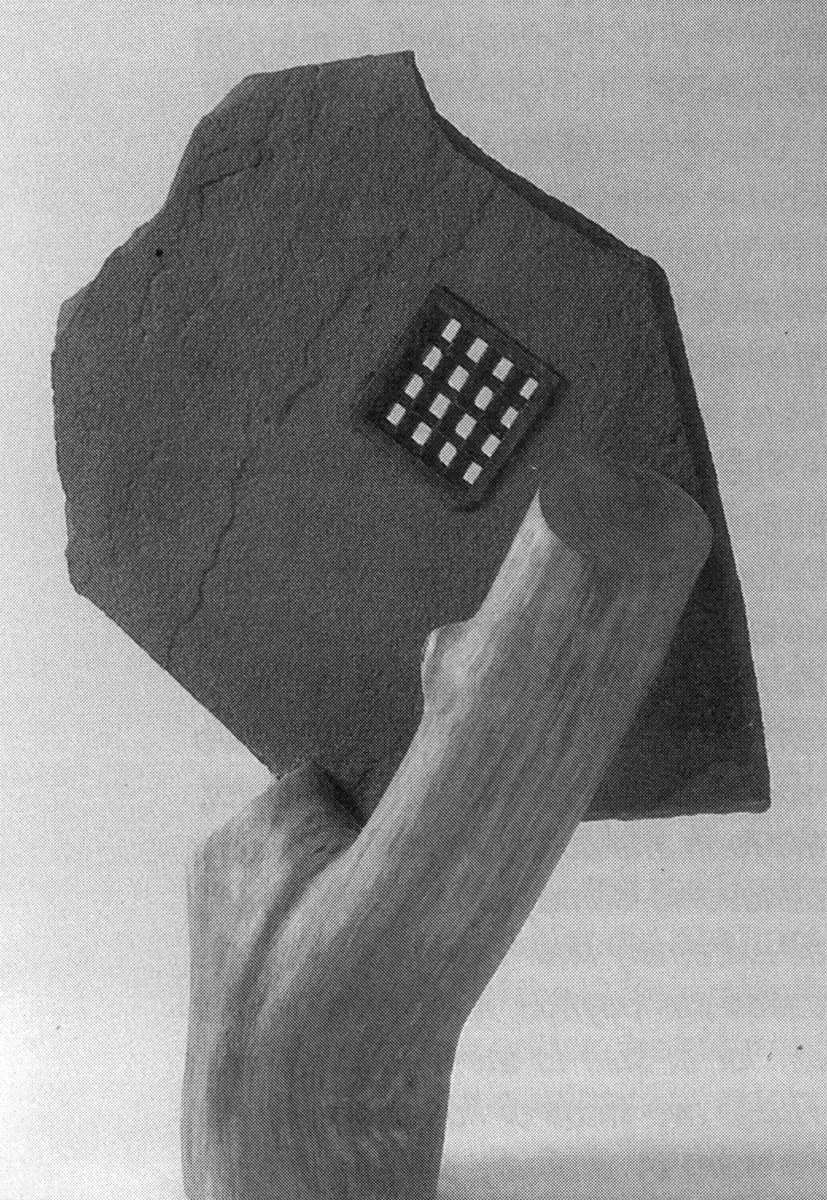
In a similar manner, Window Series # 6, built from a simple slab of pierced slate set atop a polished log stripped of its bark, reflects both contemporary architecture and pre-European culture. Reduced to its essential elements, the modern skyscraper bears a message not far removed from the multiple meanings behind Mayan stelae and Incan huacas. Casique’s sculptures capture the inevitable effects of time through the use of enduring symbols, reminding us of the humanity that lies behind our monuments and of humanity’s place in the natural world.
K. MITCHELL SNOW