
"The Canal interests me for various reasons. Some are part of a nostalgia for my childhood. I always liked to play on the beach and make a path on the sand to let the water run from one side to another. The idea of doing it between two oceans is like fulfilling one of my super-dreams from that time. The other idea, no less childish, is to invent a country of your own, a country, for example, where you only eat cakes. In this sense, Panama and Disneyland are expressions of the same spirit, a spirit which I shared fervently between the ages of four and six. And lastly, I am interested in the Canal because it is a structure that combines things which are so different, such as French greed, Gauguin’s urine, and North American racism in the creation of a monument which compares itself with the Egyptian pyramids. This appreciation is already more adult, because it implies a knowledge of surrealism. That this monstruosity should be used to manipulate a people with bombs and invasions every few years converts all this history into an emblematic part of that which they call "magical realism" and which so delightfully describes Latin America."1
In looking at a work by Luis Camnitzer, this is not the first time that I have found, hidden in some kind of footnote, a sort of parallel and involuntary work which acts as a complement or counterpoint to the premeditated work, a personal narrative which has been pushed to one side by some sense of modesty. This was the case with the chronology which Camnitzer wrote for the retrospective exhibition of his work at the Museum of Visual Arts in Montevideo in 1986, which itself became a work of art. I had a similar reaction to the notes in his new book, entitled New Art of Cuba, in which objectivity and desire become one. A similar process seems to exist between this letter, which confesses to and explores the artist’s interest in the Canal, and the installation that Camnitzer recently presented at the Museo del Barrio in New York.
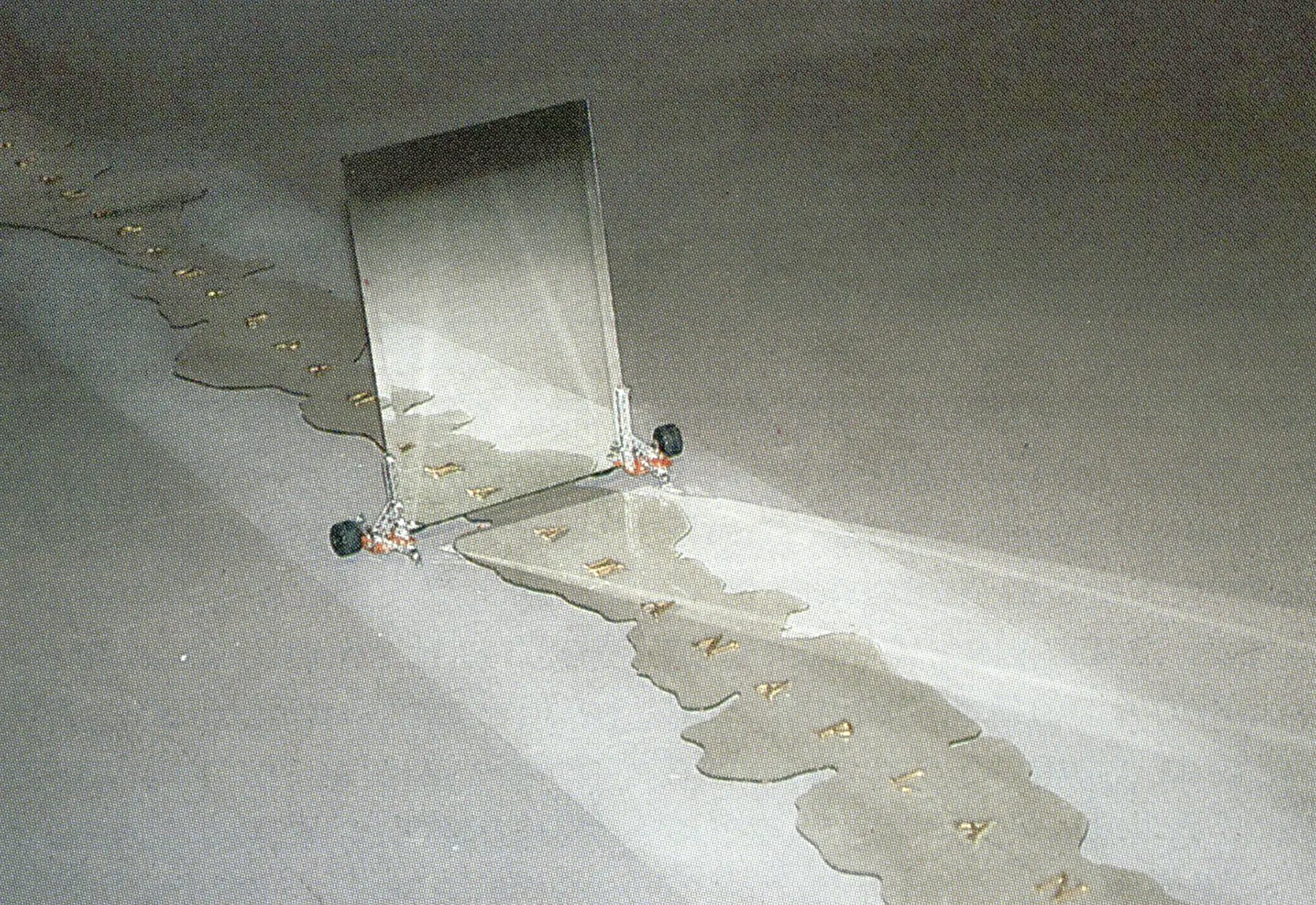
The artist’s confession, in addition to its poetic contribution (a word which makes Camnitzer prickle), acts as a kind of self-corrector, compensating for the excessively illustrative aspect of the work. Under the title Amanaplanacanalpanama, a word which can be read the same way from right to left and from left to right, Camnitzer organizes a series of documents dealing with the Panama Canal and around a resin-constructed watercourse which crosses the exhibition room.
A couple of mirrors mounted on a little vehicle constructed with Meccano parts cut the canal symmetrically in the center, with the reflection emphasizing the palindrome of the title and the idea of the circularity of a situation without any escape or exit. The documentation in question, on bronze sheets arranged in a continuous sequence on the surrounding walls, illustrated various versions of the exercise of colonization, exploitation, and imperialism which characterized the birth of this canal between two oceans and which continue to bedevil its existence.
Interwoven with these texts, which are nonetheless predictable for being strange, there is a letter from Gauguin about his own experience with the Canal and another from Camnitzer directed to the Hotel Waldorf Astoria in which he includes himself in his artistic-historiographic exercise. Despite certain other thematic points which are outlined in these letters and some abstruse comparisons between the Canal and the Egyptian pyramids, the arguments of these texts and photographs are univocal. In this way, they become support materials rather than another factor to be clarified in the final equation.
This literalness is completely upset by the letter-confession, and for this reason, I have called it self-correcting. To locate in the Canal the dreams of childhood, the incoherences of personal history, the coherences of political history, the paradoxes of artistic nomenclature, and the ironies perceived by the adult is a gesture which reflects the most notable feature of Camnitzer’s work. He himself has spoken of his concern to design processes enabling him to sidestep description and to activate the spectator’s "power of symbolization."2 Nothing in this literalness means that I am saying that Camnitzer is being didactic. That would be to accuse him of being the artist whom he himself has created as an ethical option and to lapse into a simplistic reductionism with respect to the didactic. We should remember that his initiation in the production of artifacts which relate image and text was preceded by a declaration of principles: "I thought that the verbal description of a visual situation would enhance the spectator’s creativity better than a real visual situation. It further had the advantage of being cheaper and less totalitarian. I was beginning to think again in Uruguayan terms, in an aesthetics of poverty, in using the contexts in which people live."3
These are the bases of Camnitzer’s conceptualism, a conceptualism which, when seen in a historical perspective, places more emphasis on ideological aspects than on the linguistic concerns reflected in the term. To put it in another way, he activates the controversial element inherent in the use of any language as an intermediary for an ideological discourse rooted in the avant-garde premises of the modern movement.
Camnitzer transforms the problems of linguistics and phenomenology into his own operating systems. Thus, whereas Magritte relates text and images and reveals the arbitrariness of the dictionary, Camnitzer constructs dictionaries with random relations —along the lines of John Cage— the key to which each reader will determine according to the data incorporated into the problem.
It is precisely in The Book of the Walls4 that Camnitzer begins to conjugate all these aspects. This exhibit, a selection from a larger one originally conceived for the Subte in Montevideo, takes Uruguay and the dictatorship experience as its basic references. But rather than limiting access to the work, the subject matter becomes a metaphor that can be applied to other geographical and thematic realities. At all events, the Uruguayan starting point merely means that Camnitzer will allow himself to permeate the work with a certain dose of emotion.
The objects which make up the pages of this book are partially arranged on the walls and on the floor, with the texts also placed on the floor in an organized sequence within a historical context beginning with the first bullets fired against the walls of the University.
Paradoxically, Liber Arce was the name of the first student to die from the repression in Uruguay. No other bullet seems to have been more explicit in its message. With this page, The Wall of Announcements, the photo of the bullet on the wall, Camnitzer’s book opens, and with it,a history in which the focus becomes increasingly precise. That bullet against culture and freedom is followed by an artifact, a box-shrine, where a bronze plate in the form of a heart shows a swarm of flies. This camouflaged horror is followed by a knife nailed to the wall, The Wall of Objectives, followed by The Wall of Incredulity, with a broken vase full of blood coagulated into its form. A series of invented instruments without any specific reference introduces the theme of torture through imaginary formal and sensorial analogies.
As these "text-objects" succeed one another, the metaphors encompass an ever-widening range of speculation, leading to the lack of any exit in The Wall of Exits, which refers to the amnesty of the military officials, and the noise imprisoned in the silence imposed in The Wall of Silence. The references extend to sociopolitical experiences in other regions of the world, as well as to readings based on more individual and existential experiences.
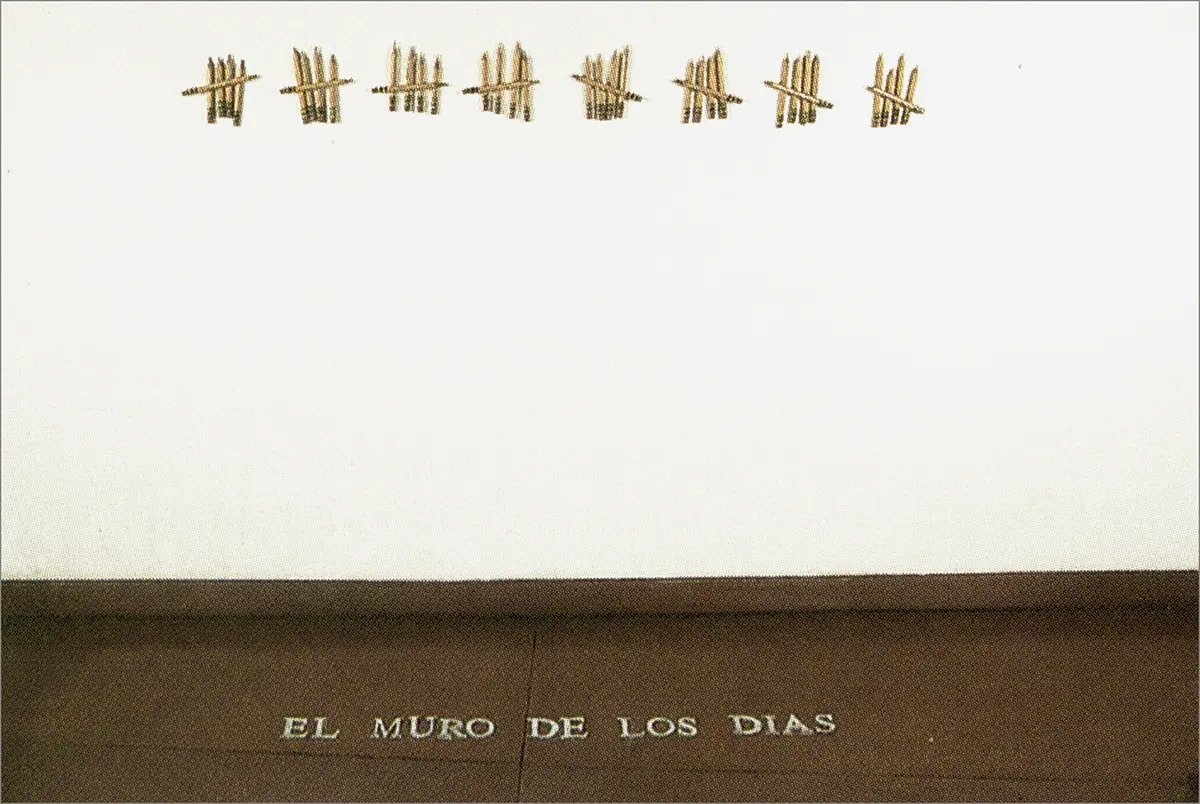
The Wall of the Days, a grouping together of pencils in the form of accounting ticks, recalled another work by Camnitzer, The Invasion of the Days in the Days, although more because of what had changed than because of any actual similarity. In the former version, time was escaping without control, whereas in the new work, each day passes and is counted, each day has the weight of much pain and many stories which cannot be rewritten, a point emphasized by The Wall of Re-writings. It is both curious and paradigmatic that the earlier work dates from 1973, the year the dictatorship began in Uruguay.
To return to the installation, it is interesting to see that each of the pages making it up is independent and acquires a degree of enigma which enhances their meaning as artifacts, faithful to Camnitzer’s ideological principles and affiliation with arte povera, which rather than povera recalls the "modern rustic," which is how one of Camnitzer’s colleagues as a young man described the way he constructed his objects. Camnitzer’s persistence in this respect is far from being a stylistic element and is, in fact, a further sign to be decoded in terms of ideological identification with the cultural producer in the Third World. Camnitzer has always insisted on his theory that conceptualism, as he understands the term, should have been born in Latin America.
He believes that conceptualism is the most appropriate instrument for political action within our peripheral reality. Camnitzer’s artistic activity, which is political activity (perhaps he would prefer to reverse the order of the words), shows that his ideological beliefs remain intact and that the variables introduced by the post-modern era, and the resulting militant diaspora, have in no way eroded his convictions or his creative capacity.
NOTES
1. Letter from Camnitzer to Fatima Bercht, curator of the exhibition at the Museo del Barrio, New York.
2. Chronology included in the 1986 exhibition at the National Museum of Visual Arts of Uruguay.
3. Luis Camnitzer, 1977, catalogue of the Galería Latinoamericana, Casa de las Américas, Havana, Cuba. 1983.
4. Carla Stellweg Gallery, New York.
ANA TISCORNIA
Uruguayan artist and art critic. Lives in New York.